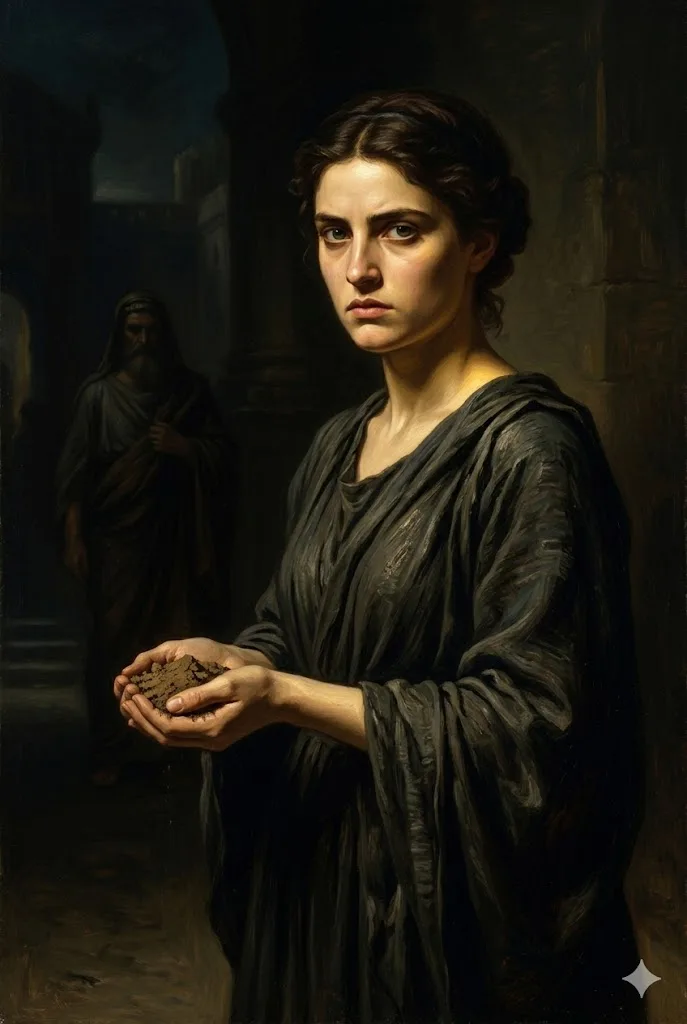
Daughter of Tragedy
Antigone was the daughter of Oedipus and Jocasta, born from the most cursed union in Greek mythology. Her father was also her half-brother. When the truth about Oedipus was revealed, Jocasta hanged herself and Oedipus blinded himself and was exiled from Thebes. Antigone, barely more than a girl, chose to accompany her blind father into exile, guiding him through years of wandering until his death. Her loyalty to family would define her life and seal her fate.
The Burial
After Oedipus died, his two sons Eteocles and Polynices fought for control of Thebes. They killed each other in single combat. The new king, Creon, decreed that Eteocles would receive a hero's burial but Polynices, who had attacked Thebes with a foreign army, would be left unburied, his body exposed to dogs and birds. Anyone who attempted to bury him would be executed.
Antigone defied the order. She went to the battlefield and performed the burial rites for her brother, sprinkling earth over his body and pouring libations. She was caught, brought before Creon, and given a chance to deny her actions. She refused. She told the king that the laws of the gods, which require proper burial of the dead, outweigh the laws of any mortal ruler. Creon sentenced her to be sealed alive inside a stone tomb.
The Tragedy
Creon's son Haemon, who was engaged to Antigone, begged his father to relent. The blind prophet Tiresias warned Creon that the gods were angry. Creon finally changed his mind and rushed to free Antigone, but he was too late. She had hanged herself inside the tomb. Haemon, finding her dead, tried to kill his father and then fell on his own sword. Creon's wife Eurydice, learning of her son's death, killed herself as well. Creon was left alive, surrounded by the corpses of his family, destroyed by his own stubbornness.
Why Antigone Matters
Sophocles' Antigone, first performed around 441 BC, asks one of the most important questions in political philosophy: when the law of the state conflicts with a higher moral law, which should you obey? Antigone chose conscience over obedience and paid with her life. Her story has been invoked by every generation that has faced unjust authority, from the French Resistance to the Civil Rights movement to modern political prisoners. She is arguably the most important female character in Western literature.
Classical Sources
- 📜 Homer, Iliad & Odyssey (c. 750 BC)
- 📜 Hesiod, Theogony (c. 700 BC)
- 📜 Apollodorus, Bibliotheca (c. 1st-2nd century AD)
- 📜 Ovid, Metamorphoses (8 AD)
Cross-referenced with multiple classical sources for accuracy.