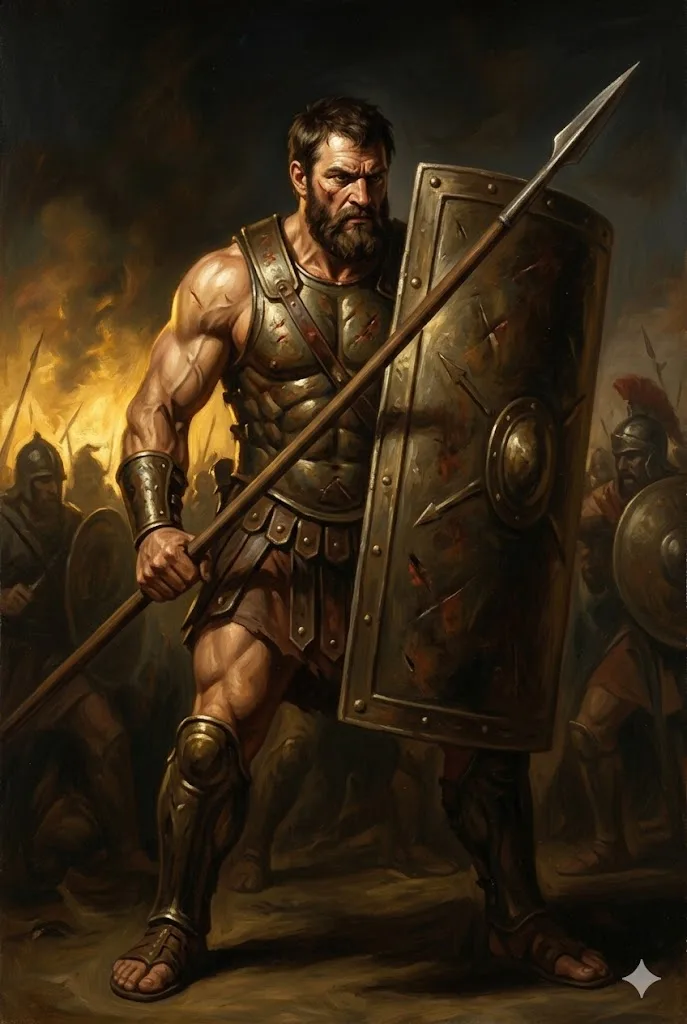
The Towering Warrior
Ajax, son of Telamon and king of Salamis, was the largest and strongest of the Greek warriors at Troy after Achilles. He carried an enormous shield made of seven layers of ox-hide reinforced with bronze, a shield so large it was described as a wall unto itself. While other heroes had divine parents or magical weapons, Ajax relied on nothing but his own physical prowess and indomitable will. He was never wounded in the entire Iliad, a feat no other warrior on either side can claim.
Holding the Line
Ajax's greatest moment came when Achilles withdrew from battle and the Trojans, led by Hector, pushed the Greeks back to their ships. With the entire army in retreat and the war on the verge of being lost, Ajax stood alone on the decks of the Greek ships and fought off the entire Trojan advance with a massive naval pike. Homer describes him striding from ship to ship, a colossus who refused to give ground when every other Greek had broken. He did not save the day through cleverness like Odysseus or divine intervention like Diomedes. He saved it through sheer stubborn refusal to die or retreat.
The Arms of Achilles
When Achilles was killed, his divine armour, forged by Hephaestus, was awarded not to Ajax but to Odysseus. The decision was made by the Greek commanders (or in some versions, by Trojan prisoners asked who had hurt them most). Ajax, who had carried Achilles' body from the battlefield while Odysseus fought off the Trojans, believed the armour was rightfully his. The rejection drove him mad. In his madness, sent by Athena, he slaughtered a flock of sheep believing they were Odysseus and the Greek leaders. When sanity returned and he saw what he had done, Ajax fell on his own sword.
The Tragedy of Ajax
Sophocles' Ajax (c. 440 BC) is one of the great tragedies about honour and the cruelty of a system that rewards cunning over loyalty. Ajax did everything right. He fought harder than anyone. He never asked for divine help. He held the line when everyone else ran. And his reward was to be passed over for a man who fought with words instead of weapons. His suicide is not weakness but a final assertion of the warrior code: better to die with honour than live with the knowledge that honour means nothing to those in power.
Classical Sources
- 📜 Homer, Iliad & Odyssey (c. 750 BC)
- 📜 Hesiod, Theogony (c. 700 BC)
- 📜 Apollodorus, Bibliotheca (c. 1st-2nd century AD)
- 📜 Ovid, Metamorphoses (8 AD)
Cross-referenced with multiple classical sources for accuracy.
Explore More
Achilles · Odysseus · Trojan War · Troy · Home