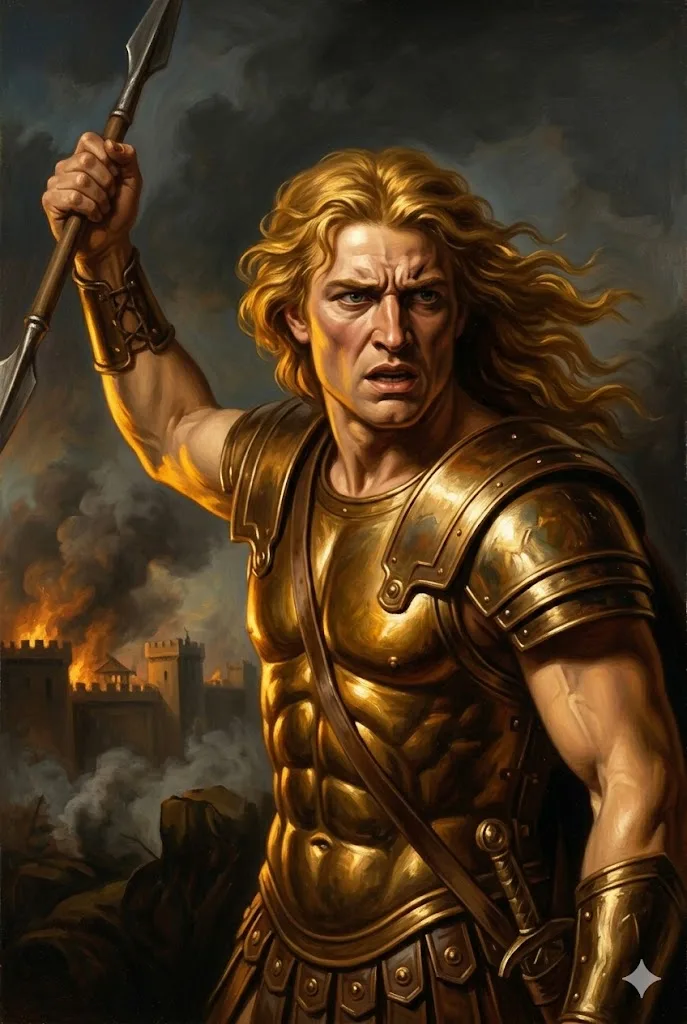
I. Who Was Achilles?
Achilles was the greatest warrior of the Greek heroic age and the central figure of Homer's Iliad, the foundational text of Western literature. Son of the mortal king Peleus and the sea nymph Thetis, he was a demigod of unmatched speed, strength, and martial skill. He was said to be nearly invulnerable — his mother had dipped him in the River Styx as an infant, rendering his body impervious to all weapons. All except his heel, where she had held him, which remained his one fatal weakness.
Achilles' story is one of rage, glory, and tragedy. He sailed to Troy with the Greek army and quickly established himself as the most feared fighter on either side. But when Agamemnon, commander of the Greeks, dishonored him by seizing his war-prize Briseis, Achilles withdrew from battle in furious pride. Without their champion, the Greeks suffered catastrophic losses — a spiral of destruction that forms the core narrative of the Iliad.
II. The Wrath of Achilles
Achilles's withdrawal from battle had devastating consequences. The Trojans, led by Hector, pushed the Greeks back to their ships and nearly destroyed the entire army. Achilles's beloved companion Patroclus, unable to watch the slaughter, donned Achilles's own armor and led the Myrmidons back into battle. He fought valiantly but was slain by Hector, who stripped the armor from his body.
The death of Patroclus transformed Achilles's cold rage into volcanic grief. He reconciled with Agamemnon, received magnificent new armor forged by Hephaestus, and returned to the battlefield in a frenzy of killing that turned the Scamander River red with blood. He hunted Hector around the walls of Troy three times before finally killing him in single combat, then dragged his body behind his chariot for twelve days — an act of desecration that horrified even the gods.
Achilles in the Iliad
The Iliad is fundamentally the story of Achilles' rage. The epic opens with Achilles withdrawing from battle after Agamemnon, the Greek commander, seizes his war-prize Briseis — a slight to Achilles' honour that he considers unforgivable. His absence from the battlefield tips the war decisively in Troy's favour, and the Greeks suffer devastating losses. Zeus himself intervenes on behalf of Achilles' wounded honour, allowing the Trojans to push the Greeks back to their ships.
The turning point comes when Achilles' beloved companion Patroclus borrows his armour and enters battle, attempting to rally the Greeks. Patroclus fights brilliantly but is ultimately killed by Hector, the greatest Trojan warrior. Achilles' grief is total and transformative — he screams so loudly that the sound alone drives the Trojans back from the Greek camp. His rage, previously directed at Agamemnon, now focuses entirely on Hector. He receives new armour forged by Hephaestus himself, including a magnificent shield depicting the entire cosmos, and returns to battle as an unstoppable force of destruction.
The climactic duel between Achilles and Hector is one of the most powerful scenes in Western literature. Hector, knowing he is outmatched, initially flees — running three times around the walls of Troy before Athena tricks him into standing his ground. Achilles kills Hector, then drags his body behind his chariot around the walls of Troy for days, refusing burial — a shocking violation of the honour code he had previously fought to uphold. Only when Hector's father, old King Priam, comes alone to the Greek camp and begs for his son's body does Achilles relent. The two enemies weep together, sharing a moment of profound human connection across the divide of war.
The Heel — Vulnerability and Mortality
The most famous detail about Achilles — his vulnerable heel — does not actually appear in Homer's Iliad. The story that his mother Thetis dipped him in the River Styx as an infant, holding him by the heel and making his entire body invulnerable except for that one spot, comes from later sources. The Roman poet Statius (1st century AD) provides the fullest account in his unfinished epic the Achilleid.
The image of Achilles' heel has become one of the most enduring metaphors in any language — a fatal weakness in an otherwise invincible person or system. It speaks to a truth the Greeks understood deeply: that perfection is impossible, that every strength conceals a corresponding vulnerability, and that even the greatest among us are mortal. The phrase "Achilles' heel" has entered dozens of languages worldwide, used in contexts from sports to geopolitics to cybersecurity.
The Choice of Achilles
Before the Trojan War, Achilles was given a choice by his mother Thetis: he could live a long, comfortable, anonymous life at home, or he could go to Troy, win eternal glory, and die young. Achilles chose glory — and this choice defines his character and the entire Greek heroic ideal. For the ancient Greeks, a short life of extraordinary deeds was infinitely preferable to a long life of mediocrity. Fame (kleos) was the only true immortality available to mortals, and Achilles achieved it more completely than any other hero.
Yet Homer complicates this ideal. When Odysseus meets Achilles' shade in the Underworld in the Odyssey, the dead hero delivers a devastating reversal. He tells Odysseus that he would rather be a living servant to a landless peasant than king of all the dead. This single statement undermines the entire heroic code that Achilles embodied in life — suggesting that glory is a poor consolation for the loss of life itself. The tension between these two perspectives — glory versus survival, fame versus happiness — remains one of the most profound philosophical questions raised by Greek mythology.
III. Death & Legacy
Achilles knew from prophecy that he was fated to die at Troy. He could have chosen a long, peaceful life at home in Phthia, but instead chose a short life of immortal glory — a choice that defined the Greek heroic ideal. He was eventually killed by an arrow to his vulnerable heel, guided by Apollo and shot by the Trojan prince Paris. The phrase "Achilles' heel" has entered virtually every language as a metaphor for a fatal weakness in an otherwise invincible being.
Childhood: Fire, Chiron and Skyros
The Styx dipping is only one of several ancient stories about Achilles' near-immortality, and it is the latest of them. In an older version, told by Apollonius of Rhodes and Apollodorus, Thetis laid the baby in the fire at night to burn away his mortal parts and rubbed him with ambrosia by day. Peleus caught her at it and cried out in horror. Thetis then abandoned both her husband and her son and returned to the sea. Peleus gave the boy to the centaur Chiron on Mount Pelion. Apollodorus says Chiron fed him on the innards of lions and wild boars and the marrow of bears, and changed his name from Ligyron to Achilles.
When the Greek army gathered for Troy, Thetis, knowing that her son was fated to die there, hid him on the island of Skyros, dressed as a girl among the daughters of King Lycomedes. While he was there he fathered Neoptolemus, also called Pyrrhus, by the princess Deidamia. Odysseus exposed him with a trick. In the most famous version, he set out jewellery and weapons among the women, or sounded a war trumpet, and only Achilles reached for the spear. Statius' unfinished Achilleid tells this episode most fully, but it was known in Greece much earlier and was the subject of a lost play by Euripides.
The Wars Before and After the Iliad
The Iliad covers only a few weeks of the tenth year of the war. The lost epics of the Trojan Cycle, known today mainly through a summary by Proclus, filled in the rest. In the Cypria, the Greeks first land by mistake in Mysia, where Achilles wounds King Telephus. Later he heals him with rust scraped from the same spear, because an oracle had said "the one who wounded will heal." The Cypria also describes the ambush of Troilus, the youngest son of Priam, at a fountain outside Troy. This scene is painted on the François Vase and on many other Archaic pots. In Euripides' Iphigenia at Aulis, Achilles' name is used without his knowledge as bait. Agamemnon summons Iphigenia to Aulis on the pretence that she will marry Achilles, and the furious hero offers to defend her.
After Hector's death, the Aethiopis continued his story. Achilles kills the Amazon queen Penthesilea and, in one tradition, falls in love with her at the moment of her death. He kills Thersites for mocking him and then defeats Memnon, the Ethiopian son of Dawn. Soon afterward he is killed at the Scaean Gate by Paris and Apollo, exactly as the dying Hector had predicted in Iliad 22. Ajax carries his body back from the battle while Odysseus holds off the Trojans. The contest over his armour afterwards destroys Ajax.
After Death: Funeral, Polyxena and the White Island
Book 24 of the Odyssey describes his funeral. Thetis rose from the sea with the Nereids, the nine Muses sang the lament, and the Greeks mourned for seventeen days. His bones were mixed with those of Patroclus in a golden urn made by Hephaestus and buried under a great mound on the Hellespont. Later tradition said that his ghost demanded the sacrifice of the Trojan princess Polyxena at the tomb. Euripides dramatises this in the Hecuba.
Not every source leaves him in Hades. According to the Aethiopis, Thetis snatched him from the pyre and carried him to the White Island, Leuke, in the Black Sea. Pindar places him in the Isles of the Blessed. Leuke, usually identified with today's Snake Island off the Danube delta, became the centre of a real hero cult. Greek colonists around the Black Sea, especially at Olbia, worshipped him as Achilles Pontarches, "Lord of the Sea." In the Troad, visitors honoured his tomb at Sigeion. Arrian and Plutarch report that Alexander the Great placed a wreath on it in 334 BC, while Hephaestion did the same at the tomb of Patroclus.
Achilles and Patroclus, Art and Interpretation
Homer describes the bond between the two men in intense terms but never calls it sexual. Fifth-century Athenians did. Aeschylus' lost Myrmidons presented Achilles as the older lover. Plato's Symposium has Phaedrus object that Aeschylus got it wrong, because Achilles was the younger and more beautiful of the two, and the beloved. The ancient debate is itself evidence of how the relationship was read.
In art, two images stand out. On a black-figure amphora by Exekias (c. 530 BC, Vatican Museums), Achilles and Ajax lean over a board game in full armour. The scene does not appear in any surviving text. On the Sosias Painter's cup in Berlin, Achilles carefully binds a wound on Patroclus' arm.
Ancient sources
- Homer, Iliad 9.410–416: Achilles describes the two fates his mother foretold, a long life without fame or a short life with undying glory.
- Homer, Odyssey 24.36–94: the shade of Agamemnon describes Achilles' funeral, the Muses' lament and the golden urn shared with Patroclus.
- Apollodorus, Library 3.13.6–8: Thetis and the fire, Chiron's upbringing, and the hiding on Skyros.
- Proclus, summary of the Cypria and Aethiopis: Telephus, Troilus, Penthesilea, Memnon, Achilles' death and his removal to the White Island.
- Euripides, Iphigenia at Aulis and Hecuba: the false marriage plot, and the sacrifice of Polyxena at his tomb.
- Plato, Symposium 179e–180b: Phaedrus on Achilles and Patroclus, and his disagreement with Aeschylus.
Frequently asked questions
Who killed Achilles?
Paris, with the help of Apollo, at the Scaean Gate of Troy. Homer foretells this but does not narrate it. The heel as the exact target belongs to later tradition.
Did Achilles have a son?
Yes, Neoptolemus (Pyrrhus), born to Deidamia on Skyros. He came to Troy after his father's death and killed King Priam during the sack of the city.
Was Achilles fully a god?
No. He was the son of a goddess and a mortal king, and he was mortal. After death he was worshipped as a hero, and some traditions said he lived on in the White Island or the Isles of the Blessed.
Why was Achilles disguised as a girl?
Thetis knew that he would die if he went to Troy, so she hid him among the daughters of King Lycomedes on Skyros. Odysseus tricked him into giving himself away.
Explore More Mythology
Get weekly deep dives into the gods, heroes, and myths of ancient Greece.