Zeus — King of the Gods
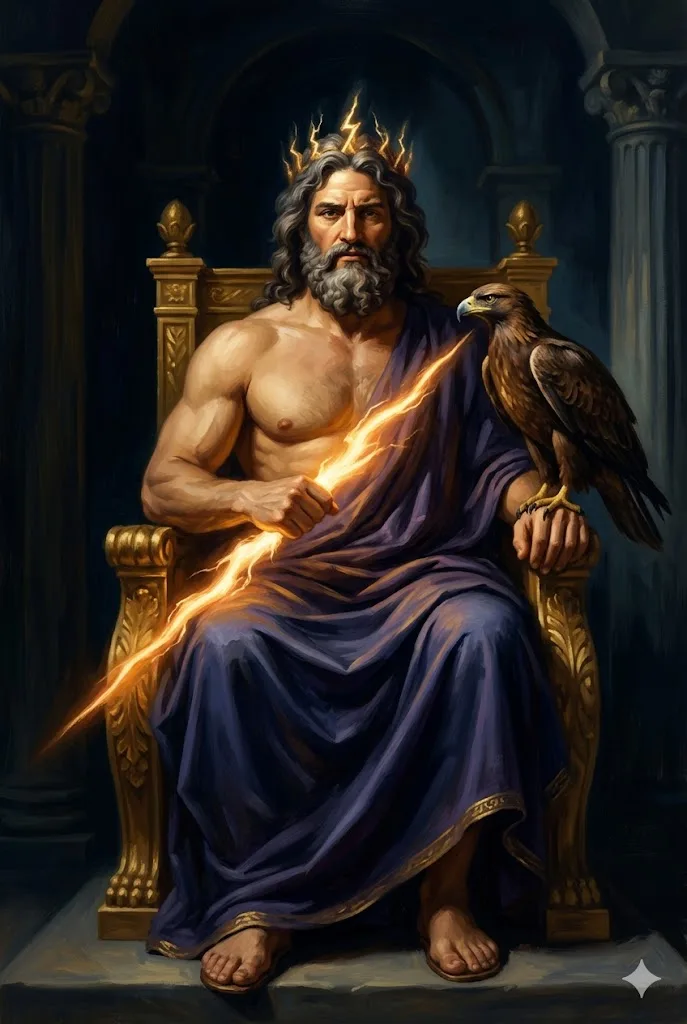
I. Who Was Zeus?
Zeus was the supreme deity of the ancient Greek pantheon, ruling as king of gods and mortals from his throne atop Mount Olympus. Known to the Romans as Jupiter, he was the god of the sky, thunder, lightning, law, and order. The ancient Greeks regarded him as the father and protector of both gods and humans — a title reflected in his common epithet "Father of Gods and Men."
His authority was absolute among the Olympians. While other gods held dominion over specific realms — Poseidon over the sea, Hades over the underworld — Zeus claimed the heavens and the earth itself as his domain. He wielded the thunderbolt as both weapon and symbol of divine justice, hurling it against those who broke oaths or defied the natural order.
More than just a warrior-king, Zeus represented cosmic order. He upheld the sacred laws of hospitality (known as xenia), protected suppliants and guests, presided over oaths and treaties, and ensured that fate unfolded as it should. In many ways, he was the embodiment of civilization itself — the force that kept chaos at bay.
II. Birth & Early Life
The story of Zeus's birth is one of the most dramatic tales in all of mythology. He was the youngest son of the Titan king Cronus and the Titaness Rhea. Cronus had received a prophecy that one of his own children would eventually overthrow him — just as he himself had overthrown his father Uranus. Terrified by this fate, Cronus devoured each of his children the moment they were born.
One by one, he swallowed Hestia, Demeter, Hera, Hades, and Poseidon. When Rhea became pregnant with her sixth child, she was desperate to save him. She sought counsel from her parents, Gaea (Earth) and Uranus (Sky), who advised her to travel to the island of Crete. There, in a hidden cave on Mount Dicte (or Mount Ida, depending on the tradition), Rhea gave birth to Zeus in secret.
To deceive Cronus, Rhea wrapped a large stone in swaddling clothes and presented it to him. Believing it was his newborn son, Cronus swallowed the stone without question. Meanwhile, the infant Zeus was hidden away on Crete, where he was raised in secret. According to various traditions, he was nursed by the divine goat Amalthea and guarded by the Kouretes — warrior spirits who clashed their shields and spears together to drown out the baby's cries so Cronus would not discover him.
III. The Rise to Power
When Zeus reached maturity, he returned to confront his father. With the help of the Titaness Metis (who would later become his first wife), Zeus administered an emetic to Cronus that forced the Titan to disgorge all the children he had swallowed. Out came Poseidon, Hades, Hera, Demeter, and Hestia — along with the stone that had been substituted for Zeus. This stone, called the Omphalos, was later placed at the oracle of Delphi as a sacred relic.
Together, the liberated gods declared war on Cronus and the Titans in a cataclysmic conflict known as the Titanomachy. The war raged for ten years, with Zeus and his siblings battling from Mount Olympus against the Titans on Mount Othrys. The turning point came when Zeus freed the Cyclopes and the Hecatoncheires (Hundred-Handed Ones) from the depths of Tartarus, where Cronus had imprisoned them. In gratitude, the Cyclopes forged Zeus's iconic thunderbolts, Poseidon's trident, and Hades' helm of invisibility.
With these divine weapons and the might of the Hundred-Handed giants hurling mountains, the Olympians prevailed. The defeated Titans were cast into the abyss of Tartarus, and the three brothers — Zeus, Poseidon, and Hades — drew lots to divide the cosmos. Zeus received the sky and the heavens, Poseidon the sea, and Hades the underworld. The earth and Mount Olympus remained common ground, though Zeus's authority was recognized as supreme over all.
IV. Powers & Attributes
As king of the gods, Zeus possessed powers far beyond those of any other deity. His primary weapon was the thunderbolt — a devastating bolt of lightning forged by the Cyclopes, capable of destroying anything in its path. He could summon storms, command the winds, and shake the heavens with thunder at will.
Beyond his control over weather and sky, Zeus had the power of shapeshifting. He frequently transformed himself into various forms — an eagle, a swan, a bull, a shower of golden rain, even the likeness of other mortals — often as part of his many romantic pursuits. His symbol, the eagle, was said to serve as his personal messenger and companion, soaring over the battlefield and carrying his thunderbolts.
Other sacred symbols associated with Zeus include the oak tree (the oracle at Dodona interpreted the rustling of oak leaves as Zeus's messages), the scepter of kingship, and the aegis — a divine shield or cloak that he sometimes lent to his daughter Athena. The bull was also sacred to him, as was the thunderstone and the cornucopia.
V. Family & Relationships
Zeus's family tree is arguably the most complex in all of mythology. His official consort was his sister Hera, queen of the gods and goddess of marriage, but he was legendarily unfaithful. His numerous liaisons with both goddesses and mortal women produced an extraordinary number of offspring who became central figures in Greek myth.
Notable Children of Zeus
By Hera, Zeus fathered Ares (god of war), Hephaestus (god of the forge), Hebe (goddess of youth), and Eileithyia (goddess of childbirth). Through his many other relationships, he became father to some of the most famous figures in mythology: Athena (born from his own head after he swallowed her mother Metis), Apollo and Artemis (by the Titaness Leto), Hermes (by the nymph Maia), Dionysus (by the mortal princess Semele), Persephone (by Demeter), and the hero Heracles (by the mortal woman Alcmene).
His mortal sons and daughters founded many of the great royal houses of Greek legend. Perseus, Minos, Helen of Troy, and the Dioscuri (Castor and Pollux) were all counted among his offspring. This vast family network meant that Zeus's blood ran through the veins of nearly every hero and king in Greek mythology.
VI. Key Myths & Stories
The Gigantomachy
After defeating the Titans, Zeus faced another challenge when the Giants — enormous beings born from Gaea — rose up against Olympus. This war, the Gigantomachy, could only be won with the help of a mortal hero. Zeus fathered Heracles specifically for this purpose, and together gods and hero defeated the Giants.
The Defiance of Prometheus
When the Titan Prometheus stole fire from the gods and gave it to humanity, Zeus was furious. He chained Prometheus to a rock in the Caucasus Mountains, where an eagle would devour his liver each day — only for it to regenerate each night, ensuring eternal torment. Zeus also punished humanity by creating Pandora, the first woman, who carried a jar (often mistranslated as "box") containing all the world's evils.
The Great Flood
Disgusted by human wickedness, Zeus once sent a great flood to destroy all of humanity. Only the pious couple Deucalion (son of Prometheus) and Pyrrha survived by building a chest and floating to safety. When the waters receded, they repopulated the earth by throwing stones over their shoulders, which transformed into people — creating a new, better race of humans.
Zeus and Europa
In one of his most famous transformations, Zeus took the form of a magnificent white bull to abduct the Phoenician princess Europa. Charmed by the gentle beast, Europa climbed onto its back — and Zeus carried her across the sea to Crete, where she became the mother of King Minos and gave her name to the continent of Europe.
"Zeus, first cause, prime mover; for what thing without Zeus is done among mortals?" — Aeschylus, Agamemnon
VII. Worship & Legacy
Zeus was the most widely worshipped deity in the ancient Greek world. His chief sanctuary was at Olympia in the Peloponnese, where the Olympic Games were held every four years in his honor. The games were so sacred that a truce, called the ekecheiria, was declared across all Greek city-states during the competition.
At Olympia stood one of the Seven Wonders of the Ancient World: the enormous Statue of Zeus, crafted by the sculptor Phidias around 435 BC. Standing approximately 40 feet tall, the chryselephantine (gold and ivory) statue depicted Zeus seated on an elaborate throne, holding a figure of Nike (Victory) in his right hand and a scepter topped with an eagle in his left.
His oracle at Dodona, in northwestern Greece, was considered one of the oldest in the Greek world, predating even the famous oracle at Delphi. There, priests known as the Selloi interpreted the will of Zeus from the rustling of sacred oak leaves and the cooing of doves.
Zeus's influence extends far beyond antiquity. His Roman counterpart Jupiter became the chief god of the Roman state religion. The planet Jupiter — the largest in our solar system — bears his Roman name. His image and stories have permeated Western art, literature, and culture for over three thousand years, making him one of the most enduring figures in human civilization.
IX. Zeus in Classical Literature
Zeus appears more frequently in ancient Greek literature than any other deity. In Homer's Iliad, he presides over the Trojan War from his throne on Mount Ida, weighing the fates of heroes on golden scales and struggling to remain impartial as gods on both sides plead for his intervention. Homer portrays Zeus as a complex figure — immensely powerful yet constrained by fate, authoritative yet vulnerable to the schemes of his wife Hera, who repeatedly tricks and manipulates him to favour her preferred side in the conflict.
In Hesiod's Theogony (c. 700 BC), Zeus's rise to power is described in full — from his birth and concealment on Crete to the decade-long war against the Titans. Hesiod emphasizes Zeus's intelligence and strategic thinking as much as his raw power. It was Zeus who freed the Cyclopes from Tartarus to forge his thunderbolt, and Zeus who recruited the Hundred-Handed Ones (Hecatoncheires) as allies. His victory was not merely the triumph of the strongest, but the triumph of the wisest.
The tragedian Aeschylus, in his Prometheus Bound, presents a darker portrait of Zeus — a tyrant who punishes Prometheus for bringing fire to humanity. Aeschylus's Zeus is powerful but cruel, representing the dangers of absolute authority. This more critical view of the king of the gods shows the remarkable freedom Greek authors had to question even the highest divine authority — a tradition that would be unthinkable in many other ancient religions.
X. Cult and Worship in the Ancient World
Zeus was worshipped throughout the Greek world, but his most important cult centres were at Olympia in the Peloponnese and Dodona in Epirus. At Olympia, the Olympic Games were held every four years in his honour — a pan-Hellenic festival so sacred that wars were suspended during its duration. The sanctuary at Olympia housed one of the Seven Wonders of the Ancient World: a colossal seated statue of Zeus made of gold and ivory by the sculptor Pheidias, standing over 12 metres (40 feet) tall. Ancient visitors described being overcome with awe upon seeing it, as though they were in the actual presence of the god.
At Dodona, the oldest oracle in Greece operated under Zeus's authority. Priests interpreted the will of Zeus by listening to the rustling of leaves in a sacred oak tree and the sound of wind chimes and bronze vessels hung from its branches. Pilgrims came from across the Mediterranean to submit questions inscribed on lead tablets, many of which have been recovered by archaeologists — providing a remarkable window into the everyday concerns of ancient worshippers.
Zeus was also worshipped under numerous epithets that reflected his many functions: Zeus Olympios (of Olympus), Zeus Xenios (protector of guests and hospitality), Zeus Horkios (guardian of oaths), Zeus Polieus (protector of the city), Zeus Meilichios (the kindly one, associated with purification), and Zeus Ktesios (protector of household property). Each epithet represented a distinct aspect of his worship and was often associated with specific rituals, festivals, and local traditions.
XI. Zeus in Ancient Art
Zeus was one of the most frequently depicted figures in ancient Greek art, appearing on vase paintings, sculptures, coins, gems, and architectural reliefs from the Archaic period through the Roman era. In the earliest depictions (7th-6th century BC), he typically appears as a bearded man in vigorous motion, hurling a thunderbolt with one arm raised. This dynamic pose — known as the "thunderbolt-hurler" — became his most iconic visual representation.
The most famous surviving ancient representation of Zeus is the bronze Artemision Zeus (or Poseidon), recovered from a shipwreck off Cape Artemision. This magnificent statue, dating to around 460 BC, depicts the god poised to throw his weapon — whether a thunderbolt (Zeus) or a trident (Poseidon) remains debated. The figure radiates calm authority and physical perfection, embodying the Greek ideal of divine power expressed through the human form.
On Attic red-figure vase paintings, Zeus appears in countless mythological scenes: enthroned among the Olympians, pursuing his many loves (often in animal form), battling giants, weighing the fates of heroes, and delivering justice. These images provide invaluable evidence for how the ancient Greeks visualized their most important deity and the stories told about him.
XII. Zeus and the Problem of Theodicy
Perhaps the most intellectually fascinating aspect of Zeus mythology is the question of divine justice. Zeus was simultaneously the upholder of cosmic order and the most frequent violator of moral standards among the gods. He was the punisher of liars and oath-breakers, yet he routinely deceived his wife. He was the protector of guests and strangers, yet he destroyed entire populations with floods and plagues. This paradox — a supreme god who is both just and unjust — troubled Greek thinkers from the earliest times.
The philosopher Plato, in his Republic, argued that the traditional myths about Zeus were morally corrupting and should be censored from the education of children. He objected to stories of Zeus's deceptions, transformations, and sexual adventures, arguing that the supreme god should be portrayed as perfectly good and unchanging. This tension between mythological tradition and philosophical idealism reveals a civilization actively wrestling with fundamental questions about the nature of power, justice, and divinity — questions that remain central to theology and philosophy today.
XIII. Roman Zeus: Jupiter
When Rome absorbed Greek culture, Zeus was identified with the Roman god Jupiter (also called Jove). Jupiter Optimus Maximus ("Jupiter Best and Greatest") became the supreme deity of the Roman state, worshipped in a magnificent temple on the Capitoline Hill that was the political and religious centre of the Roman world. Roman generals celebrated triumphs at this temple, and the Roman Senate met there to make its most important decisions.
While Jupiter inherited most of Zeus's mythology, the Roman version was more closely associated with the state and military power. Jupiter was the divine guarantor of Rome's imperial mission — the god who had ordained that Rome would rule the world. This political dimension of Jupiter worship went beyond anything in the Greek Zeus cult and helped shape the relationship between religion and political power throughout Western history.
The days of the week preserve Jupiter's name: Thursday derives from "Thor's Day" in Norse, but in the Romance languages, the connection is direct — Jeudi (French), Jueves (Spanish), Giovedì (Italian) all derive from Jovis Dies, "the day of Jupiter/Zeus."
VIII. Quick Facts
The Battles Hesiod and Homer Remember
The Titanomachy was not Zeus's last fight for the throne. In Hesiod's Theogony, Gaia's final child, Typhon, rises against him: a monster with a hundred snake heads, whose voices sound sometimes like a bull, sometimes like a lion, sometimes like a hissing serpent. Zeus fights him with thunder and lightning until the earth, the sea and the sky are burning, then hurls him into Tartarus. Apollodorus tells a much less flattering version. Typhon wrestles Zeus down, cuts the sinews from his hands and feet, and hides them in the Corycian cave in Cilicia, guarded by the she-dragon Delphyne. Hermes and Aegipan steal the sinews back, and only then does Zeus recover and eventually bury Typhon beneath Mount Etna.
Homer adds an episode that even many enthusiasts never come across. In Iliad book 1, Achilles reminds his mother Thetis of how Hera, Poseidon and Athena once plotted to put Zeus in chains. Thetis foiled them by summoning the Hundred-Hander Briareus to sit beside Zeus, and the rebels backed down out of fear. In Iliad book 8, Zeus boasts that if the gods hung a golden chain from heaven and all pulled together, they could not drag him down, while he could haul them up along with the earth and the sea. In book 14, Hera seduces him on Mount Ida with Aphrodite's embroidered band, and he sleeps while Poseidon helps the Greeks. Homer's Zeus is supreme, but his rule is never completely secure.
Rival Birthplaces and the Cretan "Tomb"
Greek communities argued about where Zeus was born. Hesiod places the birth near Lyctus in Crete, later writers point to caves on Mount Dicte or Mount Ida, and the Arcadians claimed Mount Lykaion. Callimachus' Hymn to Zeus opens with exactly this dispute and settles it by quoting the line "Cretans are always liars." His reason was that the Cretans also claimed to show the tomb of Zeus, which is impossible for an immortal god. The idea of a Zeus who dies and is reborn may come from older Minoan religion. The Cretan "Zeus Kretagenes" worshipped by the Kouretes, a young god born each year, looks very different from the bearded king of Olympia.
Mount Lykaion in Arcadia was home to one of the darkest cults in Greece. Pausanias tells of the myth of Lycaon, who sacrificed a child on Zeus's altar and was turned into a wolf. He also hints, without giving details, that secret sacrifices continued there. He reports a belief that anyone who entered the forbidden precinct would lose their shadow and die within the year. Ovid's Metamorphoses makes Lycaon's crime the direct cause of the great flood.
Festivals and Lesser-Known Cults
Besides the Olympic Games, Athens honoured Zeus with several festivals. The Diasia, held for Zeus Meilichios, was described by Thucydides as the greatest Athenian festival of Zeus, and it was celebrated outside the city with bloodless offerings shaped like animals. The Dipolieia on the Acropolis included the strange Bouphonia, the "ox-murder." An ox was killed after eating grain from the altar, the axe was then put on trial and found guilty, and the hide was stuffed and yoked to a plough as if the animal had come back to life. At Nemea, Zeus's sanctuary held the Nemean Games, and at Dodona the lead question tablets were addressed jointly to Zeus Naios and his consort Dione.
Outside Greece itself, Greeks identified Zeus with the Egyptian Amun at the oasis of Siwa, where Zeus Ammon was shown with ram's horns. When Alexander the Great visited that oracle in 331 BC, the priests' greeting was later taken as a declaration that he was a son of Zeus.
Zeus the Host: Philemon and Baucis
Myths about Zeus Xenios, protector of guests, are often told only in general terms. The clearest story is in Ovid. Jupiter and Mercury, disguised as travellers, are turned away from every house in a Phrygian town until a poor old couple, Philemon and Baucis, take them in and share their simple meal. The wine jug keeps refilling itself. The gods flood the inhospitable town, turn the cottage into a temple, and grant the couple their wish to die at the same moment. They become an oak and a linden growing from one trunk.
For more on his many partners and offspring, see the guides to the lovers of Zeus and the children of Zeus.
Ancient sources
- Hesiod, Theogony 820–880: Zeus's battle with Typhon and the monster's banishment to Tartarus.
- Apollodorus, Library 1.6.3: Typhon cuts out Zeus's sinews and hides them in the Corycian cave, and Hermes and Aegipan recover them.
- Homer, Iliad 1.396–406, 8.18–27 and 14.153–353: the plot to bind Zeus foiled by Briareus, the golden chain boast, and Hera's deception of Zeus on Mount Ida.
- Callimachus, Hymn 1 (To Zeus): the dispute between Crete and Arcadia over his birthplace, and the Cretan tomb.
- Pausanias, Description of Greece 8.2 and 8.38: Lycaon and the cult and taboos of Zeus Lykaios in Arcadia.
- Ovid, Metamorphoses 8.611–724: Jupiter and Mercury entertained by Philemon and Baucis.
Frequently asked questions
Where was Zeus born?
Most accounts say Crete, either near Lyctus or in a cave on Mount Dicte or Mount Ida. The Arcadians claimed Mount Lykaion instead, and ancient writers argued over which claim was true.
Was Zeus ever defeated?
In Apollodorus' version, Typhon briefly overpowered him and cut out his sinews. Homer also mentions a near-coup by Hera, Poseidon and Athena. In both cases Zeus came back to rule.
Who was Zeus's first wife?
According to Hesiod, it was Metis. He swallowed her to stop the birth of a son who would overthrow him, and Athena was later born from his head. Themis was his second, and Hesiod lists Hera as the last of seven divine wives.
Is Zeus more powerful than fate?
The Greeks never fully agreed. In the Iliad, Zeus considers saving his son Sarpedon but accepts that doing so would overturn what was destined, which suggests that even he chose to respect the Fates.
Explore More Mythology
Get weekly deep dives into the gods, heroes, and myths of ancient Greece.