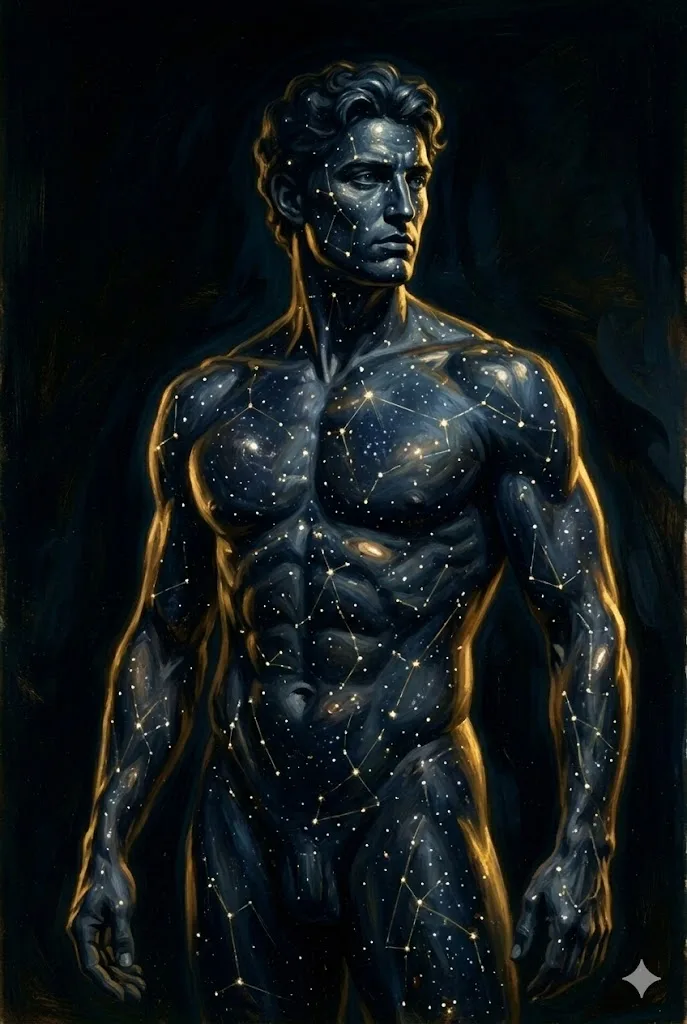
Son and Husband of Gaia
Uranus (Ouranos in Greek) was the primordial god of the sky, born from Gaia (Earth) without a father. He then became Gaia's consort, and together they produced the first generation of divine beings: the twelve Titans, the three Cyclopes (Brontes, Steropes, and Arges), and the three Hecatoncheires (Hundred-Handed Ones). Uranus was the first ruler of the cosmos, a sky that literally lay upon the earth, covering Gaia completely.
The Tyrant
Uranus feared and despised several of his own children, particularly the Cyclopes and Hecatoncheires, whose monstrous forms offended him. He imprisoned them inside Gaia's body, deep within the earth, causing her terrible pain. This act of cruelty against his own children and his consort set in motion the first great revolution in cosmic history.
The Castration
Gaia, wracked with pain from the children imprisoned inside her, fashioned a great sickle of grey adamantine and asked her Titan sons to punish their father. Only the youngest, Cronus, had the courage to act. Gaia hid him in ambush, and when Uranus descended to lie with Gaia that night, Cronus reached out and castrated his father with the sickle, hurling the severed parts into the sea. From the blood that fell on the earth sprang the Erinyes (Furies), the Giants, and the Meliae (ash-tree nymphs). From the severed parts floating in the sea foam, Aphrodite was born.
Uranus retreated permanently to the heights of the sky, never again descending to lie upon the earth. His role as cosmic ruler passed to Cronus, who would in turn be overthrown by his own son Zeus, establishing the pattern of generational conflict that defines the Greek succession myth.
Legacy
The planet Uranus, discovered in 1781, was named after the primordial sky god, continuing the tradition of naming planets after mythological figures. He is also the source of the word 'uranium' for the radioactive element. Despite being overthrown in the first generation of the cosmic story, Uranus's act of fathering the Titans made him the ultimate ancestor of every Olympian god. Without him, the entire Greek pantheon would not exist.
Classical Sources
- 📜 Homer, Iliad & Odyssey (c. 750 BC)
- 📜 Hesiod, Theogony (c. 700 BC)
- 📜 Apollodorus, Bibliotheca (c. 1st-2nd century AD)
- 📜 Ovid, Metamorphoses (8 AD)
Cross-referenced with multiple classical sources for accuracy.
Explore More
Gaia · Cronus · Aphrodite · The Furies · Home
Different Versions of His Origin
Hesiod's Theogony is the standard account. Gaia first bore Ouranos "equal to herself, to cover her on every side," along with the mountains and Pontus, the barren sea, all without a partner. Not every tradition agreed. In some Orphic theogonies, Ouranos is a child of Night and holds the kingship in a line of rulers that runs from Phanes through Nyx to Ouranos, Cronus and Zeus. Cicero and Hyginus, drawing on Greek genealogists, make Caelus (the Latin Ouranos) the son of Aether and Day. These variants matter because they show that the "first king" could be placed at different points in the cosmic family tree, depending on which author or religious group was telling the story.
Hesiod also reports Ouranos' parting shot to his children. After the castration he called them "Titans," punning on two Greek words: they had "strained" (titainontes) in their arrogance to do a terrible deed, and there would be "vengeance" (tisis) for it later. The Titans' name, then, is a curse from their father.
Ouranos After the Castration
A common assumption is that Ouranos disappears from myth after he is maimed. In fact Hesiod keeps him active as an elder adviser, almost always alongside Gaia. The two foretell to Cronus that he will be overthrown by a son, which is why Cronus swallows his children. When Rhea is pregnant with Zeus, she goes to her parents for help, and they send her to Lyctus in Crete. Later, Gaia and Ouranos warn Zeus that Metis is destined to bear a son stronger than his father, and they advise him to swallow her. In this way the castrated sky god keeps a voice in the succession story, as a source of prophecy instead of power.
Apollodorus' version differs from Hesiod's in several details. He says that Ouranos threw the Cyclopes and the Hundred-Handers into Tartarus, not into Gaia's body. He also says that the Titans freed their brothers after the revolt, only for Cronus to imprison them again. Apollodorus agrees that the Erinyes sprang from the falling blood, but he does not tell the story of Aphrodite's birth from the foam.
Near Eastern Parallels
Scholars have long pointed out that Hesiod's succession myth has close relatives further east. The Hurrian-Hittite Kingship in Heaven text (also called the Song of Kumarbi), known from tablets found at the Hittite capital Hattusa, tells how the sky god Anu was overthrown by Kumarbi, who bit off Anu's genitals and became pregnant with the storm god who would eventually dethrone him. The pattern is the same: a sky-father mutilated by his son, followed by a weather god who wins final kingship. The Phoenician History of Philo of Byblos, which claims to translate an old writer called Sanchuniathon, includes another version in which El, identified with Cronus, castrates Ouranos. Most scholars believe Greek poets absorbed these motifs through contact with the Near East in the early first millennium BC.
Worship, Art and Misconceptions
Ouranos had almost no cult. Like many primordial powers, he was invoked in oaths and cosmic hymns rather than honoured with temples and sacrifice. His name lived on in religion mainly through the epithet Aphrodite Ourania, "Heavenly Aphrodite." In Plato's Symposium, the speaker Pausanias distinguishes the motherless Ourania, born from Ouranos alone, from the more common Aphrodite Pandemos, daughter of Zeus and Dione. The Muse Urania shares his name but is a daughter of Zeus and Mnemosyne, not his child.
In art he is rare. One famous Roman example is on the breastplate of the Augustus of Prima Porta, where Caelus spreads a billowing cloak of sky above the scene. In the Renaissance, Giorgio Vasari and his workshop painted the mutilation of Ouranos by Saturn for a ceiling in the Palazzo Vecchio in Florence. A trivia point: the planet Uranus is the only major planet named after a Greek god rather than his Roman equivalent. The name was proposed by the astronomer Johann Elert Bode, who thought the father of Saturn belonged next to Saturn.
Ancient sources
- Hesiod, Theogony 126–210: Ouranos' birth from Gaia, the imprisonment of his children, the castration, and the naming of the Titans.
- Hesiod, Theogony 463–491 and 886–893: Gaia and Ouranos prophesy to Cronus, advise Rhea, and warn Zeus about Metis.
- Apollodorus, Library 1.1.1–1.1.4: Ouranos as first ruler, Tartarus as prison for the Cyclopes and Hundred-Handers, the castration and the birth of the Erinyes.
- Plato, Symposium 180d–181c: the distinction between Aphrodite Ourania, daughter of Ouranos, and Aphrodite Pandemos.
- Cicero, On the Nature of the Gods, book 3: Caelus as son of Aether and Day.
Frequently asked questions
Who were Uranus' children?
With Gaia he fathered the twelve Titans, the three Cyclopes and the three Hundred-Handers. The Erinyes, the Giants and the Meliai sprang from his blood, and Aphrodite was born from the foam around his severed genitals.
Why did Cronus castrate Uranus?
Gaia was suffering because Ouranos had pushed some of their children back inside her. She made a sickle and asked her sons for help, and Cronus agreed. The act ended the constant embrace of sky and earth.
What is Uranus' Roman name?
Caelus, from the Latin caelum, "sky." The Romans gave him little more attention than the Greeks did.
Was Uranus ever worshipped?
Hardly at all. There are no significant temples to him. He mattered mainly as an ancestor in genealogy and a figure in cosmogony.
Books to read next
- Hesiod, Theogony and Works and Days (Oxford World's Classics)
- Stephen Fry, Mythos
- Apollodorus, The Library of Greek Mythology (Oxford World's Classics)
Links go to Bookshop.org, which supports independent bookstores. We earn a small commission if you buy, at no extra cost to you.