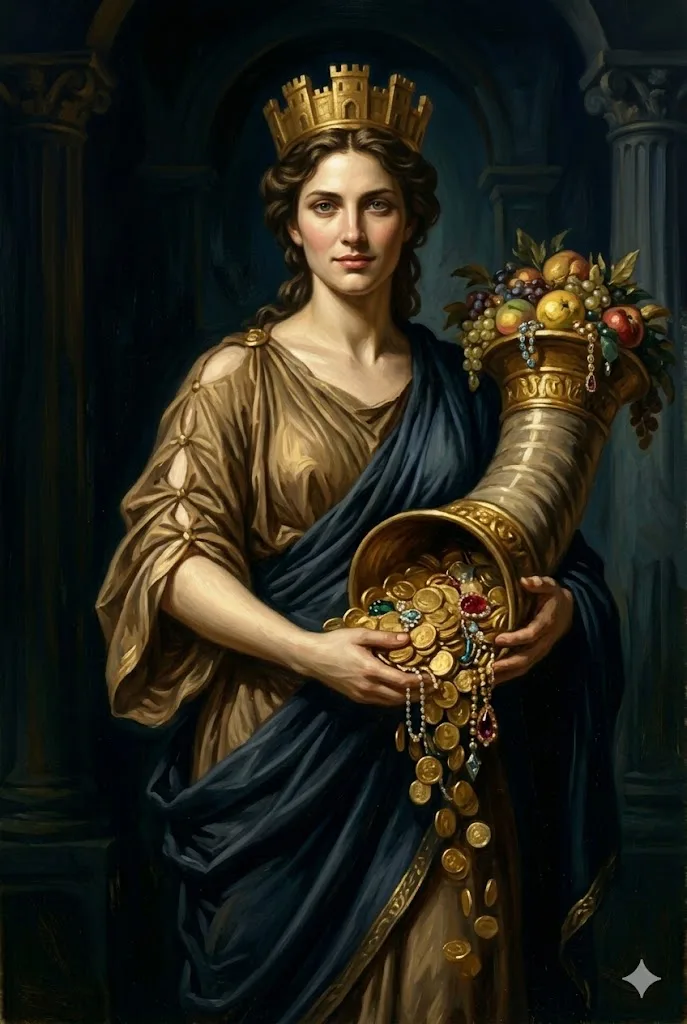
Who Was Tyche?
Tyche was the Greek goddess who governed fortune, prosperity, and chance — the unpredictable force that could elevate a beggar to a king or bring a mighty empire to ruin overnight. She represented the element of randomness in human affairs that even the gods could not fully control, making her one of the most powerful and feared forces in the Greek imagination.
Her very name became our word "luck," and her influence permeated every aspect of ancient life. Merchants prayed to her before voyages, generals invoked her before battles, and gamblers whispered her name over dice. She was the divine acknowledgment that skill, virtue, and planning could only carry a person so far — the rest was in Tyche's capricious hands.
Origins
Tyche's parentage varies across ancient sources. Hesiod listed her among the Oceanids — the three thousand daughters of Oceanus and Tethys. Other traditions named her as a daughter of Zeus or Hermes. The poet Pindar called her a daughter of Zeus and one of the Moirai (Fates), linking her directly to the forces that determined human destiny. This genealogical uncertainty itself seems appropriate for a goddess whose defining quality was unpredictability.
The Wheel of Fortune
Tyche's most enduring symbol was the great wheel upon which she stood or which she turned with her hand. This wheel represented the ceaseless rotation of fortune — those at the top would inevitably descend, while those at the bottom might rise. The concept survived through Roman culture (as Fortuna's wheel) into the medieval period, where the "Wheel of Fortune" became one of the most popular images in European art and literature, and eventually gave its name to the famous television game show.
She was also depicted wearing a mural crown — a crown shaped like the walls and towers of a city — representing her role as protector and patron of individual cities. Many Greek cities adopted Tyche as their guardian deity, erecting statues of their own personalized Tyche wearing the distinctive landmarks of their city on her head. The most famous of these was the Tyche of Antioch, a celebrated bronze statue created by the sculptor Eutychides around 300 BC.
Other Attributes
Beyond the wheel and the mural crown, Tyche carried a cornucopia (horn of plenty), overflowing with fruits and grain — the bounty she could bestow on the fortunate. In her other hand, she often held a rudder, symbolizing her power to steer the course of human lives. Some depictions show her standing on a ball or sphere, emphasizing the instability and precariousness of fortune. She was sometimes shown blindfolded, representing the impartiality — or perhaps the carelessness — with which she distributed her gifts.
Nemesis: The Counterbalance
Tyche worked in tandem with Nemesis, the goddess of retribution. Where Tyche randomly distributed fortune both good and bad, Nemesis ensured that those who received excessive good fortune — and became arrogant because of it — were humbled. Together, the two goddesses maintained the cosmic balance that the Greeks called "moira," the proper allotment given to each person. To enjoy good fortune with humility was wise; to boast of it was to invite Nemesis's correction.
The Roman equivalent of Tyche was Fortuna, who became even more prominent in Roman religion. The great Temple of Fortuna at Praeneste (modern Palestrina) was one of the largest religious complexes in the ancient world. Fortuna's influence extended deep into Roman political life — emperors claimed her favor, and her image appeared on countless coins as propaganda for the prosperity of Rome.
From Minor Nymph to Ruling Power
Tyche starts out modestly. In Hesiod's list of the daughters of Oceanus and Tethys she is just one name among many. In the Homeric Hymn to Demeter she is one of the Oceanid girls who were picking flowers with Persephone when Hades carried her off. Pausanias noticed this himself. He comments that Homer never makes Tyche a great power in the epics, and that the hymn is the earliest place her name appears.
Her importance grew with the lyric poets. Pindar's Twelfth Olympian Ode opens with a prayer to "Tyche the Saviour," daughter of Zeus the Liberator, who steers swift ships at sea, wars on land and the decisions of assemblies. Pausanias quotes another Pindar poem in which she is one of the Fates and the strongest of them. By the fourth century BC, Tyche had become a dominant idea in Greek thinking. In Menander's comedy The Shield she appears in person to deliver a late prologue, explaining to the audience that she controls how the plot will turn out. Historians such as Polybius used tyche to explain the sudden reversals of history, including Rome's rapid rise to world power.
Cities, Statues and Sanctuaries
Pausanias is the best guide to Tyche's actual worship. He credits the Archaic sculptor Bupalus with making the first known statue of her, for the people of Smyrna, wearing a polos (a cylindrical crown) and carrying the horn of Amalthea. At Thebes he saw a statue of Tyche carrying the infant Plutus, god of wealth, in her arms, made by Xenophon of Athens and Callistonicus of Thebes. Pausanias says it was a clever idea to show Wealth as Fortune's child. At Aegira in Achaea, Tyche held the horn of Amalthea and had a winged Eros standing beside her, which Pausanias reads as a message that love depends on luck as much as on beauty.
Many Hellenistic and Roman-era cities honoured a local Tyche as their protecting spirit, and her mural-crowned head appears on hundreds of civic coins from Asia Minor, Syria and Palestine. The Tyche of Antioch, with the river god Orontes swimming at her feet, was copied so often that she became a model for city goddesses throughout the eastern Mediterranean. A related figure was Agathe Tyche, "Good Fortune," often paired with Agathos Daimon, the Good Spirit. Athenian public decrees often began with the phrase "with good fortune" (agathei tychei), a sign of how deeply the goddess had become part of ordinary civic language.
Not every Greek gave fortune credit for success. Plutarch tells how the Corinthian general Timoleon, after freeing Sicily from tyrants, set up a shrine in his house to Automatia, Spontaneity, effectively a cult of luck, and so gave the gods credit for his victories instead of claiming them for himself.
Greek Tyche and Roman Fortuna
Several of Tyche's best-known attributes are really Roman or medieval. The cornucopia and the ship's rudder are genuinely ancient, and the rudder makes Pindar's image of Tyche "steering" concrete. The famous wheel, though, belongs mainly to Fortuna. Its classic literary form is in Boethius' Consolation of Philosophy (c. AD 524), where Fortune speaks of turning her wheel and bringing the lowest to the top and the highest to the bottom. The blindfold comes from even later, mostly from medieval and Renaissance art. Greek images of Tyche are usually calm and dignified matrons, not wild figures standing on balls.
The relationship with Nemesis also needs a note of caution. Greek writers often put the two side by side, and in the Roman imperial period they were sometimes merged into a single goddess. Still, Tyche was not simply "luck" in the modern sense. For many Greeks she was the share of good or bad allotted to a person or a city, close to what we might call destiny. That is why cities could worship her as a protector rather than treat her as a gamble.
Ancient sources
- Hesiod, Theogony 360: Tyche named among the daughters of Oceanus and Tethys.
- Homeric Hymn to Demeter: Tyche among the Oceanid companions of Persephone at the time of the abduction.
- Pindar, Olympian 12: a prayer to Tyche Soteira, daughter of Zeus Eleutherios, who steers ships, wars and councils.
- Pausanias, Description of Greece 4.30.4–6, 7.26.8 and 9.16.2: the first statue by Bupalus, the Tyche with Eros at Aegira, and the Tyche carrying Plutus at Thebes.
- Menander, Aspis (The Shield): Tyche speaks the delayed prologue and claims control of events.
- Plutarch, Life of Timoleon: Timoleon's household shrine to Automatia.
Frequently asked questions
Who are Tyche's parents?
The sources disagree. Hesiod makes her a daughter of Oceanus and Tethys, Pindar calls her a daughter of Zeus, and some later writers name other parents. There was never one official version.
What is the difference between Tyche and Fortuna?
Fortuna is the Roman goddess identified with Tyche. Fortuna had much older native Italian cults, such as those at Praeneste and Antium, and she contributed the wheel and blindfold images that people now attach to Tyche.
Why does Tyche wear a crown of city walls?
The mural crown marks her as the guardian spirit of a particular city. Each city's Tyche represented its collective fortune and safety.
Is Tyche the goddess of gambling?
Gamblers certainly invoked her, but her role was much wider. She covered every turn of fortune, from shipwrecks to the rise and fall of kingdoms.
Join the Pantheon
Weekly mythology stories & deep dives delivered to your inbox.