The Moon Made Divine
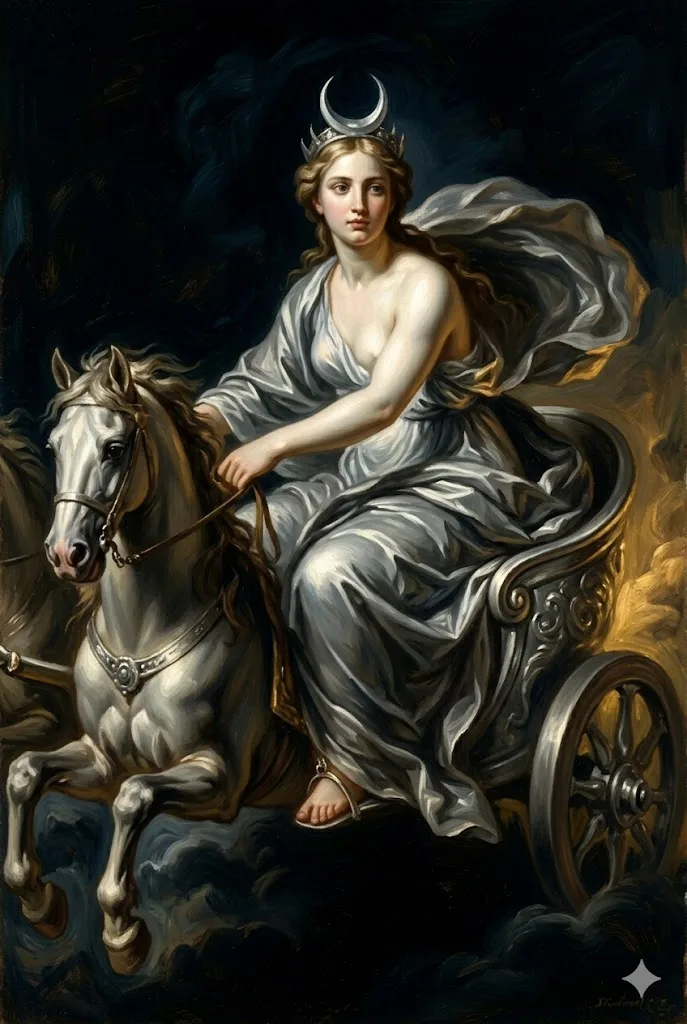
Selene was the Titan goddess who personified the moon itself. Each night, she drove her silver chariot across the dark sky, drawn by a pair of magnificent white horses or oxen, casting her pale light across the sleeping world. She was the moon in its fullest, most radiant aspect — the luminous disk that turned night into silver and inspired poets, lovers, and dreamers across the ancient world.
Selene was the daughter of the Titans Hyperion and Theia, making her sister to Helios (the Sun) and Eos (the Dawn). Together, these three siblings governed the celestial cycle that measured the passage of every day: Eos opened the gates of morning, Helios blazed across the daytime sky, and Selene illuminated the hours of darkness. It was a divine relay that never ceased, marking the eternal rhythm of the cosmos.
Selene and Endymion
The most celebrated myth of Selene concerns her passionate love for Endymion, a breathtakingly handsome mortal shepherd — or, in some versions, a king or hunter. As Selene drove her chariot over the hills of Caria, she gazed down and saw Endymion sleeping in a cave on Mount Latmus. She was struck with an overwhelming love for him and descended from the sky to be with him.
Unable to bear the thought of Endymion growing old and dying, Selene asked Zeus to grant him eternal sleep — a state of perpetual youth and beauty from which he would never age or awaken. Zeus agreed. Endymion slept forever in his cave, eternally beautiful, and each night Selene descended to lie beside him. According to some traditions, she bore him fifty daughters during these visits — a number some ancient scholars connected to the roughly fifty lunar months in an Olympiad, the four-year cycle between Olympic Games.
Selene, Artemis, and Hecate
In later Greek religion, Selene became closely associated with two other goddesses connected to the moon: Artemis and Hecate. Artemis, the virgin huntress, was linked to the crescent moon — the new and waxing phases associated with youth and independence. Selene represented the full moon — maturity, illumination, and fulfillment. Hecate was connected to the dark moon — mystery, magic, and the unseen. Together, these three formed a triple moon goddess that profoundly influenced later religious traditions.
By the Hellenistic and Roman periods, the boundaries between these three goddesses had blurred considerably. Artemis was frequently called 'Selene' by poets, and the Romans merged Selene with their moon goddess Luna. Despite this syncretism, Selene retained her distinct identity in myth as the Titan who literally was the moon — not merely associated with it, but its living embodiment.
Symbols and Worship
Selene was depicted wearing a crescent moon upon her head or as a diadem, and she was often shown riding her chariot or mounted on a horse or bull. Her robes were typically white or silver, and she was surrounded by a luminous aura. The full moon was her most sacred symbol, and rituals honoring her were conducted under its light. Offerings included white cakes, milk, and cheese — foods associated with the moon's pale colour.
Other Children, Other Lovers
Endymion dominates Selene's story, but he is not her only partner. The Homeric Hymn to Selene says that Zeus once lay with her and that she bore him Pandeia, a daughter of outstanding beauty among the immortals. The lyric poet Alcman made Herse, the Dew, a daughter of Zeus and Selene, a neat piece of nature poetry: the moist night air was imagined as the moon's child. Plato's Republic mentions books of rites attributed to Musaeus and Orpheus, "offspring of Selene and the Muses," which shows that Selene could also be claimed as the mother of mystic poets.
A stranger episode involves Pan. Virgil's Georgics (book 3) alludes to a story, which the later scholar Macrobius traced back to the Hellenistic poet Nicander, in which Pan lured the moon goddess into the woods with a gift of snow-white fleece. The tale was obscure even in antiquity, but it shows Selene treated as a goddess who could be seduced, not just a disk of light.
Ancient writers also gave her more than one family tree. Hesiod and the Homeric Hymn to Helios make her a daughter of Hyperion and his consort (Theia in Hesiod, Euryphaessa in the hymn). The Homeric Hymn to Hermes, however, calls her the daughter of "Pallas, son of Megamedes," a figure otherwise almost unknown. In Euripides' Phoenician Women she is addressed as the daughter of Helios, a natural way to describe the moon, which borrows the sun's light.
The Endymion Story in Its Variants
No two authors tell the Endymion legend quite the same way. In Apollodorus he is the son of Aethlius and leads Aeolian settlers out of Thessaly to found Elis; Zeus offers him a wish, and he chooses to sleep forever, deathless and unageing. In other versions the eternal sleep is Selene's request or Zeus's punishment. Pausanias records that the people of Elis showed Endymion's tomb at Olympia, while the people of Heraclea near Miletus said he had withdrawn to Mount Latmus, where a shrine to him was maintained. Pausanias also reports the fifty daughters by Selene, but adds that a more believable account gave Endymion an ordinary wife and sons, among them Aetolus, ancestor of the Aetolians.
Another tradition preserved by Athenaeus, quoting the poet Licymnius, says it was Hypnos, the god of sleep, who loved Endymion, and that he let the youth sleep with his eyes open so he could keep looking at him. In Apollonius of Rhodes, Selene herself, watching Medea hurry through the night, remarks that she is not the only one driven mad by love, thinking of her own longing for Endymion on Latmus.
Cult, Magic and Art
Selene received little formal temple worship compared with the Olympians. Pausanias saw statues of Helios and Selene in the marketplace of Elis, the moon goddess shown with horns on her head. At Thalamai in Laconia he visited an oracle of a goddess called Pasiphae, and notes that some identified her with Selene, though he himself thought she was Ino. Selene was far more present in private religion and magic. In Theocritus' second Idyll the abandoned Simaetha works a love spell at night and addresses her prayers to Selene. Thessalian witches were famous for "drawing down the moon," a joke Aristophanes uses in the Clouds, and lunar eclipses were often blamed on such spells.
In sculpture, Selene often appears as a cosmic frame for a scene. On the east pediment of the Parthenon, Helios' horses rose at one corner while Selene's chariot sank at the other. One head of her horses, worn with effort, is now in the British Museum. Pausanias says the base of Pheidias' statue of Zeus at Olympia showed Helios in his chariot and Selene riding a horse. On the Great Altar of Pergamon she rides into the battle against the Giants. Roman sarcophagi of the second and third centuries AD show Selene stepping down from her chariot toward the sleeping Endymion again and again, an image of death as a gentle sleep watched over by love.
A common modern assumption is that Selene, Artemis and Hecate formed an ancient "maiden, mother, crone" trinity. Ancient writers did identify these goddesses with one another, especially in later magical texts. The neat three-phase scheme, though, owes much more to twentieth-century writers such as Robert Graves than to any Greek source.
Ancient sources
- Homeric Hymn 32, To Selene: describes her bathing in Ocean, putting on shining robes and yoking her long-maned horses at mid-month, and mentions her daughter Pandeia by Zeus.
- Hesiod, Theogony: lists Selene with Helios and Eos as children of Hyperion and Theia.
- Apollodorus, Library 1.7.5: Endymion as founder of Elis, loved by Selene, granted endless deathless sleep by Zeus.
- Pausanias, Description of Greece (books 5 and 6): the Elean and Latmian traditions about Endymion, the fifty daughters, and the statues of Helios and Selene at Elis.
- Apollonius of Rhodes, Argonautica, book 4: Selene's aside about her love for Endymion as she watches Medea.
- Theocritus, Idyll 2: Simaetha's night-time love spell addressed to Selene.
Frequently asked questions
Is Selene the same goddess as Artemis?
Not originally. Selene was the moon itself, a Titan-generation goddess, while Artemis was an Olympian huntress. Later poets and philosophers increasingly identified the two, and in Roman times Luna, Diana and Selene were often blended together.
Why did Endymion sleep forever?
The sources disagree. In some versions Selene asks Zeus to keep him young, in others Endymion chooses eternal sleep as his own wish, and in still others it is a punishment. The common thread is that he stays ageless and Selene visits him every night.
What is Selene's Roman name?
Luna. The Romans also gave the moon goddess a temple on the Aventine Hill, and the Latin name survives in words like "lunar."
Did the Greeks build temples to Selene?
Only a few. She had statues and shrines in places like Elis, but most of her worship took place in private prayer, in magic, and in observances held at the full or new moon, not at large public temples.
Join the Pantheon
Weekly mythology stories & deep dives delivered to your inbox.