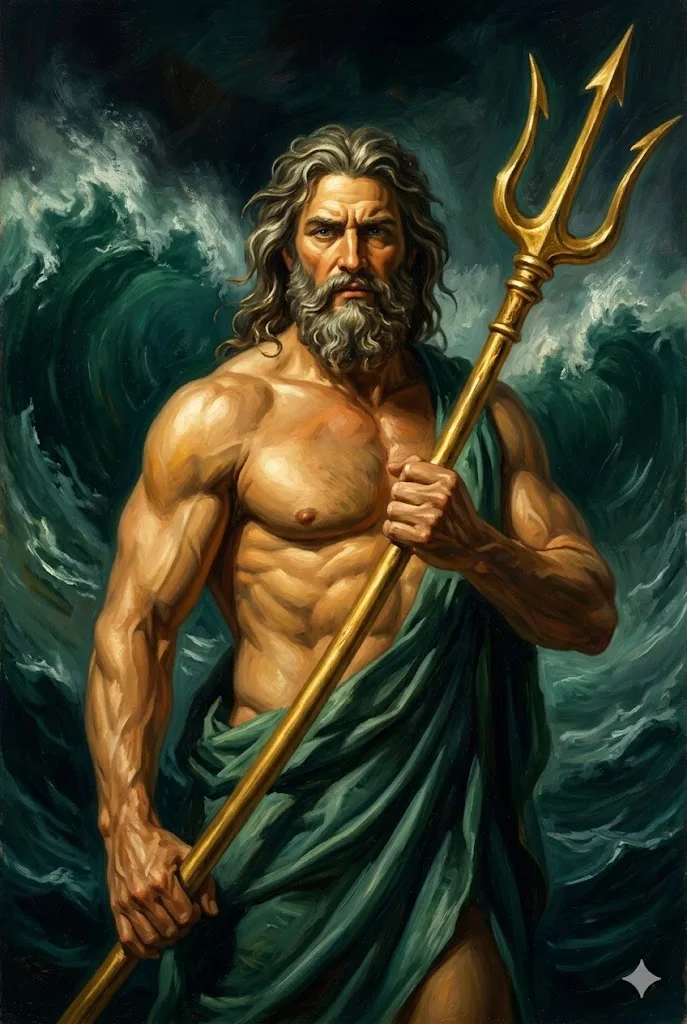
I. Who Was Poseidon?
Poseidon was one of the three supreme gods of Olympus, brother to Zeus and Hades, and absolute ruler of the world's oceans, rivers, and waterways. The ancient Greeks called him the "Earth-Shaker" for his terrifying ability to cause earthquakes by striking the ground with his trident, and sailors throughout the Mediterranean offered prayers and sacrifices to him before every voyage.
Though second to Zeus in the divine hierarchy, Poseidon was no less powerful in his own domain. His mood determined whether the seas were calm or catastrophic. A pleased Poseidon granted fair winds and safe passage; an angry Poseidon sent hurricanes, tidal waves, and sea monsters to destroy those who had earned his wrath. He was proud, volatile, and deeply jealous of his brother's supreme authority — a tension that surfaces throughout Greek mythology.
Beyond the sea, Poseidon held a surprising secondary domain: horses. The Greeks credited him with creating the first horse, either by striking a rock with his trident or through his union with Demeter while both were in equine form. Horse races and chariot competitions were held in his honor, and he was worshipped as Poseidon Hippios — Poseidon of the Horses — at sanctuaries across the Peloponnese.
II. Origins & the Titanomachy
Like his siblings, Poseidon was swallowed by his father Cronus at birth. He remained trapped inside the Titan king until Zeus, the youngest brother who had escaped this fate, forced Cronus to regurgitate his children. Once freed, Poseidon joined the decade-long war against the Titans known as the Titanomachy.
During this war, the Cyclopes — ancient one-eyed giants freed from Tartarus by Zeus — forged three weapons of immense power for the three brothers. Zeus received his thunderbolts, Hades received the Helm of Darkness, and Poseidon received the Trident: a three-pronged spear capable of shattering any object, summoning storms, and causing the earth itself to split open.
After the Titans were defeated and imprisoned in Tartarus, the three brothers drew lots to divide the cosmos. Zeus drew the sky, Hades drew the underworld, and Poseidon drew the sea. The earth remained shared territory, though this arrangement was a frequent source of conflict between the brothers, particularly between Poseidon and Zeus.
III. Powers & Symbols
Poseidon's power was vast and terrifying. With a single blow of his trident, he could call forth springs from barren rock, raise islands from the ocean floor, or send earthquakes rippling across entire continents. He commanded all sea creatures, from the smallest fish to the most fearsome sea monsters, and he rode across the waves in a golden chariot pulled by hippocampi — creatures with the head and forelegs of a horse and the tail of a fish.
His palace lay deep beneath the Aegean Sea, near the island of Euboea, built of shimmering coral and precious gems. When he traveled across the surface of the water, the waves themselves parted before him, and sea creatures leaped joyfully in his wake. Ancient art consistently depicts him as a powerful, bearded figure — similar in appearance to Zeus but distinguished by his trident and his association with marine creatures, particularly the dolphin and the horse.
IV. Family & Offspring
Poseidon's wife was Amphitrite, a Nereid (sea nymph) and granddaughter of the Titan Oceanus. According to myth, she initially fled from his advances, but was persuaded to return by the dolphin Delphinus, whom Poseidon rewarded by placing among the stars as a constellation. Together they had a son, Triton, a merman who served as his father's herald, calming the waves by blowing through a conch shell.
Like Zeus, Poseidon had many other children through various relationships. His offspring were often monstrous or gigantic, reflecting his raw, untamed nature. The Cyclops Polyphemus, who trapped Odysseus in his cave, was Poseidon's son. So too were the giant Orion, the winged horse Pegasus (born from Medusa's blood after Perseus slew her), and Theseus, the legendary king of Athens. The ocean itself seemed to echo his wild, unpredictable character through his descendants.
V. Major Myths
The Contest for Athens
One of Poseidon's most famous myths is his rivalry with Athena for patronage of the city of Athens. Both gods desired to be the city's protector, so they agreed to a contest: each would offer a gift to the people, and the citizens would choose the better one. Poseidon struck the rock of the Acropolis with his trident and produced a saltwater spring (or, in some versions, the first horse). Athena planted an olive tree. The citizens chose Athena's gift, and the city was named in her honor. Poseidon, furious at the rejection, flooded the surrounding plains in retaliation.
The Wrath Against Odysseus
Poseidon's grudge against the hero Odysseus is one of the central driving forces of Homer's Odyssey. After Odysseus blinded Poseidon's son Polyphemus the Cyclops to escape his cave, the sea god pursued him with relentless vengeance across the Mediterranean for ten years, sending storm after storm to prevent his return home to Ithaca. Only the intervention of Athena and Zeus finally allowed Odysseus to complete his journey.
Building the Walls of Troy
Poseidon and Apollo were once punished by Zeus and forced to serve the mortal King Laomedon of Troy. Together, the two gods built the legendary walls of Troy — walls so strong they were considered impregnable. When Laomedon refused to pay the promised reward, Poseidon sent a terrible sea monster to ravage the coastline. This betrayal planted the seeds of Poseidon's hatred for Troy, which would influence his role in the Trojan War, where he fought fiercely on the side of the Greeks.
"I am Poseidon, shaker of the earth, and I do not intend to let any mortal escape my wrath." — Homer, The Odyssey (paraphrased)
VI. Worship & Temples
Poseidon was worshipped throughout the Greek world, particularly in coastal cities and among seafaring communities. His most important sanctuary was at Cape Sounion, on the southern tip of Attica, where the ruins of his temple still stand dramatically overlooking the Aegean Sea. Sailors passing the cape would offer prayers and libations for safe voyages.
The Isthmian Games, held every two years near Corinth, were sacred to Poseidon and second in prestige only to the Olympic Games. Corinth, as a major port city controlling trade routes between the Aegean and Adriatic seas, had a particularly strong cult of Poseidon. His Roman equivalent, Neptune, became equally important in Roman maritime culture and gave his name to the eighth planet in our solar system.
Poseidon in Classical Literature
In Homer's Odyssey, Poseidon is the primary antagonist — the divine force that prevents Odysseus from reaching home for ten years. After Odysseus blinds the Cyclops Polyphemus, Poseidon's son, the sea god pursues the hero with relentless fury, sending storms, shipwrecks, and sea monsters to block his journey. Homer's portrayal reveals Poseidon as a god who holds grudges and whose wrath, once provoked, is nearly impossible to appease. The entire Odyssey can be read as the story of one mortal's struggle against the implacable anger of the sea.
In the Iliad, Poseidon supports the Greeks against Troy — partly because the Trojan king Laomedon had once cheated him of payment for building Troy's walls. Poseidon intervenes directly in battle, inspiring Greek warriors and even fighting alongside them, though he must do so carefully to avoid Zeus's prohibition against divine interference. His defiance of Zeus's authority throughout the Iliad hints at the deep rivalry between the two brothers — a tension that reflects the ancient Greek understanding of the sea as a force that no authority, even divine kingship, can fully control.
The Contest for Athens
One of the most famous myths involving Poseidon was his competition with Athena for the patronage of the city that would become Athens. Both gods desired the city's worship, and Zeus decreed that each should offer the citizens a gift — the one who gave the more useful gift would win. Poseidon struck the Acropolis with his trident and produced a saltwater spring (or, in some versions, the first horse). Athena planted an olive tree. The citizens judged Athena's gift superior, as the olive provided food, oil, and wood. The city was named Athens, and Poseidon, furious at his defeat, flooded the surrounding plain in retaliation.
This myth reflects a genuine historical tension in ancient Athens between maritime power (Poseidon's domain) and agricultural civilization (Athena's domain). Athens ultimately became both a great naval power and an agricultural society, suggesting that in practice, the Athenians honoured both deities — they simply gave Athena pride of place.
Worship and Sacred Sites
Poseidon's most important sanctuary was at Isthmia, near Corinth, where the Isthmian Games were held every two years in his honour. He was also worshipped at Cape Sounion at the southern tip of Attica, where the dramatic ruins of his temple still stand overlooking the Aegean Sea — one of the most photographed ancient sites in Greece. Sailors departing Athens would see this temple as the last landmark before the open sea, and returning sailors would see it as the first sign of home.
As "Poseidon Hippios" (Poseidon of Horses), he was credited with creating the first horse — either by striking a rock with his trident or by his union with Demeter when both had taken the form of horses. Horse races were a central feature of his festivals, and he was the patron of charioteers and cavalry. The connection between the god of the sea and the horse seems paradoxical, but the ancient Greeks saw the crashing waves as resembling galloping white horses — an image that persists in the English term "white horses" for wave crests.
VII. Quick Facts
Poseidon Before Zeus: The Bronze Age Evidence
Poseidon may be the oldest of the major gods to be clearly attested in Greek. Linear B tablets from the Mycenaean palace at Pylos, written around 1200 BC, record offerings to Po-se-da-o more often than to Zeus, along with a sanctuary called the Posidaion. A goddess named Posidaeja, apparently a female counterpart, appears too. This fits Homer surprisingly well: when Telemachus arrives at Pylos in Book 3 of the Odyssey, he finds Nestor's people on the beach sacrificing black bulls to Poseidon in nine great companies. Many scholars think Poseidon's earliest role was as an earth god and lord of horses, and that his dominion over the sea became central later. His Homeric epithets support this: Ennosigaios and Enosichthon, "earth-shaker," and Gaieochos, "earth-holder," say nothing about water.
A God Who Lost Contests
The contest with Athena for Athens is only one of a series of disputes over cities, and Poseidon lost or split almost all of them. Pausanias and Plutarch record several:
- Corinth: Poseidon contested it with Helios. The hundred-handed Briareus judged, giving the Isthmus to Poseidon and the citadel of Acrocorinth to Helios. This is why Poseidon's games were held at the Isthmus. See Corinth.
- Argos: the river Inachus and his fellow river gods awarded the land to Hera. In anger Poseidon dried up their streams, which Pausanias offers as the reason the rivers of the Argolid have no water except after rain. See Argos.
- Troezen: he and Athena were ordered by Zeus to share it.
- Aegina and Naxos: he lost Aegina to Zeus and Naxos to Dionysus.
On the Athenian Acropolis, the contest left physical traces that visitors were shown for centuries: a "sea" of salt water and the marks of the trident in the rock inside the Erechtheion, where Poseidon was worshipped together with the hero Erechtheus. For other aspects of these rivalries, see Poseidon vs Athena and Zeus vs Poseidon.
Lesser-Known Myths
Demeter, Arion and Despoina. Pausanias records an Arcadian story from Thelpusa: while searching for her daughter, Demeter took the form of a mare to escape Poseidon, who became a stallion and mated with her. She bore the immortal horse Arion and a daughter whose name could be revealed only to initiates, called simply Despoina, the Mistress. Demeter's fury at the assault earned her the title Erinys at Thelpusa.
Pelops and the winged chariot. Pindar's first Olympian ode tells how Poseidon loved the young Pelops and later gave him a golden chariot drawn by winged horses, with which Pelops won the race against King Oenomaus and with it his bride Hippodamia.
Caenis and Caeneus. Ovid tells how Poseidon raped the Thessalian woman Caenis and then granted her a wish; she asked to become a man who could never suffer such harm again, and became the invulnerable warrior Caeneus, later crushed under tree trunks by the centaurs.
The bull of Minos. Poseidon sent King Minos a white bull from the sea to be sacrificed. When Minos kept it, Poseidon made Pasiphaë desire the bull, and the Minotaur was the result.
The end of the quarrel with Odysseus. Homer gives the anger a specific resolution. Tiresias tells Odysseus that after he reaches home he must carry an oar inland until he meets people who know nothing of the sea and mistake it for a winnowing fan; there he is to sacrifice a ram, a bull and a boar to Poseidon. Before that, Poseidon takes out his anger on the Phaeacians, turning their ship to stone as it comes back into harbour after delivering Odysseus to Ithaca.
Sanctuaries and Earthquakes
Beyond Sounion and Isthmia, Poseidon had several important sanctuaries. The island of Kalaureia (modern Poros) was the seat of an early league of cities devoted to him, and the orator Demosthenes took poison in his temple there in 322 BC rather than surrender to the Macedonians. Onchestus in Boeotia had a grove where, according to the Homeric Hymn to Apollo, a newly broken colt was let loose with an empty chariot, a ritual tied to Poseidon as tamer of horses. The Panionion on Mount Mycale was the common sanctuary of the Ionian Greeks, dedicated to Poseidon Helikonios.
The Greeks took his title of earth-shaker literally. In 373 BC the city of Helike in Achaea was destroyed in a single night by an earthquake and a wave from the sea, and ancient writers blamed Poseidon's anger, saying the inhabitants had driven out suppliants from his sanctuary. The Spartans believed a great earthquake around 464 BC was punishment for dragging helots from his temple at Taenarum.
Poseidon's other children are discussed in the children of Poseidon.
Ancient sources
- Homer, Iliad 13.10–38 and 15.184–199 — Poseidon drives his chariot from Aegae to help the Greeks, and states that the three brothers divided the world by lot, with earth and Olympus held in common.
- Homer, Odyssey 3.1–8, 11.119–137 and 13.125–187 — the Pylian sacrifice to Poseidon, Tiresias' instructions for appeasing him, and the petrified Phaeacian ship.
- Homeric Hymn to Apollo and Homeric Hymn 22 — the horse ritual at Onchestus, and a short hymn to Poseidon as earth-shaker, tamer of horses and saviour of ships.
- Pindar, Olympian 1 — Poseidon's love for Pelops and the gift of the winged chariot.
- Pausanias, Description of Greece 1.26, 2.1, 2.15 and 8.25 — the trident marks in the Erechtheion, the contests over Corinth and Argos, and the birth of Arion and Despoina.
- Ovid, Metamorphoses 12.189–209 — the story of Caenis transformed into Caeneus.
Frequently asked questions
Was Poseidon more powerful than Zeus?
No. In the Iliad Poseidon claims equal rank as a brother who drew his share by lot, but he backs down when Zeus orders him off the battlefield. He was second to Zeus in authority, though not always in temper.
Why is Poseidon god of horses?
His horse connection may be older than his sea connection. He was said to have fathered the first horses, was worshipped as Poseidon Hippios, and was honoured with chariot races, perhaps because Bronze Age Greeks linked horses with the power of the earth.
Where did Poseidon live?
Homer places his golden palace in the depths of the sea at Aegae. He also had a seat on Olympus as one of the twelve gods.
Who was Poseidon's favourite city?
Corinth, with its Isthmian sanctuary, has the strongest claim. He also had deep roots in Pylos, Troezen and Onchestus, despite losing Athens to Athena.
Explore More Mythology
Get weekly deep dives into the gods, heroes, and myths of ancient Greece.