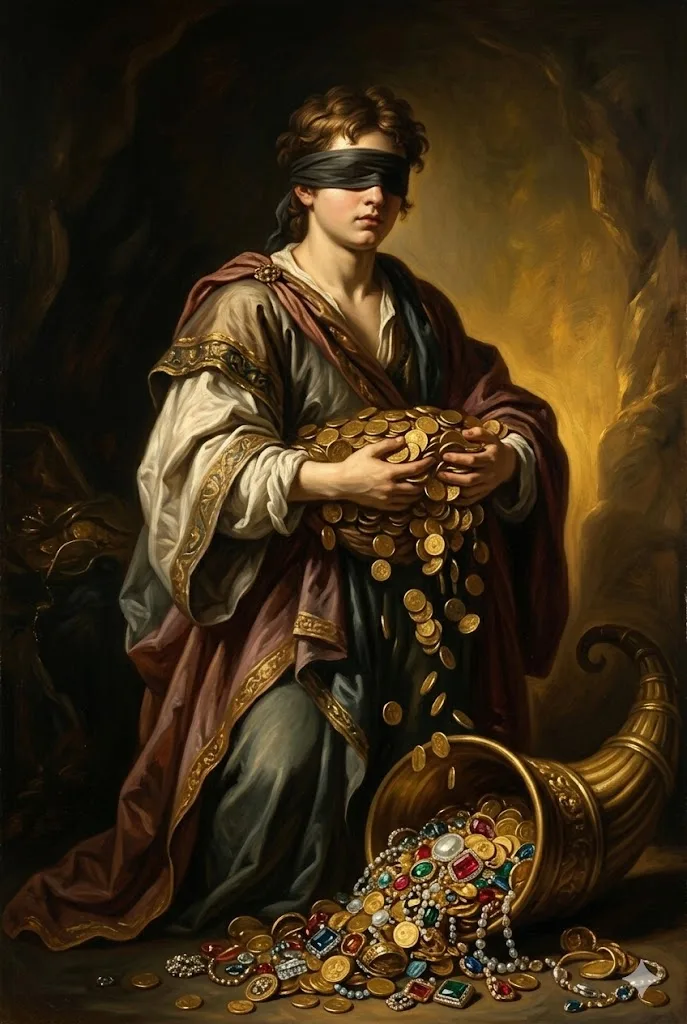
The Blind God of Riches
Plutus was the Greek god of wealth, riches, and agricultural abundance. Son of the goddess Demeter and the mortal hero Iasion, he was originally a deity of bountiful harvests — the wealth that sprang from fertile soil. But his story took a darker turn when Zeus, fearing that Plutus would distribute riches only to the virtuous and deserving, blinded him so that wealth would fall upon people randomly, without regard to their moral character. This single mythological detail encapsulated one of the most profound observations in Greek thought: that wealth has nothing to do with virtue.
Birth on Crete
Plutus was conceived when Demeter lay with Iasion in a thrice-ploughed field on the island of Crete during the wedding feast of Cadmus and Harmonia. The detail of the thrice-ploughed field was significant — it connected Plutus directly to agriculture, specifically to the most productive, most carefully tended farmland. Zeus, enraged that a mortal had lain with an immortal goddess, struck Iasion dead with a thunderbolt. But the child survived, and Plutus grew to embody the wealth that the earth itself produces. In this sense, he was the most democratic of gods: his gifts came from the ground beneath everyone's feet.
Aristophanes' Comedy
Plutus received his most famous treatment in Aristophanes' comedy Plutus (388 BC), the playwright's last surviving work. In the play, an honest Athenian named Chremylus encounters the blind god wandering the roads. He takes Plutus to the temple of Asclepius, where the god's sight is restored. With his vision returned, Plutus begins distributing wealth only to good people. The results are both comic and profound: the honest prosper, the wicked are ruined, and even the gods find themselves without offerings because humans no longer need divine favor. The play raises questions that remain relevant: what would happen if wealth actually went to those who deserved it?
Plutus vs. Pluto
Plutus should not be confused with Pluto (Plouton), a title of Hades as lord of the underworld. However, the two were sometimes deliberately conflated in ancient thought. The wealth of Plutus came from the earth's surface (harvests, crops), while the wealth of Pluto came from beneath the earth (minerals, gems, precious metals). Both forms of wealth emerged from the ground, and the Greeks saw a deep connection between the richness of the soil and the riches hidden below it. The name Plouton itself means 'the wealthy one,' reflecting the ancient belief that the lord of the dead was also the lord of all treasures buried in the earth.
Classical Sources
- 📜 Hesiod, Theogony (c. 700 BC)
- 📜 Aristophanes, Plutus (388 BC)
- 📜 Homer, Odyssey (c. 750 BC)
- 📜 Apollodorus, Bibliotheca
Cross-referenced with multiple classical sources for accuracy.
Explore More
Demeter · Hades · Persephone · Home
Plutus in Hesiod and the Eleusinian World
Hesiod's few lines on Plutus describe a god who travels, not one who sits on a treasure. Demeter, he says, bore Plutus after lying with Iasion in a thrice-ploughed fallow field in the rich land of Crete, "a kindly god who goes over all the earth and the broad back of the sea, and whoever meets him, into whose hands he comes, he makes rich and gives him great prosperity." Homer's Odyssey mentions the same union of Demeter and Iasion, in Calypso's complaint that the gods begrudge goddesses their mortal lovers, and adds that Zeus learned of it and killed Iasion with a thunderbolt; Homer does not mention a child.
Plutus mattered most in the religion of Eleusis. The Homeric Hymn to Demeter ends by promising that anyone whom Demeter and Persephone love will be blessed, for they send Plutus to his house as a guest at his hearth, "who gives wealth to mortal men." In this setting Plutus is grain itself, the stored harvest that keeps a household alive through winter. Attic vase painters of the fourth century often show him as a small boy holding a cornucopia, sometimes rising out of the earth among the Eleusinian deities, sometimes held by Demeter or by Gaia. For the rites behind these images, see the Eleusinian Mysteries.
Why Wealth Is Blind
The blindness of Plutus is older than Aristophanes. The sixth-century iambic poet Hipponax grumbles that Plutus has never once come to his house, because he is completely blind. The joke shows that by then "blind wealth" was already a proverb: riches fall on people with no regard to merit. Aristophanes made the blindness a punishment from Zeus, imposed so that Plutus could not reward only the good.
Aristophanes' play also introduces a character who rarely gets mentioned: Penia, Poverty. When Chremylus plans to cure Plutus, Penia appears and argues, more persuasively than the comic setting suggests, that she is the source of all human effort. If everyone were rich, she asks, who would work as smith, shipwright or farmer? Chremylus drives her off rather than refuting her. Late in the play Hermes himself arrives, starving because no one sacrifices any more, and asks for a job in the new household. The theme of wealth and its unfair distribution returned in Lucian's dialogue Timon, where Zeus sends Plutus, with Hermes as guide, back to the impoverished misanthrope Timon. Plutus complains that he is lame when he goes to good men, because he arrives slowly, but winged when he leaves.
The elegiac poet Theognis also addresses Plutus directly, calling him the most beautiful and desirable of gods and admitting that with him a bad man becomes good, a bitter line about how wealth confers status.
Plutus in Sculpture: Peace and Fortune
The best-known image of Plutus is a statue group by Kephisodotos, made in Athens in the 370s BC and known today from Roman copies, the finest in the Munich Glyptothek. It shows Eirene, Peace, holding the infant Plutus on her arm. Pausanias saw it in the Athenian Agora, and the message is clear: prosperity is the child of peace. Pausanias also describes a statue at Thebes of Tyche, Fortune, carrying Plutus as a child, and comments that it was a clever idea to place Wealth in the arms of Fortune as his mother or nurse. He adds that the Athenian Eirene with Plutus was conceived in the same spirit. Together these statues show how Greeks thought of wealth as a child who must be carried and protected by peace and luck.
Later Afterlife and Common Mistakes
Dante placed a monstrous Pluto, usually understood as Plutus the wealth-demon, at the entrance to the fourth circle of Hell, guarding the misers and spendthrifts and shouting the famous unintelligible line "Papé Satàn, papé Satàn aleppe." In English the god survives in "plutocracy," government by the wealthy.
The most frequent confusion, mixing him up with Pluto, is covered above, but two others are worth noting. Plutus is not a god of money in the sense of coinage or trade; that territory belongs more to Hermes. And the scene of his cure in Aristophanes takes place in a sanctuary of Asclepius through the ritual of incubation, sleeping in the temple to be healed, which makes the play a valuable source for how real Athenian healing cults worked.
Ancient sources
- Hesiod, Theogony 969–974 — Plutus born to Demeter and Iasion in a thrice-ploughed field on Crete, travelling over land and sea and enriching those he meets.
- Homeric Hymn to Demeter 486–489 — the goddesses send Plutus as a guest to the hearth of those they favour.
- Homer, Odyssey 5.125–128 — Demeter's union with Iasion and his death by Zeus's thunderbolt.
- Aristophanes, Plutus — the blind god cured at Asclepius' sanctuary, the debate with Penia, and Hermes' defection.
- Lucian, Timon — Plutus, Hermes and Penia in a comic dialogue about who deserves riches.
- Pausanias, Description of Greece 1.8 and 9.16 — the statues of Eirene with Plutus in Athens and Tyche with Plutus in Thebes.
Frequently asked questions
Why is Plutus blind?
Because wealth seems to come to people without regard for their character. Aristophanes says Zeus blinded him to stop him rewarding only the just; Hipponax already called him blind a century and a half earlier.
Who were Plutus's parents?
Demeter and the mortal Iasion, according to Hesiod. Some later writers give Iasion's brother as Dardanus, which links Plutus to the royal line of Troy.
Are Plutus and Pluto the same god?
No. Plutus is wealth, a son of Demeter; Pluto is a name for Hades. The names share the Greek root for wealth, and ancient writers sometimes played on the connection.
What does "plutocracy" mean?
Rule by the rich, from ploutos, wealth, and kratos, power.