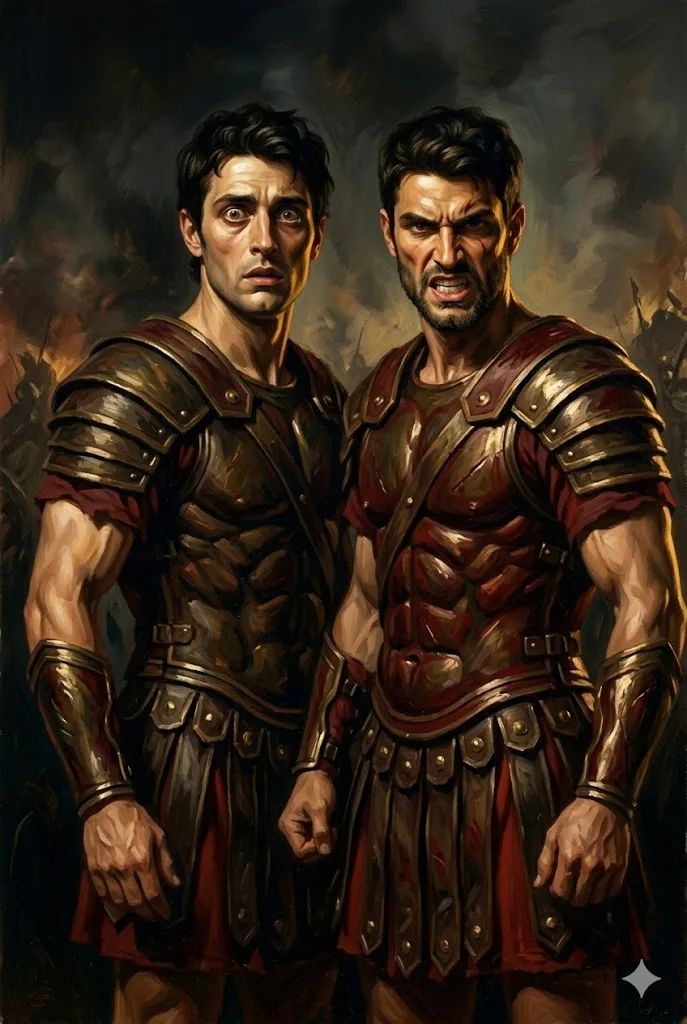
Sons of War and Love
Phobos (Fear) and Deimos (Terror) were the twin sons of Ares, god of war, and Aphrodite, goddess of love. They accompanied their father into every battle, driving his chariot and spreading panic through enemy ranks. Phobos represented the fear that grips you before a fight, the dread that makes your hands shake and your legs feel weak. Deimos was the terror of the battle itself, the screaming chaos and confusion that overwhelms rational thought.
The pairing of their parents is significant. That Fear and Terror are born from the union of War and Love tells us something the Greeks understood deeply: the things we love most are the things we are most afraid to lose. The soldier on the battlefield is not afraid of death in the abstract. He is afraid because he loves his life, his family, his home. Fear and love are not opposites. They are twins.
In the Iliad
Homer describes Phobos and Deimos preparing Ares's chariot for war. They are not characters with their own storylines but rather extensions of their father's power, the emotional weapons he deploys alongside the physical ones. When Ares enters the battlefield, Fear and Terror clear the path before him. Enemy warriors break and flee not because they are physically overpowered but because Phobos and Deimos have already destroyed their will to fight.
The Moons of Mars
When two small, irregularly shaped moons were discovered orbiting Mars in 1877, they were named Phobos and Deimos. The naming was perfect: Mars is the Roman name for Ares, and his two tiny attendants orbit him forever, just as they did in Homer. Phobos is slowly spiraling inward and will eventually either crash into Mars or break apart to form a ring, a fate that feels appropriately mythological.
Classical Sources
- 📜 Homer, Iliad & Odyssey (c. 750 BC)
- 📜 Hesiod, Theogony (c. 700 BC)
- 📜 Apollodorus, Bibliotheca (c. 1st-2nd century AD)
- 📜 Ovid, Metamorphoses (8 AD)
Cross-referenced with multiple classical sources for accuracy.
Explore More
Ares · Aphrodite · Trojan War · Home