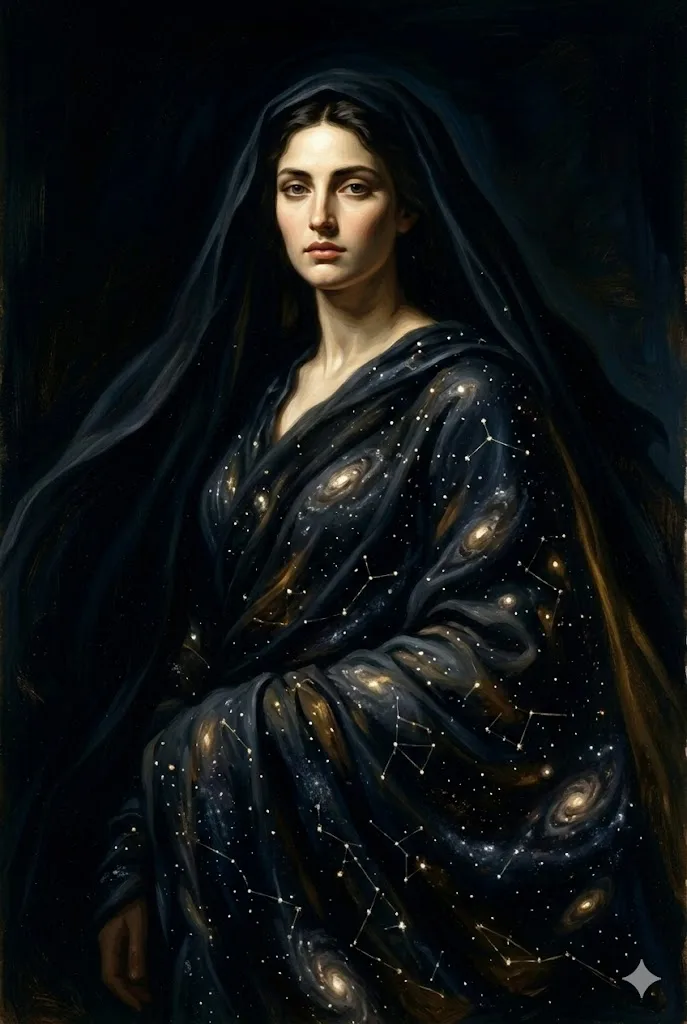
The Goddess Even Zeus Feared
Nyx was the primordial goddess and personification of the Night — one of the first beings to emerge from Chaos at the very dawn of creation. She was among the most ancient and powerful forces in Greek cosmology, predating the Titans and the Olympians alike. So formidable was Nyx that even Zeus, king of the gods, feared to displease her — a distinction shared by no other deity in the Greek pantheon.
In Homer's Iliad, this extraordinary detail emerges when Zeus considers punishing Hypnos (Sleep), who had tricked him. Hypnos fled to his mother Nyx for protection, and Zeus, despite his rage, relented — for he did not wish to do anything that would anger Night. This brief but remarkable passage reveals that even the supreme ruler of Olympus recognized limits to his power when confronted with the primordial forces of the cosmos.
Origins
According to Hesiod's Theogony, Nyx was born from Chaos — the yawning void that existed before all things. She was a sibling or near-contemporary of Erebus (Darkness), Gaia (Earth), Tartarus (the Abyss), and Eros (Love). From Nyx and Erebus came Aether (Upper Air) and Hemera (Day) — light born paradoxically from the union of darkness and night. This cosmological detail encapsulates a profound Greek philosophical insight: that light cannot exist without darkness, and that creation requires the interplay of opposing forces.
The Children of Night
Nyx's offspring constitute some of the most powerful and feared forces in Greek mythology. Many she bore alone, without a partner — dark emanations of her own being. Her children included Thanatos (Death) and his twin Hypnos (Sleep), the Moirai (the three Fates who controlled every mortal's destiny), Nemesis (Retribution), Eris (Strife and Discord), the Keres (spirits of violent death), Moros (Doom), Apate (Deceit), Oizys (Misery), Philotes (Affection), Geras (Old Age), and the Oneiroi (Dreams).
This terrifying catalogue reveals how the Greeks understood the night as the source of nearly everything that haunts the human condition. Death, fate, conflict, aging, deception, and suffering all emerged from Night's realm. But so too did Sleep and Dreams — reminders that the darkness also brings rest, imagination, and the possibility of prophecy. Nyx embodied the full, unresolved complexity of what happens when the light goes out.
Nyx in Cosmology
In the Orphic traditions — the mystical religious movement associated with the poet Orpheus — Nyx played an even more exalted role. The Orphic cosmogony placed Nyx at the very beginning of creation: from an egg laid by Nyx emerged Phanes, the first god, who then set the creation of the universe in motion. In this tradition, Nyx was not merely one of several primordial forces but the ultimate source from which all existence flowed.
Nyx dwelt in a palace in the far west, at the edge of the world where the sun sets. Each evening, she emerged in her dark chariot — drawn by black horses — to draw her veil of shadow across the sky. As she rode forth, her daughter Hemera (Day) returned home; when Hemera emerged at dawn, Nyx retreated. Mother and daughter were said to pass each other at the threshold of their shared palace, never occupying the world at the same time.
Modern Legacy
Nyx has experienced a cultural renaissance in recent years. She appears as a powerful figure in Rick Riordan's Percy Jackson series, the video game Hades, and numerous fantasy novels. Her name has been adopted by cosmetics brands, musical projects, and astronomical objects. The enduring appeal of Nyx lies in what she represents: the vast, ungovernable mystery of darkness — beautiful, terrifying, and ultimately beyond even the gods' control.
The House of Night at the Edge of Tartarus
Hesiod gives Night a precise address, and it is not a pleasant one. In a later passage of the Theogony he describes the far boundary of the world beside Tartarus: there stands "the dread house of murky Night, wrapped in dark clouds," and before it Atlas holds up the sky. Night and Day approach each other there and exchange greetings as they pass over a great bronze threshold; one goes down into the house as the other goes out, and the house never holds both at once. Day carries light for mortals, while Night carries Sleep in her arms, "deadly Night, veiled in mist." In the same neighbourhood live her sons Hypnos and Thanatos, whom the shining sun never looks on.
Later poets turned this geography into a chariot ride. In Euripides' Ion, a tapestry shows Night driving her chariot across the sky in black robes, with the stars following her, and Roman writers such as Virgil speak of Nox rising from Ocean. The image of Night as a charioteer is real, but it belongs mostly to tragedy and later poetry rather than to Hesiod.
Night as Oracle and Mother of the World
Several competing creation stories gave Nyx a higher rank than Hesiod does. In Aristophanes' Birds, the chorus parodies a cosmogony in which "black-winged Night" lays a wind-egg in the depths of Erebus, and from it springs golden-winged Eros, who then sets the rest of creation going. The joke only works because audiences recognised the pattern from religious poetry.
That poetry survives in fragments of the Orphic theogonies. In these versions Night is not simply an early goddess but a source of wisdom and continuity between the generations of gods. She is said to give oracles from a cave, and when Zeus comes to power he consults her about how to establish his rule over the cosmos. The Derveni papyrus, the oldest surviving Greek book, a fourth-century BC commentary on an Orphic poem, calls Night the "immortal nurse of the gods" who prophesies from her inner sanctuary. The pseudo-Orphic Hymn to Night, from the Roman imperial period, addresses her as mother of gods and men.
The oracular Night was not only literary. Pausanias saw an "oracle of Night" on the acropolis of Megara, one of very few recorded places where she had anything like a cult. Ordinary Greeks seem not to have built temples to her; she received offerings mainly in the context of mystery religion and occasional sacrifices of black animals, a standard offering to dark powers.
Nyx in Ancient Art
Night is rarely labelled in Greek art, but a few images are secure. Pausanias describes the Chest of Cypselus at Olympia, an elaborately carved archaic chest, on which a woman held two sleeping children: a white one, Sleep, and a black one, Death, with their feet twisted. An inscription named her as Night. On the great Altar of Zeus at Pergamon, whose Gigantomachy frieze is now in Berlin, a goddess identified as Nyx takes part in the war against the Giants, hurling a vessel wrapped by a snake at her opponent. On vases, Nyx sometimes appears as a veiled woman driving a chariot down towards the sea as Helios rises, the reverse of the dawn scenes more often painted for Eos.
What People Often Get Wrong
Nyx is not the first being in Hesiod. Chaos comes first; Gaia, Tartarus and Eros follow, and only then does Chaos produce Erebus and Night. The idea that Night is the very first principle belongs to the Orphic and other alternative cosmogonies. She is also not the wife of Zeus, nor a figure of evil. Her children include the Fates, Eris and Nemesis, but also Philotes (Affection) and the Hesperides in some lists. Hesiod's catalogue is less a list of horrors than a map of everything that lies outside human control. For the wider sequence of primordial beings, see the Greek creation myth.
Ancient sources
- Hesiod, Theogony 123–125, 211–232 and 744–766 — Nyx's birth from Chaos, her children with and without Erebus, and the house of Night where Night and Day pass on the bronze threshold.
- Homer, Iliad 14.256–261 — Hypnos recalls fleeing to Night, "subduer of gods and men," and Zeus holding back his anger out of respect for her.
- Aristophanes, Birds 693–702 — black-winged Night lays a wind-egg in Erebus from which Eros is born.
- Derveni papyrus and the Orphic fragments — Night as nurse of the gods and giver of oracles who advises Zeus.
- Pausanias, Description of Greece 1.40 and 5.18 — the oracle of Night at Megara and the image of Night with Sleep and Death on the Chest of Cypselus.
Frequently asked questions
Why was Zeus afraid of Nyx?
Homer does not explain it, only that Zeus would not do anything displeasing to "swift Night." The likeliest reading is that Night is older than Zeus and outside the order he controls; even the king of the gods respected the primordial powers.
Who is Nyx's husband?
Erebus, the primordial Darkness, with whom she had Aether and Hemera. Most of her other children she produced alone.
What is the Roman name for Nyx?
Nox. She plays a similar role in Latin poetry but had little independent cult in Rome.
Is Nyx the mother of the Fates?
In Hesiod's list of Night's children, yes. Elsewhere in the same poem, though, the Moirai are daughters of Zeus and Themis, so Hesiod himself preserves two traditions.
Explore More
Thanatos · Nemesis · Hades · Persephone · Home
Join the Pantheon
Weekly mythology stories & deep dives delivered to your inbox.