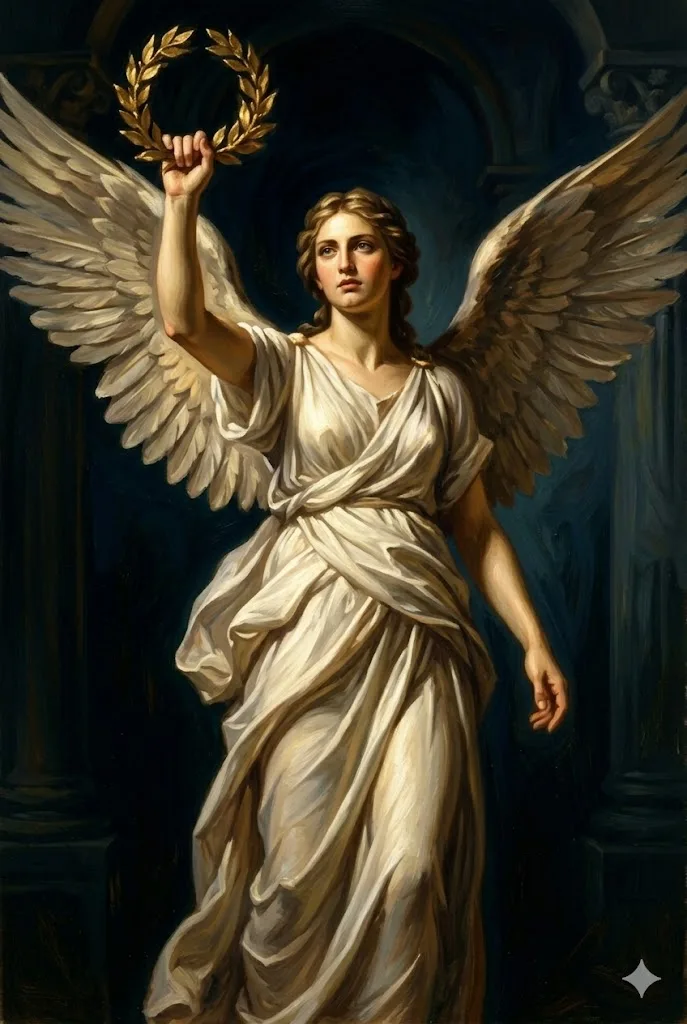
Who Was Nike?
Nike was the divine personification of victory in Greek mythology. She presided over every form of triumph — from athletic competitions to military conquests and artistic achievements. Wherever success was celebrated, Nike was believed to be present, bestowing her favor upon the worthy.
Depicted as a beautiful woman with magnificent wings, Nike could move swiftly between the mortal and divine realms, carrying the laurel wreath of victory to those chosen by the gods. She became one of the most frequently represented figures in ancient Greek art, from coins and pottery to monumental sculpture.
Origins and Family
Nike was the daughter of the Titan Pallas and the Oceanid Styx, the goddess of the great underworld river. Her siblings were equally formidable personifications: Zelus represented zeal and rivalry, Kratos embodied strength and power, and Bia personified force and raw energy. Together, these four siblings served as the attendants and enforcers of Zeus himself.
When the Olympian gods went to war against the Titans in the great conflict known as the Titanomachy, Styx brought her four children to fight alongside Zeus. This was a crucial alliance, and Zeus rewarded them by keeping them eternally at his side on Olympus. Nike in particular became his constant companion, standing or flying beside his throne as a symbol of his invincible authority.
Nike and Athena
Nike shared a deep connection with Athena, the goddess of wisdom and strategic warfare. In Athens, Nike was frequently worshipped alongside Athena under the combined title "Athena Nike" — Athena the Victorious. A beautiful Ionic temple dedicated to Athena Nike still stands on the Acropolis in Athens, perched on a bastion overlooking the city.
According to one Athenian tradition, the statue of Athena Nike in this temple was depicted without wings — a unique departure from Nike's usual iconography. The Athenians called her "Apteros Nike" (Wingless Victory), claiming they had removed her wings so that Victory could never fly away from their city. This charming folk legend reveals how deeply the ancient Greeks valued the concept of lasting triumph.
The Winged Victory of Samothrace
The most famous ancient depiction of Nike is the breathtaking marble sculpture known as the Winged Victory of Samothrace, created around 190 BC. Standing over eight feet tall atop the prow of a stone ship, this masterpiece captures Nike at the moment of landing, her wings spread wide, her garments pressed against her body by the sea wind. It now stands at the top of the grand staircase in the Louvre Museum in Paris and is considered one of the greatest sculptures ever created.
The sculpture was originally erected on the island of Samothrace to commemorate a naval victory. Despite the loss of its head and arms, the Winged Victory remains extraordinarily powerful — a testament to the enduring artistic legacy of Nike's image.
Nike in the Modern World
Nike's influence extends far beyond the ancient world. The world's most recognizable sportswear company, Nike Inc., takes its name directly from the Greek goddess. The company's famous "Swoosh" logo is said to represent the wing of Nike, and the brand's association with athletic victory perfectly mirrors the goddess's ancient domain. The connection between the ancient deity and the modern brand demonstrates how Greek mythology continues to shape contemporary culture, commerce, and identity.
Symbols and Attributes
Nike is most commonly identified by her great feathered wings, which allowed her to descend swiftly to the mortal world to bestow victory. She typically carries a laurel wreath — the traditional prize awarded to victors in the ancient Olympic Games and other competitions. In some depictions, she holds a palm branch, another ancient symbol of triumph. She is also shown bearing a small statue of herself or a trophy, and occasionally carries a lyre or kithara, reflecting her patronage of musical victories as well.
Worship and Legacy
Nike was honoured throughout the Greek world, particularly in Athens and Olympia. At the great sanctuary of Olympia, where the Olympic Games were held, a magnificent gold and ivory statue of Nike was placed in the hand of the colossal statue of Zeus — one of the Seven Wonders of the Ancient World. This gesture symbolized that all victory ultimately flowed from the king of the gods.
Athletes, generals, and cities all invoked Nike before competitions and battles. Her image appeared on countless coins throughout the Greek and later Roman world, serving as both a religious symbol and a statement of political power. To possess the image of Nike was to claim divine favor and the promise of triumph.
Why Nike Has So Few Myths
Readers looking for adventures of Nike are usually disappointed, and that absence is itself revealing. Nike almost never acts on her own. Hesiod's account in the Theogony is essentially her whole biography: Styx, daughter of Oceanus, bore Zelos, Nike, Kratos and Bia to the Titan Pallas, and when Zeus called on the gods to join him against the Titans, Styx was the first to arrive with her children. Zeus honoured Styx by making her the oath of the gods and kept her children permanently beside him. Hesiod adds that they never have a home or a path apart from Zeus. Victory, in other words, is not a free agent; she belongs to whoever holds supreme power.
In the late epic of Nonnus, Nike appears more actively during Zeus's battle with Typhon, urging him back into the fight while disguised as Leto, but this is an elaboration of a figure who in earlier poetry is mostly an emblem. Poets addressed her directly instead of telling stories about her. Bacchylides opens one victory ode by invoking Nike as giver of sweet gifts, standing beside Zeus and judging the outcome of contests for gods and men alike.
How Nike Got Her Wings, and Who Carved Her
Ancient tradition credited the sixth-century sculptor Archermos of Chios with being the first to give Victory wings. A winged female figure in the "kneeling running" pose, found on Delos and dated around 550 BC, has long been connected with Archermos, and it shows the early way of depicting flight: legs bent sharply as if racing through the air.
Several other major Nikai survive or are well documented:
- The Nike of Paionios at Olympia (c. 420 BC), dedicated by the Messenians and Naupactians after a victory over Sparta. She descends from a tall triangular pillar, drapery blown back against her body, and the base still carries the dedicatory inscription naming the sculptor.
- The parapet of the Athena Nike temple on the Acropolis, carved with a procession of Nikai leading bulls to sacrifice and setting up trophies. The best known slab shows a Nike bending to adjust her sandal, one of the most admired drapery studies of the late fifth century.
- The Athena Parthenos, Pheidias' gold-and-ivory statue in the Parthenon, held a Nike roughly human size on her outstretched right hand, just as the Olympian Zeus did.
The Winged Victory of Samothrace was excavated in 1863 by the French consul Charles Champoiseau; her ship-shaped base was recognised and brought to Paris later, and one of her hands was found on Samothrace in 1950. On painted pottery Nike is a constant presence, pouring libations, carrying ribbons to tie on victors, flying above chariots, and even attending scenes of musical and poetic contest, since a victory at a festival was as much hers as one in war.
The "Wingless Victory" Clarified
The story that Athens clipped Victory's wings so she could never leave is told by Pausanias, who calls the Acropolis shrine the temple of Wingless Victory. Strictly, the cult statue there was Athena Nike, an armed Athena, and ancient lexicographers describe it as holding a pomegranate and a helmet, so it was never a wingless version of Nike herself. Pausanias offers a parallel from Sparta, where the war god Enyalios was shown in chains for the same reason: so that he could never desert the city. The Athenian joke is a later explanation of an old image, not evidence that Nike was normally worshipped without wings.
Victoria in Rome
The Romans worshipped Nike as Victoria and gave her a far more political role. Victoria appears on coinage of almost every emperor, crowning the ruler or standing on a globe. A statue and altar of Victory stood in the Senate House in Rome from the time of Augustus, and its fate became a famous dispute of the late fourth century. The emperor Gratian had the altar removed in 382; in 384 the senator Symmachus petitioned for its return in a celebrated plea for religious tolerance, and Bishop Ambrose of Milan successfully argued against him. The quarrel over a statue of Victory marks one of the last public stands of traditional Roman religion.
For the ancient roots of the modern sportswear name, see Greek mythology in brands; for the war in which Nike chose her side, see the Titanomachy.
Ancient sources
- Hesiod, Theogony 383–403 — Nike's parentage by Pallas and Styx, and how Styx brought her children to Zeus first, earning them a permanent place at his side.
- Bacchylides, Ode 11 — opens with an invocation of Nike as the goddess who stands beside Zeus and judges excellence.
- Pausanias, Description of Greece 1.22 and 3.15 — the temple of Wingless Victory in Athens and the chained Enyalios of Sparta.
- Pausanias, Description of Greece 5.11 and 5.26 — the Nike held by Pheidias' Zeus at Olympia, and the Messenian dedication by Paionios.
- Symmachus, Relatio 3, and Ambrose, Letters — the late Roman debate over restoring the Altar of Victory to the Senate.
Frequently asked questions
Who were Nike's parents and siblings?
Her parents were the Titan Pallas and the Oceanid Styx. Her siblings were Zelos (Rivalry), Kratos (Power) and Bia (Force), all of whom attend Zeus.
Is Nike the same as Athena?
No. They were closely linked, and Athena was worshipped as Athena Nike, but Nike is a separate goddess. Statues of Athena often held a small Nike in one hand, showing that victory was Athena's to give.
What is Nike's Roman name?
Victoria. She had a temple on the Palatine Hill and a famous altar in the Senate House.
Where is the Winged Victory of Samothrace today?
In the Louvre in Paris, displayed at the top of the Daru staircase. A cast stands at the original site on Samothrace.
Explore More
Zeus · Athena · Ares · The Trojan War · Home
Join the Pantheon
Weekly mythology stories & deep dives delivered to your inbox.