Who Was Nemesis?
Nemesis was one of the most feared and respected deities in the Greek pantheon — the goddess of righteous anger, divine retribution, and the punishment of hubris. Her name, which literally means "to give what is due," reveals her essential function: she ensured that no mortal who enjoyed excessive good fortune or committed acts of arrogance escaped the consequences of upsetting the natural balance of the cosmos.
In a world where the gods themselves were capricious and often cruel, Nemesis represented a deeper principle of cosmic justice. She was the force that struck down those who boasted too loudly, who accumulated wealth without gratitude, or who dared to compare themselves to the immortals. The Greeks called this dangerous excess "hubris," and Nemesis was its inevitable answer.
Origins and Nature
Like Thanatos, Nemesis was a child of Nyx (Night), placing her among the primordial forces that existed before the Olympian gods rose to power. Some traditions describe her as a daughter of Oceanus or even of Zeus, but the most widely accepted genealogy traces her to the darkness of Night itself — fitting for a force that operates invisibly, striking when least expected.
Nemesis was closely associated with Tyche, the goddess of fortune and chance. Where Tyche distributed good and bad luck seemingly at random, Nemesis served as the corrective force — ensuring that those who received more than their share of blessings were brought back into balance. The two goddesses were sometimes depicted together, representing the full cycle of fortune's rise and fall.
Nemesis and Narcissus
The most famous myth involving Nemesis concerns the beautiful youth Narcissus. Blessed with extraordinary beauty, Narcissus cruelly rejected every person who fell in love with him, including the nymph Echo, who wasted away from grief until only her voice remained. The rejected lovers prayed to Nemesis for justice, and the goddess answered.
Nemesis led Narcissus to a clear pool of water, where he saw his own reflection for the first time. He fell hopelessly in love with the beautiful face staring back at him, unable to look away or embrace the image he adored. He remained by the pool, gazing at himself, until he withered and died — or, in some versions, was transformed into the flower that bears his name. This myth perfectly illustrates Nemesis's method: the punishment mirrors the crime, turning the sinner's own vice against them.
Worship and Cult
The most important sanctuary of Nemesis was located at Rhamnous, a coastal town in Attica north of Athens. The temple there housed a magnificent statue of the goddess carved by the sculptor Agoracritus, a student of the legendary Pheidias. According to local legend, the marble for this statue was originally brought to Marathon by the invading Persians, who intended to use it to erect a victory monument after conquering Athens. When the Greeks defeated them at the Battle of Marathon in 490 BC, the captured marble was used instead to create the statue of Nemesis — a perfect example of the goddess's own brand of poetic justice.
Symbols and Depictions
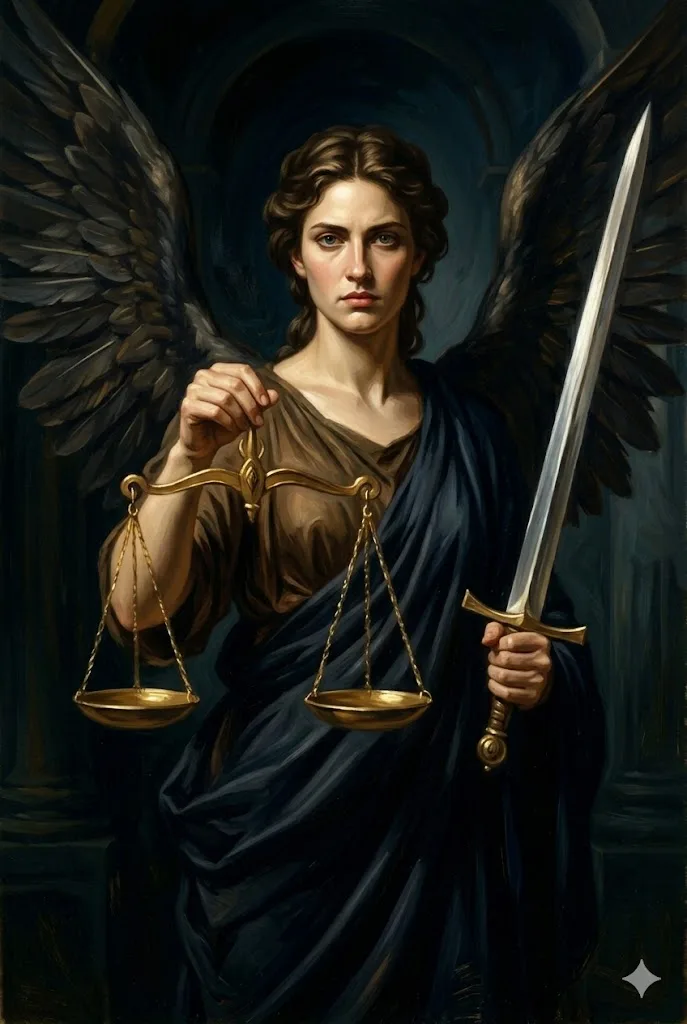
Nemesis was typically depicted as a dignified, stern woman bearing several symbolic objects. She often carried a measuring rod or cubit rule, symbolizing the limits that mortals should not exceed. A bridle represented the restraint she imposed on excessive pride. The wheel of fortune sometimes accompanied her, representing the inevitable turning of fate. In some images, she holds a sword or whip — instruments of punishment for those who transgressed the boundaries she enforced.
Wings were another common attribute, emphasizing that Nemesis could arrive swiftly and without warning. The griffin, a mythical creature combining the king of beasts (the lion) with the king of birds (the eagle), was her sacred animal, and a chariot drawn by griffins was one of her most dramatic visual motifs.
Nemesis, Zeus and the Egg of Helen
The strangest story told about Nemesis comes from the lost epic Cypria, part of the Trojan cycle. There Nemesis does not hunt the proud; she is hunted herself. Zeus desired her, and she fled in shame across land and sea, changing shape again and again to escape him: into a fish in the waves, into wild creatures on the land. At last she became a goose, and Zeus, taking the form of a swan, caught her. The egg she produced was found and brought to Leda, queen of Sparta, and from it hatched Helen. In this version Helen's true mother is Retribution herself, and the woman whose face launched the Trojan War becomes the instrument by which the gods punish a whole generation of heroes.
The Athenians knew this tradition well. Pausanias reports that the base of the cult statue at Rhamnous showed Leda leading Helen to Nemesis, and he explicitly says the Greeks held Nemesis to be Helen's mother, with Leda only her nurse. Fragments of that base survive, so this is one of the rare cases where a myth, a cult site and surviving sculpture all line up.
More on the Statue and Sanctuary at Rhamnous
Ancient writers did not agree on who carved the Rhamnous statue. Pausanias credits Pheidias himself; Pliny the Elder says it was Agoracritus, and adds a curious anecdote: Agoracritus had made a statue of Aphrodite to compete with his fellow pupil Alcamenes, lost the contest, and sold his work to Rhamnous on condition that it be renamed Nemesis. Whichever is true, Pausanias' description is precise. The goddess held an apple-tree branch in her left hand and a libation bowl (phiale) decorated with figures of Ethiopians in her right. She had no wings. Pausanias notes that later Greeks gave Nemesis wings to make her resemble Eros, because she was thought to follow lovers in particular, but the oldest image of her at her greatest shrine was wingless.
The site itself is unusual: two temples stand side by side on the terrace, a small older one and the larger fifth-century Doric temple. Rhamnous was also a fortified garrison post for Athenian ephebes, and Nemesis there was sometimes paired with Themis, the goddess of established right.
Smyrna in Asia Minor worshipped not one but two Nemeseis. Pausanias tells how Alexander the Great, resting after a hunt on Mount Pagus, dreamed that the two goddesses told him to found a city there, and the new Smyrna was built on that spot. In Athens a festival called the Nemesia was connected with the dead, apparently because Nemesis was believed to guard the dead against insult by the living.
From Moral Principle to Gladiator's Goddess
Before she was a goddess with a temple, nemesis was a feeling. In Homer the word means righteous indignation, the anger people rightly feel at behaviour that breaks the rules; characters warn one another that an act will bring nemesis from men or gods. Hesiod turns the idea into a person twice. In the Theogony Night bears Nemesis as "a pain to mortal men," and in the Works and Days he predicts that at the end of the Iron Age, Aidos (Shame) and Nemesis will wrap themselves in white robes and leave the earth for the gods, abandoning mankind to unchecked wickedness.
Herodotus gives the classic historical illustration without making her a character. After Croesus of Lydia boasts to Solon that he is the happiest of men, "a great nemesis from the god" seizes him, and his son is killed. The pattern, prosperity followed by pride followed by ruin, became the template for tragedy.
Nemesis was often merged with Adrasteia, "the inescapable," and people would say "I bow to Adrasteia" before making a boast, much as people now knock on wood. Under the Roman Empire her worship took an unexpected turn: small shrines to Nemesis appear at amphitheatres across the provinces, and she became a patron of gladiators, soldiers and venatores, the goddess who decided fortune in the arena.
Common Misunderstandings
In modern English a "nemesis" is an arch-enemy, but no Greek would have understood the word that way. Nemesis was not anyone's personal rival; she was the restoration of proper proportion. She also did not punish only crimes. Excessive good luck could itself attract her, which is why the Greeks were nervous of praising a person's fortune too openly. Finally, Nemesis is not the same as the Furies, who pursued blood-guilt, especially crimes within the family. Nemesis answered arrogance and imbalance. For a fuller profile of her as a goddess, see Nemesis, goddess of retribution.
Ancient sources
- Hesiod, Theogony 223–224 — names Nemesis among the children of Nyx, a bane to mortals.
- Hesiod, Works and Days 197–201 — Aidos and Nemesis abandon humanity at the end of the Iron Age.
- Cypria (fragments, preserved by Athenaeus) — Nemesis flees Zeus through many transformations and becomes mother of Helen.
- Herodotus, Histories 1.34 — "a great nemesis from the god" falls on Croesus after his boast to Solon.
- Pausanias, Description of Greece 1.33 and 7.5 — the Rhamnous statue and its base showing Leda and Helen; the two Nemeseis of Smyrna and Alexander's dream.
- Ovid, Metamorphoses 3.402–406 — a rejected admirer's prayer against Narcissus is heard by "Rhamnusia," Nemesis of Rhamnous.
Frequently asked questions
Was Nemesis the mother of Helen of Troy?
In one important tradition, yes. The epic Cypria and the cult at Rhamnous made Nemesis Helen's mother by Zeus, with Leda only raising the child from the egg. The more familiar version, in which Leda is the mother, is the one most later authors follow.
Who are Nemesis's parents?
Hesiod makes her a daughter of Nyx alone. Pausanias records a tradition naming Oceanus as her father, and some late writers connect her with Zeus or Dike. There was no single agreed genealogy.
Why does "nemesis" mean enemy today?
The modern sense grew from the idea of an inescapable agent of downfall. Over time "someone's nemesis" came to mean whoever brings about their defeat, and then simply a long-standing rival, a meaning the Greek word never had.
Did Nemesis have wings?
Often in later art, but not at Rhamnous. Pausanias says her oldest great statue was wingless and that wings were added in later images to liken her to Eros.
Join the Pantheon
Weekly mythology stories & deep dives delivered to your inbox.