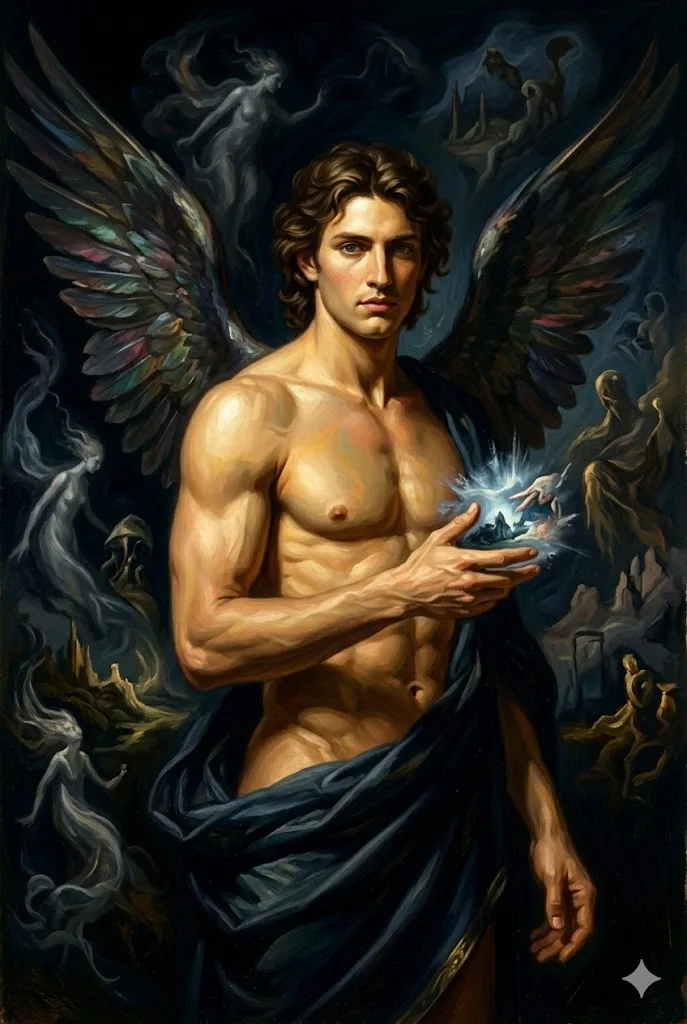
The Shaper of Dreams
Morpheus was the god of dreams and the most skilled of the thousand dream spirits who, in Ovid's Metamorphoses, were sons of Sleep (Hypnos). He comes from Ovid's Roman poem rather than from early Greek sources; in Hesiod, the Dreams (Oneiroi) are siblings of Sleep, not his sons. His name means 'Shaper' or 'Moulder,' referring to his extraordinary ability to assume the form of any human being within dreams. When the gods wished to communicate with mortals through their sleep, it was often Morpheus who delivered the message, appearing in the dreamer's mind as a trusted friend, lover, or family member.
While his brothers Phobetor could assume the forms of animals and Phantasos could become inanimate objects like rocks, water, or trees, only Morpheus could perfectly replicate humans — their voices, mannerisms, clothing, and gestures. This made him the most important of the dream gods, as human interactions carried the most emotional weight within the dreaming mind.
The Cave of Dreams
In Ovid's telling, Morpheus dwelled with his father Sleep and his brothers in a dark cave in the Underworld, surrounded by poppy fields. A separate image is often attached to him: the two gates of dreams, horn for true dreams and ivory for false ones. It comes from Penelope's speech in Homer's Odyssey (Book 19) and was later borrowed by Virgil in Aeneid 6, rather than from Ovid's description of the cave, and it became one of the most enduring metaphors in Western literature.
Modern Legacy
Morpheus has become one of the most recognized figures from Greek mythology in modern culture, largely due to the Matrix films, where the character Morpheus awakens the hero from a false reality — a perfect metaphor drawn from the ancient god who controlled the boundary between illusion and truth. The drug morphine takes its name from Morpheus, as it induces a dreamlike state. His name also gives us the word 'morphing,' reflecting his shapeshifting abilities.
Morpheus is Ovid's creation
One fact surprises many readers: Morpheus does not appear in Homer, Hesiod, or any surviving Greek author before the Roman period. His name and character come from Ovid's Metamorphoses, written around the start of the first century AD. The name is built on the Greek word morphē, "form" or "shape," which suits the one dream who specialises in imitating human appearance. Ovid also coined or popularised his brothers. The one who becomes beasts, birds and serpents, he says, is called Icelos by the gods and Phobetor by mortals; the third, Phantasos, turns into earth, rocks, water and trees. These three are singled out from Sleep's thousand sons, the rest of whom visit ordinary people. Morpheus and his two brothers, Ovid adds, appear only to kings and leaders.
Earlier Greek poetry has dream figures that behave like Morpheus, but without the name. In Iliad Book 2, Zeus sends a "destructive Dream" (Oneiros) to Agamemnon, which stands at his head in the shape of Nestor and urges him to attack Troy at once. In the Odyssey, Athena makes a phantom in the likeness of Iphthime, Penelope's sister, to comfort Penelope in her sleep. Hesiod lists "the tribe of Dreams" among the children of Night, which makes them brothers, not sons, of Sleep. Ovid's family tree, with Somnus as father of the dreams, is a later rearrangement.
The story of Ceyx and Alcyone
Morpheus has only one real myth, but it is a memorable one, told in Metamorphoses Book 11. Ceyx, king of Trachis, sails to consult an oracle against the pleas of his wife Alcyone, daughter of the wind god Aeolus. A storm wrecks his ship and he drowns with her name on his lips. Alcyone, unaware, keeps praying to Juno for his safe return. Unwilling to receive prayers for a dead man any longer, Juno sends Iris down her rainbow to the house of Sleep, a cave in the land of the Cimmerians where no rooster crows, no dog barks and the only sound is the murmur of Lethe over its pebbles. Iris has trouble even keeping Sleep awake long enough to give him the message, and she leaves quickly before drowsiness overcomes her too.
Sleep chooses Morpheus for the task. He flies to Trachis on silent wings and stands at Alcyone's bed as Ceyx: pale, naked, beard and hair dripping with seawater. He speaks in Ceyx's own voice and with his gestures, tells her he is dead, and begs her to mourn him. Alcyone wakes, goes to the shore, and sees her husband's body drifting in on the waves. She leaps from the breakwater, and as she flies over the sea she is changed into a bird. The gods change Ceyx as well, and the couple become kingfishers, or halcyons. Every winter, for seven calm days while the halcyon broods on her floating nest, Aeolus holds back the winds, the origin of the phrase "halcyon days." For other stories of change like this, see transformation myths.
Dreams in Greek religion
Morpheus never had a cult; he belongs to poetry. Real Greek dream religion centred on incubation, sleeping in a sanctuary in the hope of a healing or prophetic dream sent by the god of the place. The great centres were the sanctuaries of Asclepius, especially Epidaurus, where inscriptions record cures said to have been given in dreams, and the oracle of Amphiaraus at Oropus. Pausanias mentions statues of Dream (Oneiros) and Sleep in the sanctuary of Asclepius at Sicyon, which shows how closely sleep, dreams and healing were linked.
Morpheus after Ovid
Medieval and Renaissance writers took Morpheus straight from Ovid. Chaucer retells the Ceyx and Alcyone story in The Book of the Duchess, with Morpheus bringing the drowned king's body to speak. Spenser's Faerie Queene sends a sprite down to the house of Morpheus to fetch a false dream for the Redcrosse Knight. The phrase "in the arms of Morpheus" became a stock way of saying "asleep," which is a slight drift from Ovid, where Morpheus brings dreams rather than sleep itself. Around 1805 the German pharmacist Friedrich Sertürner isolated the main alkaloid of opium and named it after him; it became morphine. In modern fiction, Neil Gaiman's The Sandman uses Morpheus as one of the names of Dream.
Ancient sources
- Ovid, Metamorphoses 11.410–748 — the story of Ceyx and Alcyone, the house of Somnus, Morpheus and his brothers Icelos/Phobetor and Phantasos, and the transformation into halcyons.
- Homer, Iliad 2.1–34 — Zeus sends a deceptive Dream in the shape of Nestor to Agamemnon, a forerunner of Morpheus' role.
- Homer, Odyssey 19.560–567 — Penelope describes the gates of horn and ivory through which true and false dreams pass.
- Hesiod, Theogony 211–212 — the tribe of Dreams as children of Night, siblings of Sleep.
- Virgil, Aeneid 6.893–896 — the two gates of Sleep, through which Aeneas leaves the underworld.
Frequently asked questions
Is Morpheus the god of sleep?
No. The god of sleep is Hypnos, or Somnus to the Romans. Morpheus is one of his sons in Ovid, the dream who takes human form.
Who are Morpheus's brothers?
Ovid names Icelos, also called Phobetor, who appears as animals, and Phantasos, who appears as inanimate things. They head a crowd of a thousand dreams.
What does the name Morpheus mean?
It comes from Greek morphē, "form" or "shape," and is usually translated as "the shaper" or "he who forms," a fitting name for a dream that takes on human shapes.
Was Morpheus worshipped in ancient Greece?
There is no evidence of temples or rites for him. People sought dreams from gods like Asclepius and Amphiaraus instead.
Books to read next
- Stephen Fry, Heroes
- Apollodorus, The Library of Greek Mythology (Oxford World's Classics)
- Edith Hamilton, Mythology
Links go to Bookshop.org, which supports independent bookstores. We earn a small commission if you buy, at no extra cost to you.