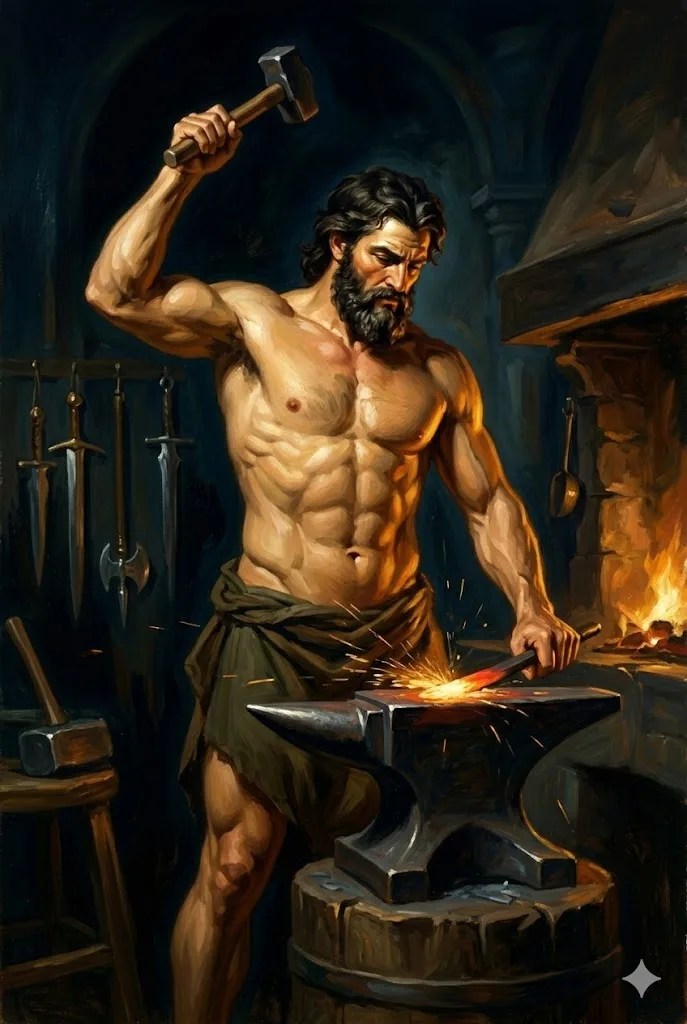
I. Who Was Hephaestus?
Hephaestus was the god of fire, metalworking, stone masonry, and the art of sculpture — the divine craftsman whose forge produced the most wondrous artifacts in all of mythology. He was the only Olympian god who was physically imperfect, born lame and disfigured, yet his hands could create objects of breathtaking beauty and devastating power. He forged Zeus's thunderbolts, Athena's aegis, Achilles's armor, the chains that bound Prometheus, and countless other legendary items.
His birth was troubled. In one version, Hera conceived him alone, without Zeus, out of spite — and was so disgusted by his lameness that she hurled him from Olympus into the sea, where the sea nymphs Thetis and Eurynome rescued him and raised him in an underwater grotto. Homer also tells of a second, separate fall: Zeus flung him from Olympus for siding with Hera, and he fell for an entire day before landing on the island of Lemnos. There, hidden from the gods, he mastered the art of metalwork.
Despite being mocked by the other gods for his appearance and his limping gait, Hephaestus earned universal respect through his unmatched skill. His forge was said to be located beneath Mount Etna in Sicily (or on the island of Lemnos), where, in later poets, the Cyclopes served as his assistants. His Roman counterpart Vulcan gave his name to volcanoes — fitting for a god whose workshop was a mountain of fire.
II. The Master Craftsman
The list of Hephaestus's creations reads like a catalogue of mythology's greatest treasures. He built the palaces of all the Olympian gods on Mount Olympus. He crafted Hermes's winged sandals and helmet. He forged the golden chariot of Helios the sun god. For the hero Achilles, he created a magnificent shield depicting scenes of war, peace, harvest, and the cosmos — described in extraordinary detail in Homer's Iliad.
His most cunning creation was the golden net he used to trap his wife Aphrodite and her lover Ares in bed together. The net was so fine it was invisible, yet so strong that even the gods could not break it. This episode — humiliating yet clever — perfectly captures Hephaestus's character: unable to compete with Ares in strength or beauty, he triumphed through superior craftsmanship and wit.
Two falls from Olympus
Homer actually tells two different stories about Hephaestus being thrown out of heaven, and later retellings often blur them into one. In Iliad Book 1, Hephaestus reminds his mother Hera that when he once tried to defend her, Zeus seized him by the foot and flung him from the threshold of Olympus. He fell all day and landed at sunset on Lemnos, barely alive, where the Sintians, the island's inhabitants, took care of him. In Book 18 the culprit is Hera herself, who wanted to hide her lame child; this time the sea goddesses Eurynome and Thetis caught him, and he spent nine years in their cave beside the stream of Ocean making brooches, bracelets and necklaces. That debt to Thetis is why he agrees at once when she later asks him for new armour for her son Achilles.
His parentage varies in the same way. Homer treats him as the son of Zeus and Hera. Hesiod's Theogony says Hera bore him alone, without union, angry with Zeus for producing Athena from his own head.
The return of Hephaestus
One of the most popular myths in Greek art has no full surviving literary telling. To punish Hera for rejecting him, Hephaestus sent her a golden throne that trapped her with invisible bonds as soon as she sat down. No god could free her, and Hephaestus refused to come back to Olympus. Finally Dionysus got him drunk and led him home on a donkey or mule, surrounded by satyrs and maenads, and he released his mother. The story was told by the poet Alcaeus in fragments that survive only in pieces, Plato mentions "Hera bound by her son" as one of the tales he would ban, and Pausanias saw it painted in the sanctuary of Dionysus at Athens. On vases it appears again and again, most famously on the François Vase in Florence, where the god rides slumped on his mount with his feet twisted.
Wives, children and other workshop stories
Aphrodite is the wife everyone remembers, from the song of Demodocus in Odyssey Book 8. But in Iliad Book 18 the woman who greets Thetis at his house is Charis, "Grace," and Hesiod names his wife as Aglaea, youngest of the three Graces. The ancient tradition never fully reconciled these versions.
Several key myths need his hands. He split Zeus's head with an axe so that Athena could spring out (Pindar and later writers name him; some give the job to Prometheus); see the birth of Athena. On Zeus's orders he shaped the first woman from earth and water, as Hesiod tells it in both the Theogony and Works and Days; see Pandora. In Prometheus Bound he pins Prometheus to the rock while Kratos and Bia stand over him, and he protests the cruelty of the job. Apollodorus records his failed attempt on Athena, from which Erichthonius, an early king of Athens, was born from the Earth.
His other children include the Cabeiri, gods of mysteries on Lemnos and Samothrace whom Herodotus calls his sons, and Periphetes, the club-wielding bandit Theseus killed near Epidaurus. Homer's Hephaestus also builds things that move on their own: tripods on golden wheels that roll to the gods' assembly and back, and golden handmaidens with minds, voices and strength who help him walk. Apollodorus and others credit him with Talos, the bronze guardian who circled Crete, which is why modern writers often describe him as the first imagined builder of robots.
Cult and worship
Lemnos was his island, and its main city was named Hephaestia. In Athens he shared a temple with Athena on the hill above the Agora, the building now called the Hephaisteion, which is the best-preserved Doric temple on the Greek mainland; Pausanias describes it as the temple of Hephaestus and notes a blue-eyed statue of Athena standing inside. Athenians honoured him at the Hephaisteia, which featured a torch race, and at the Chalkeia, a festival of bronze-workers held for Athena Ergane and Hephaestus together. Elsewhere his worship was modest; he mattered most where crafts and metalworking mattered.
Common misconceptions
The Cyclopes as his forge assistants are a later idea, developed in Hellenistic and Roman poetry, most memorably in Virgil's Aeneid Book 8. In Hesiod the Cyclopes make Zeus's thunderbolt themselves. The betrayal scene has its own wrinkle: in the Odyssey it is Helios, the all-seeing sun, who tells Hephaestus about the affair, and Velázquez's The Forge of Vulcan (1630, Prado) follows the later tradition that merges the sun with Apollo.
Ancient sources
- Homer, Iliad 1.590–594 and 18.369–617 — his fall to Lemnos at Zeus's hands; his rescue by Thetis and Eurynome; his self-moving tripods and golden maidservants; and the making of Achilles' shield.
- Homer, Odyssey 8 — Demodocus' song of Ares and Aphrodite caught in his net.
- Hesiod, Theogony and Works and Days — his birth from Hera alone, his marriage to Aglaea, and his making of the first woman.
- Aeschylus, Prometheus Bound — Hephaestus reluctantly chains Prometheus under Kratos' orders.
- Apollodorus, Library 1 and 3 — his role at Athena's birth, his gift of Talos, and the birth of Erichthonius.
- Pausanias, Description of Greece 1.20.3 — describes a painting of Dionysus bringing Hephaestus back to heaven.
Frequently asked questions
Why was Hephaestus lame?
The sources disagree. In one Homeric passage he was born lame and Hera threw him out for it; in another the implication is that his fall from Olympus crippled him. Vase painters sometimes show his feet turned backward or sideways.
Who was Hephaestus married to?
Aphrodite in the Odyssey, Charis in the Iliad, and Aglaea in Hesiod. Later writers sometimes say he married Aglaea after Aphrodite's affair with Ares.
What is the Roman name for Hephaestus?
Vulcan (Vulcanus), an old Italian fire god whose festival, the Volcanalia, was held in August. His identification with Hephaestus brought over the Greek myths.
Did Hephaestus make Pandora's box?
He made Pandora herself. The jar she opened is not described as his work, and it was a jar (pithos) in Hesiod, not a box; see Pandora's box.
Explore More Mythology
Get weekly deep dives into the gods, heroes, and myths of ancient Greece.