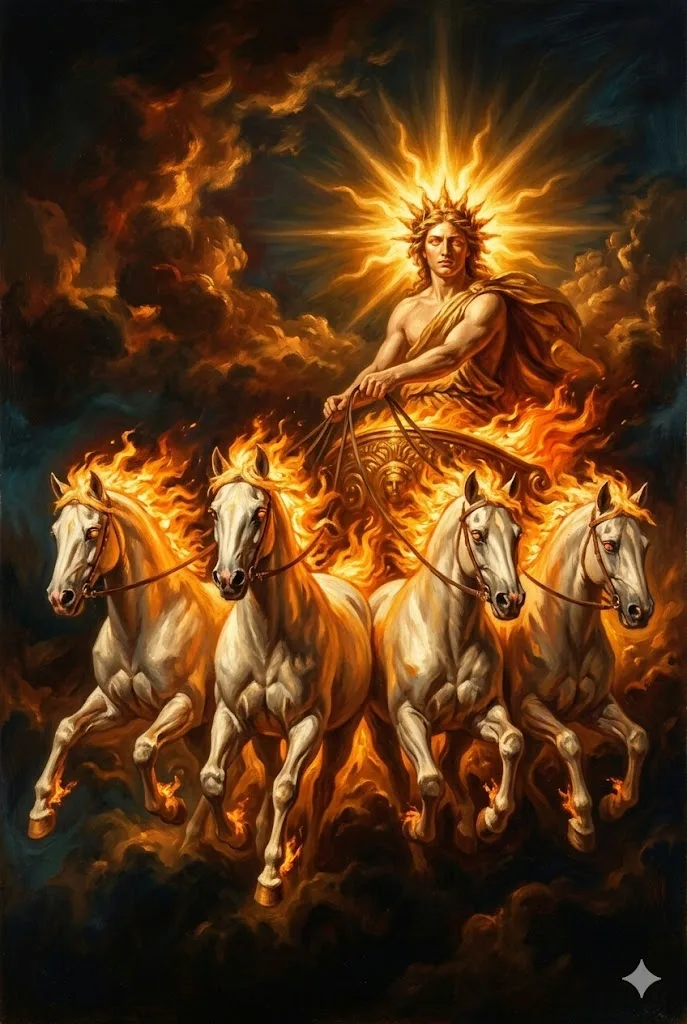
The Charioteer of the Sky
Every morning, Helios rose from his golden palace in the east, crowned with a blazing aureole, and mounted his chariot drawn by four fire-breathing horses: Pyrois, Aeos, Aethon, and Phlegon. He drove across the sky from east to west, illuminating the world below, seeing everything that happened on earth. At evening, he sank into the western ocean and was carried back to the east in an enormous golden cup or bowl that sailed along the river Oceanus through the night. This daily journey was not metaphor — for the Greeks, Helios literally was the sun, a Titan god who predated the Olympians and continued his eternal rounds regardless of who ruled on Olympus.
The All-Seeing Witness
Because Helios crossed the entire sky each day, nothing escaped his sight. He was the ultimate witness, the god who saw everything. It was Helios who told Demeter that Hades had abducted Persephone when no one else would speak. It was Helios who revealed the affair between Aphrodite and Ares to her husband Hephaestus. It was Helios who watched Odysseus's men slaughter his sacred cattle on the island of Thrinacia. In each case, Helios served as the cosmic informant — not out of malice, but because truth was inseparable from light. You cannot hide from the sun.
The Tragedy of Phaethon
The most famous myth of Helios was the disaster of his son Phaethon. The boy, mocked by his peers who doubted his divine parentage, traveled to his father's eastern palace to demand proof. Helios, overwhelmed with paternal love, swore by the river Styx to grant any wish. Phaethon asked to drive the solar chariot for one day. Helios begged him to choose anything else, knowing the horses were too powerful for a mortal to control. But the oath was unbreakable. Phaethon mounted the chariot and immediately lost control. The horses sensed the lighter hand and ran wild, scorching the earth (creating the Sahara Desert, the Greeks believed), freezing the poles, and threatening to destroy the world entirely. Zeus had no choice but to strike Phaethon with a thunderbolt. The boy's body fell into the river Eridanus, and his sisters, the Heliades, wept so long they turned into poplar trees, their tears becoming amber.
The Colossus of Rhodes
Helios's most spectacular monument was the Colossus of Rhodes, one of the Seven Wonders of the Ancient World. Built around 280 BC to celebrate Rhodes's successful defense against a siege, the bronze statue stood approximately 33 meters (108 feet) tall, making it one of the tallest statues of the ancient world. It depicted Helios standing with a crown of rays, gazing out over the harbour that his light blessed each morning. The statue stood for only 54 years before an earthquake toppled it in 226 BC, but even its ruins were so impressive that tourists came to marvel at them for centuries afterward. The Colossus inspired the design of the Statue of Liberty over two thousand years later.
Classical Sources
- 📜 Homer, Odyssey (c. 750 BC)
- 📜 Ovid, Metamorphoses (8 AD)
- 📜 Apollodorus, Bibliotheca
- 📜 Pliny, Natural History (c. 77 AD)
Cross-referenced with multiple classical sources for accuracy.