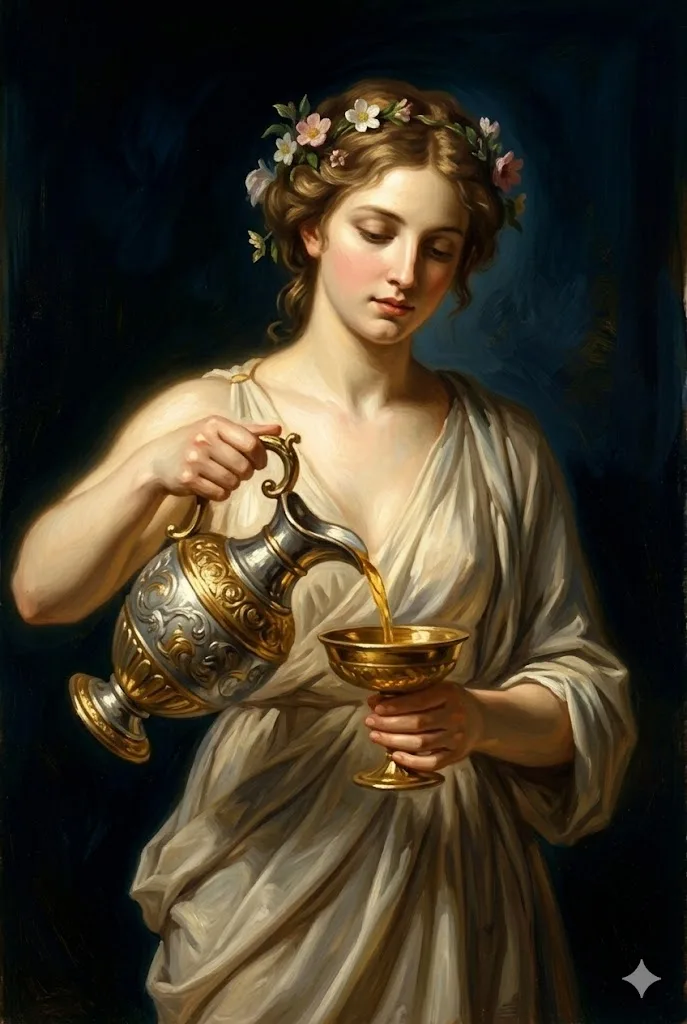
Cupbearer of the Gods
Hebe was the goddess of youth and the cupbearer of Mount Olympus, serving nectar and ambrosia to the gods at their feasts. She was the daughter of Zeus and Hera, and her very presence radiated the vitality and beauty of youth. Her name literally means 'Youth' in Greek, and she had the power to restore youth to the aged, a gift that made her one of the most symbolically important deities on Olympus.
Wife of Heracles
Hebe's most significant mythological role came after the death and apotheosis of Heracles. When the greatest hero in Greek mythology died in agony from the poisoned shirt of Nessus and was carried to Olympus by Zeus, he was granted immortality and reconciled with Hera at last. As a final blessing, he was given Hebe as his wife. The marriage was deeply symbolic: the hero who had endured more suffering than any mortal was rewarded with eternal youth and the end of all pain. Heracles and Hebe had two sons, and their union represented the ultimate reward for a life of extraordinary service.
Replaced by Ganymede
According to a late and poorly attested tradition, Hebe lost her position as cupbearer when she stumbled and fell during a feast, exposing herself in an undignified manner. Zeus then replaced her with Ganymede, a beautiful Trojan prince whom he abducted in the form of an eagle. This story was controversial even in antiquity, and many versions omit it entirely. Hebe remained an honoured goddess regardless, worshipped at sanctuaries in Phlius and Sicyon where she was associated with the forgiveness of sins and the release of prisoners.
Classical Sources
- 📜 Homer, Iliad & Odyssey (c. 750 BC)
- 📜 Hesiod, Theogony (c. 700 BC)
- 📜 Apollodorus, Bibliotheca (c. 1st-2nd century AD)
- 📜 Ovid, Metamorphoses (8 AD)
Cross-referenced with multiple classical sources for accuracy.
Explore More
Hebe in Homer: more than a wine-pourer
The earliest picture of Hebe comes from the Iliad, and it is a busier one than the title "cupbearer" suggests. At the opening of Book 4 she moves among the gods seated in Zeus's golden hall, pouring nectar while they look down on Troy. In Book 5 she is the one who fits the bronze wheels to Hera's chariot when Hera and Athena ride out to help the Greeks, and at the end of the same book, after Diomedes wounds Ares, it is Hebe who bathes her brother and dresses him in fine clothes before he sits down beside Zeus. Homer, in other words, treats her as the household daughter of Olympus: she serves, prepares, and tends to her family.
That family is consistent across the sources. Hesiod's Theogony names Hebe, Ares and Eileithyia, goddess of childbirth, as the children of Zeus and Hera, and Apollodorus repeats the list. Hebe is therefore a full sister of the war god and the birth goddess, and one of the few children Zeus and Hera had together, which matters for the symbolism of her marriage.
The marriage that ended a feud
Hesiod already knows the ending of the Heracles story: having finished his "grievous labours," the hero takes "neat-ankled Hebe, child of great Zeus and gold-shod Hera" as his wife and lives on Olympus "unharmed and unageing all his days." In the Odyssey, when Odysseus sees Heracles in the underworld, the poet explains that this is only a phantom; the real Heracles feasts with the gods and has Hebe as his wife. Ancient critics already suspected those lines were a later addition, but they show how early the pairing became standard. Pindar returns to it more than once, picturing Heracles in Olympus with Hebe as his bride and Hera as his mother-in-law.
The match was a deliberate piece of reconciliation. Hera had hounded Heracles from his cradle; giving him her own daughter turned the persecutor into family. Apollodorus names the two sons of the marriage as Alexiares and Anicetus, names that mean roughly "warder-off of curses" and "unconquerable," and which look like personifications of what Heracles himself had become.
Hebe and Iolaus: the gift of youth used once
Hebe's power to restore youth is not just a decorative idea; it drives one memorable episode. In Euripides' Children of Heracles, the aged Iolaus, Heracles' nephew and old comrade, prays to Hebe and Zeus to be young again for a single day so he can fight Eurystheus, the king who had imposed the labours. A messenger reports that two stars settled on his chariot, his youth returned, and he captured Eurystheus. Ovid gives a version in Metamorphoses Book 9 in which Hebe rejuvenates Iolaus at her husband's request, and the other gods immediately grumble that their own favourites deserve the same treatment, until Zeus reminds them that even he is bound by fate.
Cult, sanctuaries and the Ganymede question
Pausanias describes Hebe's most distinctive sanctuary, on the acropolis of Phlius in the northeastern Peloponnese. The oldest Phliasians, he says, called the goddess Ganymeda, and later Hebe; the shrine held no image of her, and suppliants who reached it were granted pardon. Freed prisoners hung their fetters on the trees of the sacred grove. Strabo mentions the same goddess under the name Dia at Phlius and Sicyon. The name Ganymeda is intriguing, because it is the feminine form of Ganymede, the Trojan boy who in other traditions takes over Hebe's job.
That replacement story deserves caution. Homer has both figures serving at once: Hebe pours nectar in Book 4, while Book 20 says the gods carried off Ganymede to be Zeus's cupbearer. The tale of Hebe stumbling and being dismissed is not found in the early poets and appears to be a late invention or explanation; the more common ancient logic is simply that she gave up the role when she married Heracles.
Elsewhere Hebe was honoured beside her mother and her husband. At the great Heraion near Argos, Pausanias saw a gold and ivory Hebe by Naucydes standing next to Polyclitus's famous Hera. At Mantinea a group by Praxiteles showed Hera enthroned with Athena and Hebe. In Athens, at the Cynosarges gymnasium, there were altars to Heracles and to Hebe, whom the Athenians regarded as his wife, along with Alcmene and Iolaus. The Romans identified her with Juventas, goddess of youth, whose shrine stood within the temple precinct of Jupiter on the Capitol.
In later art Hebe became a favourite neoclassical subject. Antonio Canova carved several versions of her stepping forward with jug and cup, and Bertel Thorvaldsen made his own. In the eighteenth century it was fashionable for aristocratic women to be painted "as Hebe," usually offering a cup to Zeus's eagle, a convention Jean-Marc Nattier used repeatedly.
Ancient sources
- Homer, Iliad 4 and 5 — Hebe pours nectar for the gods, readies Hera's chariot, and bathes the wounded Ares.
- Hesiod, Theogony — lists Hebe as daughter of Zeus and Hera, and describes her marriage to Heracles after his labours.
- Pindar, Nemean 1 and Nemean 10 — celebrate Heracles' reward on Olympus with Hebe as his bride.
- Euripides, Children of Heracles — Iolaus prays to Hebe and is made young for a day to defeat Eurystheus.
- Ovid, Metamorphoses 9 — Hebe rejuvenates Iolaus, and the gods protest on behalf of their own favourites.
- Pausanias, Description of Greece 1 and 2 — records her sanctuary at Phlius with its asylum and fetters, her statue at the Argive Heraion, and her altar at Cynosarges in Athens.
Frequently asked questions
Who were Hebe's parents and siblings?
Hebe was the daughter of Zeus and Hera. Her full siblings were Ares and Eileithyia, and some traditions add Hephaestus, although Hesiod makes him Hera's child alone.
What is Hebe's Roman name?
The Romans equated her with Juventas, the goddess of youth, who was worshipped on the Capitoline Hill in Rome.
Did Hebe have children with Heracles?
Yes. Apollodorus names two sons, Alexiares and Anicetus. They play almost no part in surviving myth.
Was Hebe really fired for falling over?
That story is late and poorly attested. Homer has Hebe and Ganymede serving at the same time, and most ancient writers simply assume she stopped pouring when she married Heracles.
Books to read next
- Stephen Fry, Mythos
- Edith Hamilton, Mythology
- Hesiod, Theogony and Works and Days (Oxford World's Classics)
Links go to Bookshop.org, which supports independent bookstores. We earn a small commission if you buy, at no extra cost to you.