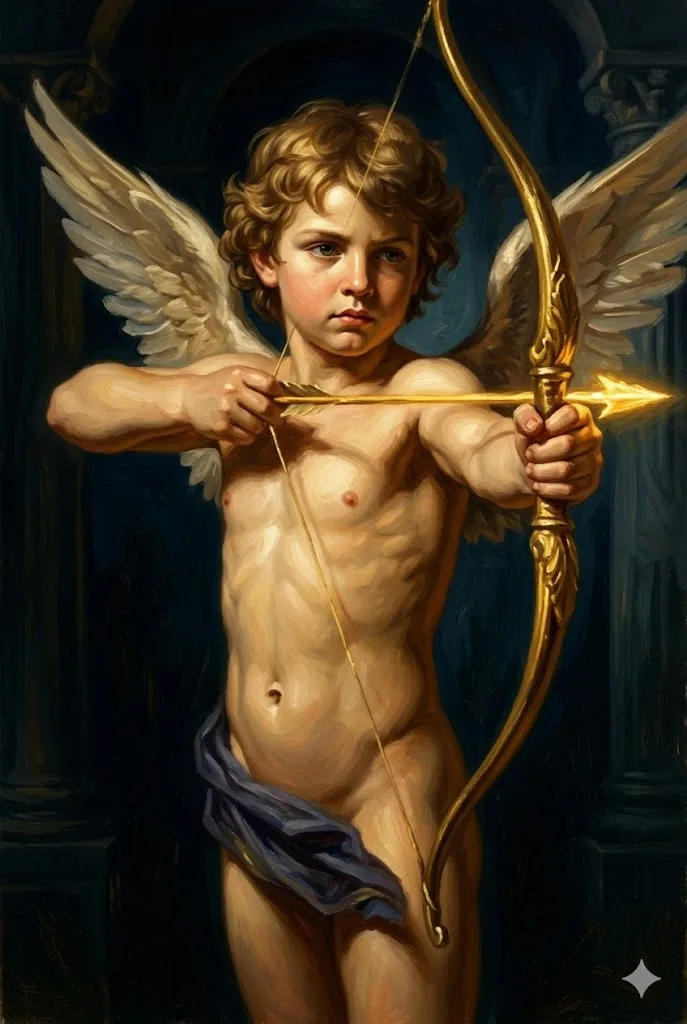
I. Who Was Eros?
Eros was the Greek god of love, desire, and erotic attraction. He exists in two forms in Greek mythology: as one of the primordial gods who emerged at the dawn of creation (in Hesiod's Theogony, Eros arose from Chaos alongside Gaea and Tartarus) and as the mischievous winged son of Aphrodite and Ares who shot golden arrows to make gods and mortals fall helplessly in love.
In his younger form — the version most people know, and the basis for the Roman Cupid — Eros was a beautiful, winged youth armed with a bow and two types of arrows. His gold-tipped arrows caused irresistible love; his lead-tipped arrows caused aversion and repulsion. He used these weapons with capricious delight, causing chaos among both gods and mortals. Even Zeus was not immune to his power — Eros could make the king of the gods fall in love with a mortal woman with a single shot.
Eros and Psyche
The most famous myth of Eros is his love story with the mortal princess Psyche (whose name means "Soul"). Aphrodite, jealous of Psyche's beauty, sent Eros to make her fall in love with the ugliest creature alive. Instead, Eros accidentally pricked himself with his own arrow and fell deeply in love with Psyche. He visited her only in darkness, forbidding her from seeing his face. When Psyche disobeyed (encouraged by her jealous sisters) and lit a lamp to see him, Eros fled. Psyche wandered the earth searching for him and was set impossible tasks by Aphrodite. She completed them all, and Zeus finally granted her immortality so she could be reunited with Eros forever. Their daughter was named Hedone (Pleasure).
Whose Son Is Eros? The Ancient Answers
The two versions of Eros on this page, the primordial force and the son of Aphrodite, are only the best-known of many. Ancient writers argued about his parentage for centuries:
- Hesiod gives him no parents at all. He comes into being just after Chaos, Gaia and Tartarus, "most beautiful among the immortal gods, the limb-loosener." Later in the Theogony he and Himeros (Longing) attend Aphrodite at her birth. They are her companions, not her children.
- Aristophanes' Birds has Eros hatch from a wind-egg laid by Night in the bosom of Erebus, on golden wings. This is close to the Orphic tradition, in which a shining first-born god (Phanes or Protogonos) bursts from the cosmic egg and is identified with Eros.
- The poet Alcaeus called him the son of Iris and Zephyrus, the rainbow and the west wind, an image that later writers took to mean the varied colours of desire.
- Simonides and many later authors make him the child of Aphrodite and Ares, the version this page follows.
- Plato's Symposium has the priestess Diotima deny that Eros is a god at all. He is a daimon, between mortal and divine, conceived at Aphrodite's birthday feast by Poros (Resource) and Penia (Poverty). That is why love is always needy yet always resourceful.
Poets and Philosophers on Desire
Greek lyric poets treated Eros as an attacker, not a sweet cherub. Sappho calls him "the limb-loosener" who shakes her "like a wind falling on mountain oaks," and coined the word glukupikron, "sweet-bitter," for him. Anacreon pictures Eros striking him like a blacksmith with a great axe and plunging him into an icy stream. Ibycus compares him to a Thracian north wind blazing with lightning. In the Symposium, each speaker praises Eros differently. Phaedrus calls him the oldest of the gods. Agathon calls him the youngest and most delicate. Socrates, through Diotima, recasts love as a ladder rising from desire for one beautiful body to the love of beauty itself.
Eros was also one of a group. The Erotes were a band of winged love-gods that included Himeros (desire for what is present) and Pothos (longing for what is absent). Anteros was "love returned," who punished those who scorned love. A relief showing Eros and Anteros wrestling for a palm branch stood in the gymnasium at Elis, according to Pausanias.
Cult and Sanctuaries
Eros was worshipped more widely than most people realise. His oldest and most important cult was at Thespiae in Boeotia. Pausanias says the earliest image there was "an unworked stone." The city held the Erotidia festival every four years, with contests in music and athletics. Praxiteles carved a famous marble Eros for Thespiae, reputedly given to the city by his lover, the courtesan Phryne. It was later carried off to Rome. In Athens there was a shrine of Eros and Aphrodite on the north slope of the Acropolis. Statues of Eros were also set up in gymnasia, where he presided over the bonds between older and younger men, and Spartans and Cretans are said to have sacrificed to him before battle.
From Youth to Toddler: Eros in Art
Archaic and Classical artists showed Eros as a slender, winged adolescent, carrying a lyre, a wreath or a hare as a love gift, as often as a bow. The chubby baby with a quiver belongs to the Hellenistic age. Apollonius of Rhodes' Argonautica captures this shift. There Eros is a spoiled child cheating Ganymede at knucklebones, until Aphrodite bribes him with a golden ball to shoot Medea with love for Jason. The Roman Cupid, and later the Renaissance putto, grew out of this playful image. The gold and lead arrows are best known from Ovid's story of Apollo and Daphne. Many readers are also surprised to learn that the Psyche story comes from a Latin novel, Apuleius' Metamorphoses (The Golden Ass), written in the second century AD, where the couple's daughter is named Voluptas. See Cupid and Psyche for the full tale.
Ancient sources
- Hesiod, Theogony 116–122, 201 — Eros as one of the first powers, the "limb-loosener," and companion of Aphrodite at her birth.
- Aristophanes, Birds — the golden-winged Eros hatches from Night's egg.
- Plato, Symposium — speeches in praise of Eros, including Diotima's account of him as a daimon, the son of Poros and Penia.
- Apollonius of Rhodes, Argonautica 3 — Eros as a mischievous child sent by Aphrodite to make Medea love Jason.
- Pausanias, Description of Greece 9.27 — the cult of Eros at Thespiae, its ancient stone image and Praxiteles' statue.
- Apuleius, Metamorphoses 4–6 — the tale of Cupid and Psyche.
Frequently asked questions
Are Eros and Cupid the same?
The Romans identified Cupid (also called Amor) with Eros and took over his myths and imagery. Cupid's famous story with Psyche, however, survives in a Latin novel, not in Greek literature.
Is Eros older than Aphrodite?
In Hesiod, yes. He is one of the first beings to exist, and he greets Aphrodite at her birth. In later tradition he is her son.
Where does the word "erotic" come from?
From eros, the Greek word for desire, which was also the god's name. Greeks used it mainly for passionate, physical longing, unlike philia (friendship) or storge (family affection).
What is Anteros?
Anteros was Eros' brother, the god of returned love, who avenged love that was spurned. He was often shown wrestling with Eros.
Explore More Mythology
Get weekly deep dives into the gods, heroes, and myths of ancient Greece.