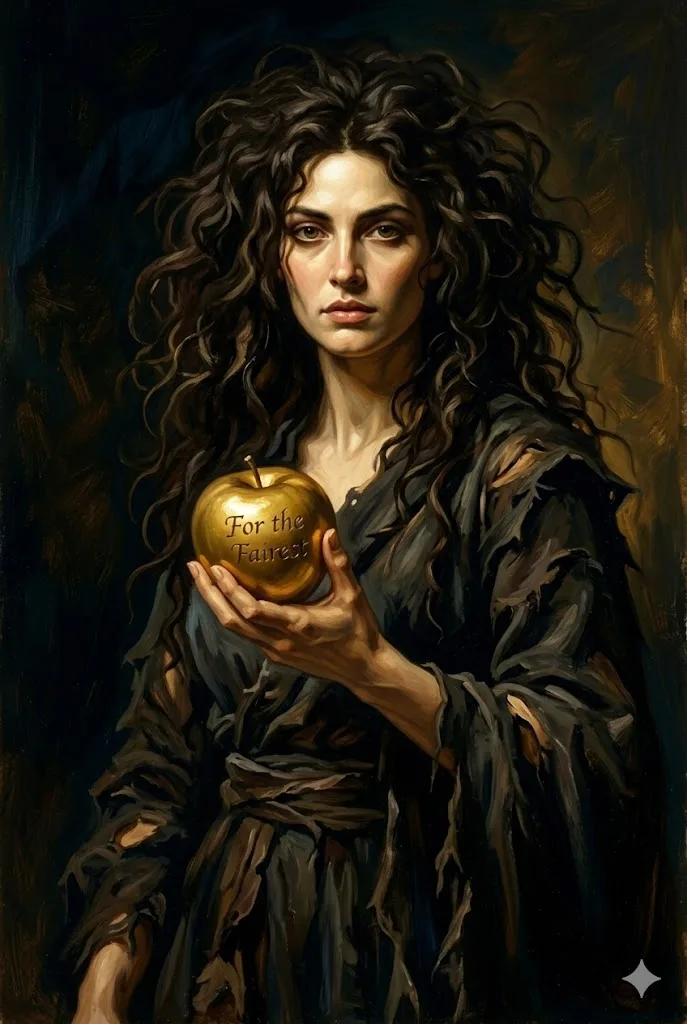
The Uninvited Guest
Eris was the goddess of discord, strife, and chaos. Daughter of Nyx (Night) in Hesiod's account, or daughter of Zeus and Hera in Homer's, she was the divine embodiment of conflict and rivalry. She delighted in the misery that quarrels bring and was said to be present at every battle, growing taller and more powerful as the fighting intensified. Even the other gods despised her, and her exclusion from a single wedding feast led to the most devastating war in mythology.
The Apple of Discord
When the hero Peleus married the sea nymph Thetis (parents of Achilles), every god and goddess was invited to the wedding except Eris. Furious at being excluded, she appeared uninvited and threw a golden apple into the crowd inscribed with a single word: Kallisti, meaning 'For the Fairest.' Three goddesses claimed it: Hera, Athena, and Aphrodite. Zeus, unwilling to choose between them, sent the three to the Trojan prince Paris to judge. Each goddess offered Paris a bribe. He chose Aphrodite's offer of the most beautiful woman in the world, Helen of Sparta. The result was the Trojan War, ten years of destruction, and the fall of an entire civilization. All from one golden apple thrown by a snubbed goddess.
Two Faces of Strife
Hesiod, in his Works and Days, makes a fascinating distinction between two types of Eris. The harmful Eris drives men to war and destruction. But there is also a beneficial Eris who inspires healthy competition: the potter who envies another potter's skill and works harder, the poet who strives to outdo a rival. This competitive spirit, Hesiod argues, is good for mortals because it drives them to excellence. The ancient Greeks understood that conflict is not always destructive. Sometimes rivalry produces the greatest achievements.
Classical Sources
- 📜 Homer, Iliad & Odyssey (c. 750 BC)
- 📜 Hesiod, Theogony (c. 700 BC)
- 📜 Apollodorus, Bibliotheca (c. 1st-2nd century AD)
- 📜 Ovid, Metamorphoses (8 AD)
Cross-referenced with multiple classical sources for accuracy.
Explore More
Judgement of Paris · Trojan War · Nyx · Ares · Home
Eris on the Battlefield of the Iliad
Long before the apple story became famous, Homer portrayed Eris as an active force in war. In Iliad 4, she is the sister and companion of man-slaying Ares, "small at first when she rears her head, but afterwards her head strikes heaven while she walks on earth." She moves through the ranks "increasing the groaning of men." At the start of Iliad 11, Zeus sends her to the Greek ships holding a portent of war. She stands on the ship of Odysseus, in the middle of the line, and gives a terrible shout that fills every man with the will to fight. She also appears on the Shield of Achilles in book 18, alongside Kydoimos (Tumult) and the deadly Ker, who drags the dead off by their feet. In Homer she sometimes stands next to Enyo, the other war goddess, though the two are not quite the same. Enyo is battle frenzy, while Eris is the quarrel that sets it off.
The Children of Strife
Hesiod's Theogony gives Eris a grim family. She is a daughter of Nyx, and she bore, with no father named, a list of evils that reads like a catalogue of human suffering. Ponos (Toil), Lethe (Forgetfulness), Limos (Famine), and the Algea (Pains). Then the Hysminai (Fights), Makhai (Battles), Phonoi (Murders) and Androktasiai (Manslaughters). Then the Neikea (Quarrels), Pseudea (Lies), Logoi (Stories) and Amphillogiai (Disputes). Dysnomia (Lawlessness) and Ate (Ruin), "who are close to one another." Last comes Horkos (Oath), who brings the most harm to men when someone deliberately swears falsely. The list follows a logic. Disputes lead to lies, lies to broken oaths, and broken oaths to ruin.
Hesiod's Works and Days then corrects his own earlier poem. "There was not just one kind of Strife after all." Alongside the destructive Eris, there is an older, good Eris, whom Zeus set "in the roots of the earth" to make even the idle man work when he sees his neighbour growing rich. In Greek culture, competition was celebrated, in athletics, drama and craft, and Hesiod's two Strifes are the earliest attempt to explain why rivalry can be both a curse and a spur.
How the Apple Story Developed
The wedding episode came from the lost epic Cypria, which survives only in a later prose summary. According to that summary, Zeus planned the Trojan War with Themis. Eris arrived while the gods were feasting at the wedding of Peleus and Thetis and stirred up a dispute among Hera, Athena and Aphrodite about which was most beautiful. The summary does not mention the apple, though it probably featured in the full epic. The golden apple bearing a message to "the fairest" is fully attested only in later writers. Hyginus has Eris toss it through the doorway, and Lucian makes it the basis of comic dialogues among the goddesses. Many tellings also omit the idea that she was not invited out of spite. In the Cypria's framing she serves Zeus' plan, not her own grudge. For the contest itself, see the Judgement of Paris and Paris.
A small fable attributed to Aesop makes the same point as Homer's image of the growing goddess. Heracles hits a strange apple-shaped object lying on a narrow path with his club, and it swells to twice its size. The harder he strikes, the bigger it grows, until it blocks the road. Athena explains that it is Strife: leave it alone and it stays small, fight it and it swells.
Cult, Art and Modern Legacy
Eris had no known temples or festivals. People feared and blamed her; they did not court her. Archaic Greek painters sometimes show her as a winged woman in running pose, and she appears in later scenes of the Judgement of Paris hovering in the background. The Romans identified her with Discordia. Virgil puts Discordia at the entrance to the Underworld with snakes in her hair bound with bloody ribbons, and again among the forces fighting at Actium. In 2005 astronomers found a dwarf planet larger in mass than Pluto and named it Eris. The arguments it caused led to Pluto's reclassification in 2006, and its moon was named Dysnomia after one of Eris' children. Eris is also the patron of Discordianism, a parody religion founded in the late 1950s around the Principia Discordia.
Ancient sources
- Homer, Iliad 4, 11 and 18 — Eris as Ares' sister who grows to touch heaven, her war-cry at the Greek ships, and her place on the Shield of Achilles.
- Hesiod, Theogony — Eris as daughter of Night and mother of Toil, Famine, Battles, Lies, Ruin, Oath and the rest.
- Hesiod, Works and Days 11–26 — the two Strifes, one destructive and one that spurs honest competition.
- Cypria (Proclus' summary) — Eris starts the quarrel of the goddesses at the wedding of Peleus and Thetis, as part of Zeus' plan for the Trojan War.
- Hyginus, Fabulae 92 — the version in which the uninvited Eris throws an apple for the most beautiful goddess.
Frequently asked questions
What is the Roman name for Eris?
Discordia. That is why the golden apple is often called the "apple of discord."
Was Eris evil?
Hesiod says one Eris is harmful and another is good for people, because she drives them to work and excel. The war-goddess of Homer, though, is presented as purely destructive.
Did Eris really cause the Trojan War?
She started the quarrel, but the ancient sources share the blame. The Cypria says Zeus planned the war, and Paris, Helen and Aphrodite all play their parts. See who started the Trojan War.
Who are Eris' parents?
Hesiod makes her a daughter of Nyx alone. Later writers sometimes treat Homer's "sister of Ares" as making her a daughter of Zeus and Hera.
Books to read next
- Stephen Fry, Mythos
- Edith Hamilton, Mythology
- Hesiod, Theogony and Works and Days (Oxford World's Classics)
Links go to Bookshop.org, which supports independent bookstores. We earn a small commission if you buy, at no extra cost to you.