Bringer of Light
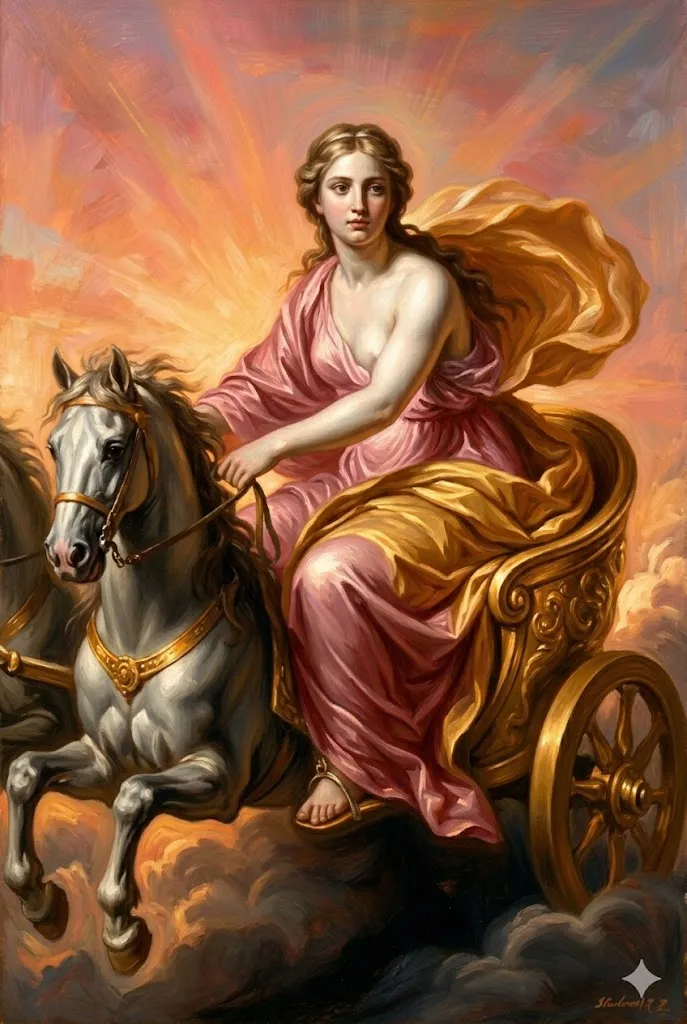
Eos was the Titan goddess of the dawn — the luminous, saffron-robed deity who rose each morning from the edge of the Ocean to open the gates of heaven for her brother Helios, the Sun. Homer immortalized her with the epithet 'rosy-fingered Dawn,' one of the most beautiful phrases in all of literature, describing the delicate pink light that spreads across the sky before sunrise.
Each day, Eos rode her chariot — drawn by the immortal horses Lampus and Phaethon — from her palace in the east, scattering the darkness before her and announcing the coming of the sun. She was the transitional deity par excellence: neither night nor day, but the magical threshold between them. The dew that covered the earth each morning was said to be the tears of Eos, shed for her fallen son Memnon.
Family
Eos was the daughter of the Titans Hyperion and Theia, and sister to Helios (the Sun) and Selene (the Moon). Her parentage placed her among the second generation of cosmic deities — those who governed the celestial bodies and the passage of time. With the Titan Astraeus (god of the stars and planets), Eos bore the Anemoi (Winds); Hesiod names three: Boreas (North), Notus (South), and Zephyrus (West). Eurus (East) is sometimes added in later accounts. She was also the mother of Eosphorus, the Morning Star — the planet Venus as it appears before dawn.
The Curse of Aphrodite
Eos became famous in mythology for her insatiable desire for handsome mortal men — a compulsion that was not entirely her fault. When Eos had an affair with Ares, the god of war, Aphrodite discovered the betrayal and cursed the dawn goddess with an uncontrollable longing for mortal men. From that point forward, Eos abducted one beautiful youth after another, carrying them off in her chariot to satisfy a desire that could never be fully quenched.
Her most famous mortal lovers included Cephalus, a hunter whom she snatched from his wife Procris, and Orion, the giant huntsman. But the most significant — and most tragic — was Tithonus, a prince of Troy whose story became one of mythology's most poignant cautionary tales.
Eos and Tithonus
Eos fell so deeply in love with the Trojan prince Tithonus that she asked Zeus to grant him immortality so they could be together forever. Zeus agreed — but Eos had forgotten to ask for eternal youth as well. Tithonus lived on and on, but he continued to age. His hair turned white, his body withered, his strength faded, and still he could not die. Eventually, he shrank into a tiny, babbling creature — some versions say he was transformed into a cicada, chirping endlessly but unable to die.
The myth of Tithonus became the ancient world's definitive warning about the difference between immortality and eternal youth. It was referenced by philosophers, poets, and storytellers for centuries as proof that even divine gifts, if carelessly requested, could become curses. The Victorian poet Alfred Lord Tennyson later wrote a famous dramatic monologue in Tithonus's voice, lamenting his eternal decay.
Legacy
The Romans identified Eos with their goddess Aurora, and the phenomenon of the aurora borealis (northern lights) takes its name from her. The scientific term for the dawn — the 'aurora' — likewise derives from Eos's Roman counterpart. In this way, every sunrise carries the memory of the ancient goddess who, each morning without fail, opened the gates of heaven and reminded the world that after every night, light returns.
The Epithets of Dawn
Homer's two favourite epithets for Eos come together in a formula used dozens of times: "when early-born, rosy-fingered Dawn appeared." Rhododaktylos means "rosy-fingered." Erigeneia means "early-born." Elsewhere she is krokopeplos, "saffron-robed," and in Hesiod and later poets she is "bringing light to mortals." Her horses Lampus ("Shining") and Phaethon ("Blazing") are named in Odyssey 23. There Athena holds Dawn back at the edge of Ocean, so that Odysseus and Penelope can have a longer night after their reunion. It is a lovely example of the goddess as a real power over time, not just a figure of speech.
A note on her children: in Hesiod's Theogony, Eos bears Astraeus only three winds, Zephyrus, Boreas and Notus, together with Eosphorus and the stars. Eurus, the east wind, gets added to the family only in later writers. Zephyrus and Boreas have their own myths, but their mother rarely appears in them.
More Lovers, and How the Stories Disagree
Eos' abductions form the largest group of love-pursuit scenes involving a goddess and a mortal. They are told differently by different authors:
- Orion. In Odyssey 5, Calypso complains that the gods resent goddesses who take mortal lovers. Her example is Eos carrying off Orion, whom Artemis then killed with her arrows on Ortygia. Apollodorus adds that Eos took him to Delos, and he is also the source for the story of Aphrodite's curse: Eos was made to fall endlessly in love because she had slept with Ares.
- Cleitus. The Odyssey 15 also mentions Cleitus, grandson of the seer Melampus, whom Dawn snatched away "for his beauty, so that he might dwell among the immortals."
- Cephalus. Hesiod has Eos bear Cephalus a son, Phaethon (a different figure from the son of Helios who crashed the sun-chariot). Aphrodite later carried this Phaethon off to be a guardian of her temple. Ovid tells the darker Attic version in Metamorphoses 7: Cephalus refuses Eos because he loves his wife Procris. The goddess releases him with a warning that he will regret his choice, which ends in Procris' accidental death.
- Tithonus. The oldest full telling of the Tithonus story is in the Homeric Hymn to Aphrodite. There Eos shuts the shrunken old man in a chamber, where his voice "flows on endlessly." The cicada transformation belongs to later tradition. Sappho also wrote a poem about Tithonus and old age, recovered on papyrus and published in 2004.
Memnon: Dawn's Grief at Troy
With Tithonus, Eos had two sons, Memnon and Emathion. Memnon, king of the Ethiopians, came to help Troy after Hector's death. He killed Nestor's son Antilochus and was killed in turn by Achilles. This story was told in the lost epic Aethiopis, which survives only in summary. According to the summary, Eos asked Zeus to make her son immortal, and he agreed. Quintus of Smyrna and Ovid add that the birds called Memnonides rose from his funeral pyre and fought above it every year. The morning dew was said to be her tears for him.
The scene inspired one of the most moving works of Greek vase painting. On a red-figure cup painted by Douris around 490–480 BC, now in the Louvre, Eos lifts her son's limp body in her arms. It is sometimes called the "Memnon Pietà." Painters also showed Eos and Thetis pleading before Zeus while Hermes weighs the fates of their two sons. Centuries later, Greek visitors to Egypt decided that one of the colossal statues of Amenhotep III at Thebes was Memnon. The cracked stone gave off a sound at sunrise, and they took it as the son greeting his mother. Pausanias and Strabo both mention it.
Cult and Modern Misreadings
Eos had very little cult. She belongs mainly to poetry and painting, not to sanctuaries and festivals, though her abductions of youths were popular images on Athenian vases in the fifth century BC. It is often said that she "opened the gates" for Helios. That is a later and Roman image more than a Homeric one. In Homer, Dawn simply rises from the streams of Ocean, and she sometimes stands for the whole day as well as the morning.
Ancient sources
- Homer, Odyssey 5, 15 and 23 — Eos and Orion, the abduction of Cleitus, and Athena holding back Dawn's horses Lampus and Phaethon.
- Hesiod, Theogony — her birth from Hyperion and Theia, her children by Astraeus, and her sons by Tithonus and Cephalus.
- Homeric Hymn to Aphrodite — the full story of Tithonus, given immortality without youth.
- Apollodorus, Library 1.4 — Eos carries Orion to Delos; Aphrodite's curse after her affair with Ares.
- Ovid, Metamorphoses 7 and 13 — Cephalus' rejection of Eos, and her mourning for Memnon and the birth of the Memnonides.
Frequently asked questions
Is Eos a Titan?
She is the daughter of the Titans Hyperion and Theia, so she is often grouped with them. She took no part in the war against Zeus, and Hesiod does not count her among the twelve Titans.
Who are Eos' siblings?
Helios, the Sun, and Selene, the Moon. Hesiod names all three as children of Hyperion and Theia.
What does "rosy-fingered dawn" mean?
It describes the streaks of pink light that spread across the sky before sunrise, like fingers reaching out. Homer uses the phrase more than twenty times.
Did Eos have children with Tithonus?
Yes. Memnon, the Ethiopian king who fought at Troy, and Emathion, whom Heracles killed.
Join the Pantheon
Weekly mythology stories & deep dives delivered to your inbox.