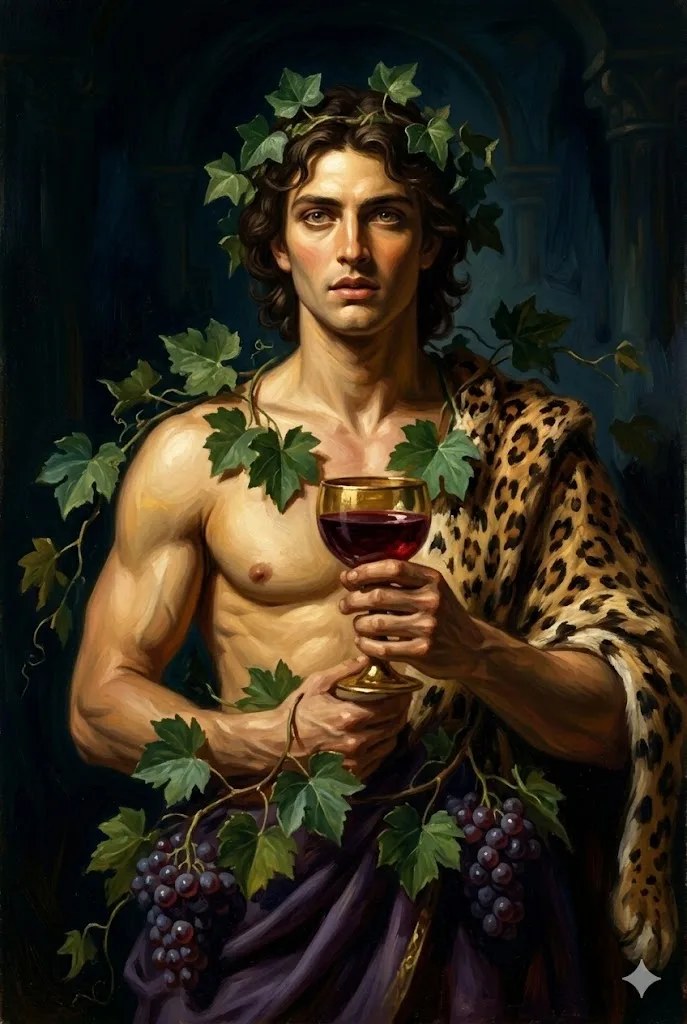
I. Who Was Dionysus?
Dionysus was the god of wine, festivity, theatre, religious ecstasy, and ritual madness — and the last deity to be admitted to Mount Olympus. He was unique among the Olympians: the only god born of a mortal mother (the Theban princess Semele), the only god who had to earn his place among the Twelve, and the only one whose worship involved wild, ecstatic rituals that deliberately broke the boundaries of civilized behavior.
Where Apollo represented order, reason, and the harmony of the lyre, Dionysus represented chaos, instinct, and the frenzy of the drum. The Greeks understood that both forces were necessary for a complete life. Too much Apollonian control led to rigidity and repression; too much Dionysian freedom led to madness and destruction. The tension between these two gods — and the human need for both — became one of the central themes of Greek philosophy and art.
Dionysus wandered the earth teaching mortals the cultivation of grapes and the art of winemaking. Those who accepted his gifts received joy, celebration, and liberation. Those who rejected him — like the Theban king Pentheus — met horrifying ends. His followers, the Maenads (or Bacchae), were women who entered states of divine frenzy, dancing through the wilderness with supernatural strength, tearing animals apart with their bare hands.
II. A Miraculous Birth
Dionysus was born twice. His mother Semele, pregnant with Zeus's child, was tricked by the jealous Hera into demanding that Zeus reveal his true divine form. When Zeus appeared in his full glory — a blaze of lightning and thunder — Semele was incinerated. Zeus snatched the unborn Dionysus from her womb and sewed him into his own thigh, from which the god was later born. This "twice-born" origin gave Dionysus his epithet Dithyrambos and connected him permanently to themes of death and rebirth.
III. God of Theatre
Dionysus was the patron god of the theatre, and the great dramatic festivals of Athens — the City Dionysia and the Lenaia — were held in his honor. All of Western drama, from Aeschylus to Shakespeare to modern cinema, traces its origins to the choral performances and tragedies performed at these festivals. The very word "tragedy" likely derives from tragoidia — "goat song" — a reference to the goats sacrificed to Dionysus.
An Old God, Not a Late Arrival
Many ancient writers treated Dionysus as a foreigner who came to Greece from Thrace, Phrygia or Lydia. Euripides' Bacchae opens with the god arriving at Thebes from Asia. For a long time modern scholars took this at face value. Then the Linear B tablets from Pylos and Chania were deciphered, and they record the name di-wo-nu-so, which shows he was worshipped in the Mycenaean world by around 1200 BC. The "newcomer" theme is better read as part of his character than as history. Dionysus is the god who always arrives, who must be recognised, and who punishes those who refuse him.
Lesser-Known Myths
Lycurgus. The earliest resistance story is in the Iliad 6. The Thracian king Lycurgus chased the young god's nurses with an ox-goad, and Dionysus fled in terror into the sea, where Thetis sheltered him. Zeus blinded Lycurgus, and he did not live long after. Later versions, such as Apollodorus, have the king driven mad until he kills his own son.
The Tyrrhenian pirates. The Homeric Hymn to Dionysus (Hymn 7) tells how pirates seized the god on a headland, thinking he was a rich prince to ransom. The ropes would not hold him. Wine ran across the deck, a vine grew up the mast, and the god turned into a lion. The terrified sailors leapt overboard and became dolphins. Only the helmsman, who had recognised the god, was spared. Ovid retells the story in Metamorphoses 3 through the mouth of that helmsman, Acoetes.
The daughters of Minyas. At Orchomenus, the three daughters of Minyas kept weaving and telling stories while the other women went out to the god's rites. Their looms sprouted ivy, and they were turned into bats (Ovid, Metamorphoses 4).
Icarius and Erigone. In an Attic tradition, Dionysus taught the farmer Icarius to make wine. Icarius shared it with shepherds, who felt its effects, thought they had been poisoned, and killed him. His daughter Erigone found his body with the help of their dog Maera and hanged herself in grief. Athenian girls later swung on ropes in a ritual linked to her.
Rescuing Semele and Ariadne. Dionysus went down to the Underworld to bring his mother Semele back, and she was made immortal under the name Thyone. On Naxos he found Ariadne, abandoned by Theseus, and made her his wife. Hesiod's Theogony already calls her his "blonde" wife, whom Zeus made deathless.
The return of Hephaestus. When Hephaestus trapped Hera in a magic throne, only Dionysus could get him back to Olympus. He made the smith drunk and brought him home on a mule, a scene vase painters loved. The god's gift to King Midas, the golden touch, was a reward for returning his lost companion Silenus.
Cult, Festivals and Epithets
Athens honoured Dionysus with several festivals. The Rural Dionysia was held in the villages in winter. The Lenaia came in January–February. At the Anthesteria in early spring, the new wine was opened and the dead were believed to walk abroad. The City Dionysia was the great dramatic festival. At Delphi he was said to take over the sanctuary during the winter months while Apollo was away. Women known as Thyiades climbed Parnassus every other year for his rites. A separate tradition, preserved in Orphic texts, told of Dionysus Zagreus, a child god torn apart by the Titans and reborn.
His epithets show the range of his powers: Bromios ("the roaring one"), Bakcheios ("of the Bacchic frenzy"), Lyaios ("the loosener," who frees people from care), Eleuthereus (from Eleutherae, whose cult image was brought to Athens), and Dendrites ("of the trees"). The last is a reminder that he ruled sap and growing things in general, not just the vine.
In Art, and a Common Myth About Hestia
Archaic painters show Dionysus as a mature, bearded man in a long robe holding a kantharos, a deep two-handled wine cup. The beardless, soft-featured youth became common only from the late fifth century BC. His companions are satyrs and maenads. His emblems are the thyrsus (a fennel stalk topped with a pine cone), ivy, and the panther. One of the most famous images is Exekias' cup of about 530 BC in Munich, which shows the god reclining in a ship whose mast has grown into a vine, with dolphins swimming around it.
It is widely repeated that Hestia gave up her Olympian throne to make room for Dionysus. No ancient text says this. The story comes from modern retellings, especially Robert Graves. Ancient lists of the Twelve Gods vary, and some include both deities.
Ancient sources
- Homer, Iliad 6.130–140 — the story of Lycurgus attacking the god's nurses and Dionysus taking refuge with Thetis.
- Homeric Hymn to Dionysus (Hymn 7) — the capture by Tyrrhenian pirates and their transformation into dolphins.
- Euripides, Bacchae — the god's return to Thebes and the destruction of Pentheus at the hands of his own mother, Agave.
- Ovid, Metamorphoses 3–4 — Semele, Pentheus, Acoetes and the pirates, and the daughters of Minyas.
- Apollodorus, Library 3.4–3.5 — a summary of his birth, wanderings, and the punishment of Lycurgus, Pentheus and others who opposed him.
- Nonnus, Dionysiaca — a huge late-antique epic of the god's Indian campaign and adventures.
Frequently asked questions
Is Dionysus the same as Bacchus?
Bacchus comes from the Greek Bakchos, one of Dionysus' own names, and the Romans adopted it. They also identified him with their older wine and fertility god, Liber Pater.
Who was Dionysus' wife?
Ariadne, the Cretan princess he found on Naxos after Theseus left her there. Their children included Oenopion and Staphylus, whose names refer to wine and grapes.
Was Dionysus one of the Twelve Olympians?
Usually, yes, though ancient lists of the Twelve differed from place to place. He appears among the seated gods on the Parthenon frieze.
Why are Dionysus' followers called maenads?
Mainades means "raving women." It refers to the ecstatic state his female worshippers entered during his mountain rites.
Explore More Mythology
Get weekly deep dives into the gods, heroes, and myths of ancient Greece.