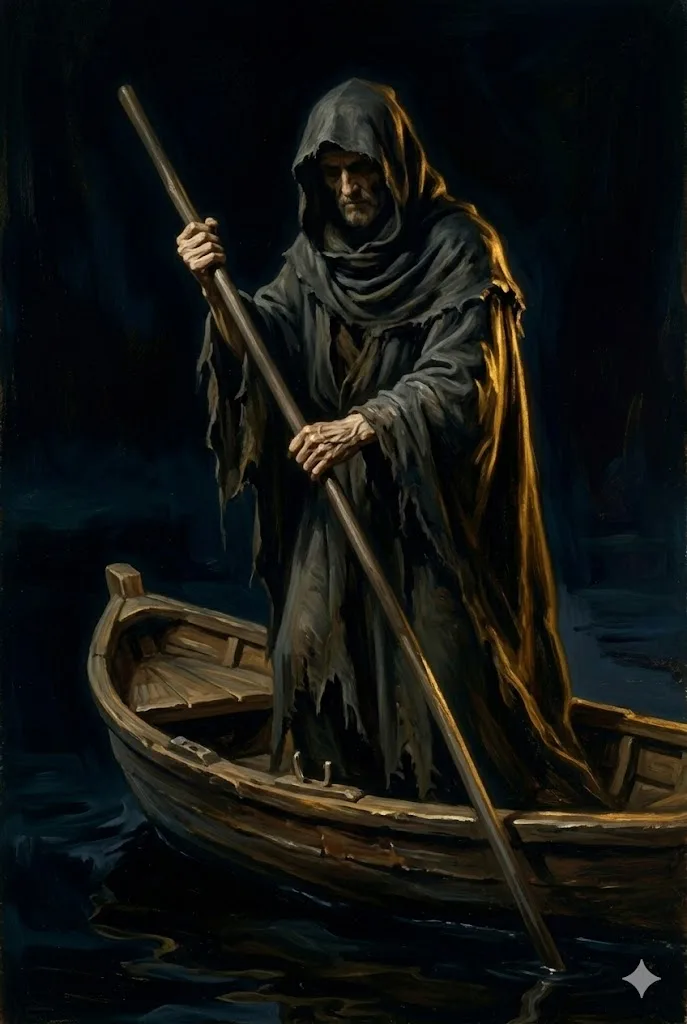
The Boatman of the Styx
Charon was the grim ferryman who transported the souls of the newly deceased across the rivers of the Underworld — in Greek sources usually the Acheron (river of woe); the Styx (river of hatred) is mainly his river in Roman poetry — to the land of the dead. He was one of the most important figures in Greek funerary religion, and the fear of being denied passage on his boat shaped burial practices throughout the ancient world for centuries.
Depicted as a gaunt, aged figure — sometimes skeletal, sometimes merely haggard — Charon stood at the stern of his dark boat, poling it across the murky waters with a long oar. His eyes burned like coals beneath a broad-brimmed hat, and his ragged cloak hung from bony shoulders. He was not evil, but he was utterly without pity — a functionary of death who performed his duty with mechanical indifference.
The Obol — Payment for Passage
Charon demanded payment from every soul who wished to cross: a single obol, a small coin of little monetary value but immense spiritual significance. This is why the ancient Greeks placed a coin in the mouth of the dead before burial — to ensure they could pay the ferryman. (Placing coins on the eyes is a later custom.) Those who could not pay — the unburied, the destitute, or those whose families had neglected the proper rites — were condemned to wander the near shore for a hundred years, unable to enter the Underworld and unable to return to the living.
Encounters with Heroes
Several heroes managed to cross the river of the dead without dying. Heracles intimidated Charon into giving him passage during his quest to capture Cerberus — and Charon was later punished by Hades with a year in chains for allowing a living mortal aboard. Orpheus charmed the ferryman with his music, and the Sibyl who guided Aeneas showed Charon a golden bough that served as a divine passport. Each of these exceptions highlighted how extraordinary the heroes were — ordinary mortals could never bypass Charon's demand.
Legacy
Charon has appeared in countless works of art from ancient vase paintings to Michelangelo's Last Judgment in the Sistine Chapel, where a terrifying Charon beats the damned with his oar. Dante placed him in the Inferno as the ferryman of Hell. The concept of paying a fee to cross into the afterlife appears in cultures worldwide, suggesting that Charon embodies a near-universal human anxiety about the transition from life to death.
Charon Before Virgil: How the Ferryman Entered Greek Belief
Charon is absent from Homer and Hesiod. When Odysseus speaks with the dead in Odyssey 11, no boatman appears, and the shades of the unburied, such as Elpenor, are simply restless. The earliest known reference came in a lost epic, the Minyas, which Pausanias quotes for a line about "the boat on which the dead embark, which the old ferryman Charon used to row." By the fifth century BC, Charon was a familiar figure in Athens, and he turns up on stage in two very different moods. In Euripides' Alcestis, the dying queen has a vision of him waiting at the lake with his hand on the pole, calling her to hurry. In Aristophanes' Frogs, he is a gruff working boatman who charges Dionysus two obols and then makes the god row himself across while a chorus of frogs croaks at him.
The famous gloomy picture of the ferryman is Roman. Virgil's Aeneid book 6 gives the portrait most later artists followed: a filthy old man with an unkempt white beard and eyes of flame, a stained cloak knotted at his shoulder, steering a rust-coloured boat. Virgil also supplies the rule about the unburied waiting a hundred years on the bank, and the episode of the Sibyl's golden bough. The story that Charon spent a year in chains for ferrying Heracles also comes from a Roman source, the commentator Servius, not from any Greek poet.
The Obol: What Archaeology Actually Shows
Coins do turn up in Greek graves, sometimes inside the skull, which fits the idea of an obol placed in the mouth. Excavators have shown, though, that the custom was never universal. Many burials have no coin at all. Others hold several coins, or thin gold leaves stamped to look like coins, and the practice varied greatly from region to region and century to century. The popular picture of coins laid over the eyes is mostly a later and post-classical habit. It has little support as a standard Greek rite. Ancient writers, Lucian among them, joked about the fee, and the satirist's Dialogues of the Dead make Charon a weary ferryman haggling with the shades of philosophers and kings, who must strip off their vanities before boarding his overloaded boat.
Charon in Greek Art
Charon became a favourite subject on Athenian white-ground lekythoi. These were slender oil flasks painted for funerals in the fifth century BC. On them he usually appears as a rugged, bearded working man in a sailor's cap (the pilos) and a short tunic, standing in his boat among reeds while Hermes, as guide of souls, leads a woman or youth toward him. These scenes are calm and even tender, nothing like the demon of later imagination. The painter Polygnotus put Charon in his great Underworld mural at Delphi, which Pausanias describes in detail. Later Greek genealogies made him a son of Erebus and Nyx, which places him among the dark children of primordial Night.
The Etruscans had a separate death-demon called Charun, a blue-skinned figure with a heavy hammer who guards tomb doorways. He borrowed the Greek name, but he is a different being, and much of the menace Renaissance artists gave Charon comes from this Etruscan strain and from Dante.
What People Often Get Wrong
- The river. Greek sources most often put Charon on the Acheron or the Acherusian lake. The Styx as his river is chiefly a Roman and later convention.
- The skeleton. Ancient Charon is an old man, not a skeleton. The skeletal ferryman comes from medieval and modern art.
- A god of death. Charon carries the dead; he does not cause death. That role belongs to Thanatos. Even so, in modern Greek folklore the name survives as Charos, a dark rider who comes for the dying, so the two ideas did eventually merge.
Ancient sources
- Euripides, Alcestis — the dying Alcestis sees Charon waiting at his boat and urging her on.
- Aristophanes, Frogs — comic Charon ferries Dionysus for two obols and makes him row; the frog chorus sings during the crossing.
- Pausanias, Description of Greece 10.28 — describes Polygnotus' Underworld painting at Delphi and quotes the lost epic Minyas on Charon's boat.
- Virgil, Aeneid 6 — the classic description of Charon, the crowd of unburied souls kept back for a hundred years, and the golden bough.
- Lucian, Dialogues of the Dead and Charon — satirical sketches of Charon collecting fares and visiting the upper world to watch mortals.
Frequently asked questions
Was Charon a god?
He was a minor divine being, not one of the great gods. He had no known cult or temples. He mattered in funerary belief and art, not in public worship.
Which river did Charon cross, the Styx or the Acheron?
Most Greek sources name the Acheron or its marsh. Roman poets and later writers shifted him to the Styx, and that version dominates today.
What happened if you couldn't pay Charon?
According to Virgil, the unburied had to wander the bank for a hundred years before crossing. Greek sources stress proper burial more than the coin itself, and the fee is often treated with humour.
Why is Pluto's moon called Charon?
When the moon was found in 1978, it was named for the ferryman who carries souls to Pluto's realm. The name was apt for a body circling the planet named after the lord of the dead.
Books to read next
- Stephen Fry, Mythos
- Edith Hamilton, Mythology
- Hesiod, Theogony and Works and Days (Oxford World's Classics)
Links go to Bookshop.org, which supports independent bookstores. We earn a small commission if you buy, at no extra cost to you.
Explore More
Underworld · Hades · Cerberus · Hermes · Home