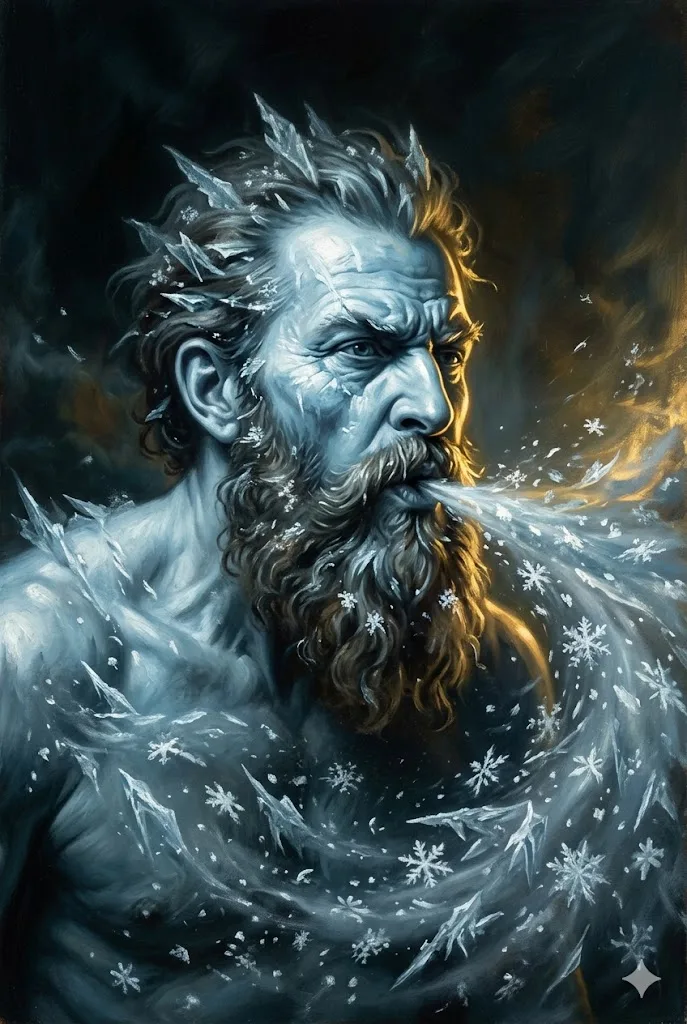
The Cold Breath of Winter
Boreas was the Greek god of the cold north wind and the bringer of winter. A winged deity of terrible power, he lived in a cave in the mountains of Thrace, the wild northern territory that the Greeks associated with cold, barbarism, and danger. When Boreas stirred, temperatures plummeted, snow blanketed the land, and the sea churned with violent storms. He was one of the four Anemoi (Wind Gods), each associated with a cardinal direction and a season. While his brothers brought gentler weather, Boreas was the most feared — his breath could freeze rivers solid and drive ships to destruction.
The Abduction of Oreithyia
The most famous myth of Boreas was his violent courtship of Oreithyia, daughter of King Erechtheus of Athens. Initially, Boreas tried diplomacy — he asked politely for her hand. But the Athenians, suspicious of anything from the barbarous north, refused. Boreas, unused to patience, simply swept down upon Oreithyia while she was playing by the river Ilissus and carried her away to Thrace. With her he fathered Calais and Zetes, the winged Boreads who later sailed with Jason and the Argonauts, as well as Chione, goddess of snow, and Cleopatra (not the Egyptian queen, but a different princess entirely).
Savior of Athens
Despite the violent abduction of their princess, the Athenians came to revere Boreas as a patron and protector. During the Persian Wars, when Xerxes' massive fleet threatened to overwhelm the Greek navy in 480 BC, the Athenians prayed to their son-in-law Boreas for help. A massive storm struck the Persian fleet off Cape Sepias, destroying hundreds of ships and killing thousands of sailors. The Athenians credited Boreas with the destruction and built him a temple on the banks of the Ilissus river where he had seized Oreithyia. Herodotus himself recorded this event, noting that the Athenians believed the north wind had answered their prayers.
The Four Winds
Boreas was the eldest and most powerful of the four Anemoi. His brothers were Zephyrus (the West Wind, bringer of spring), Notus (the South Wind, bringer of late summer storms), and Eurus (the East Wind, associated with autumn). Each was depicted as a winged man, but their temperaments differed vastly. Zephyrus was gentle and life-giving; Notus was hot and destructive to crops; Eurus was uncertain and unreliable. Boreas alone combined raw destructive power with a capacity for loyalty and protection. The Tower of the Winds (Horologion) in Athens, built around 50 BC and still standing today, depicts eight wind gods, Boreas among them, with their associated weather patterns.
Classical Sources
- 📜 Herodotus, Histories (c. 440 BC)
- 📜 Ovid, Metamorphoses (8 AD)
- 📜 Apollodorus, Bibliotheca
- 📜 Pausanias, Description of Greece (c. 150 AD)
Cross-referenced with multiple classical sources for accuracy.
Explore More
Family and Early Appearances
Hesiod's Theogony makes Boreas a son of the Titan Astraeus and Eos, the Dawn, with his brothers Zephyrus and Notus. Eurus is missing from this list and later writers added him. In the Works and Days, Hesiod gives one of the most vivid early descriptions of the wind. In the month of Lenaion, Boreas blows over the sea from horse-rearing Thrace, the earth and forests groan, and the cold cuts through the hides of cattle. But it cannot reach the soft skin of a young girl who stays indoors with her mother.
Homer gives him two memorable scenes. In Iliad Book 20 Aeneas tells how Boreas, in the form of a dark-maned stallion, mated with the mares of King Erichthonius of Dardania. The twelve fillies they bore could gallop over the tips of standing grain without breaking it and over the crests of the sea. In Book 23 Patroclus's pyre will not catch, so Achilles prays to Boreas and Zephyrus and promises them offerings. Iris fetches the winds from a feast at Zephyrus's house, and they blow all night to burn the pyre.
Oreithyia, Phineus and the Boreads
Ovid tells the Oreithyia story from Boreas's point of view in Metamorphoses Book 6. Having failed to win her with words, he reproaches himself for forgetting that force is his true nature, and he wraps the girl in his dusky wings and carries her off. Plato offers a sceptical version. In the Phaedrus, Socrates and Phaedrus walk along the Ilissus near the very spot, and Socrates mentions the rationalising view that a gust blew Oreithyia off the rocks while she played with her companion Pharmacia. He declines to spend his time explaining away such myths. Some placed the abduction on the Areopagus.
The children's stories are rich. Their daughter Cleopatra married the Thracian king Phineus, who later imprisoned or blinded the sons she bore him. Sophocles alludes to her suffering in an ode in the Antigone. Her winged brothers Calais and Zetes sailed on the Argo, and in Apollonius' Argonautica they chase the Harpies away from Phineus until Iris stops them at the Strophades islands. Apollonius also says Heracles later killed the brothers on Tenos for urging the Argonauts to sail on without him. He set up two pillars over their grave, and one of them sways whenever the north wind blows. For the voyage, see the Golden Fleece.
Worship Beyond Athens, and Art
Herodotus is precise about the event of 480 BC. Following an oracle telling them to call on their "son-in-law", the Athenians prayed and sacrificed to Boreas and Oreithyia. A violent easterly gale, which locals called a Hellespontian, then wrecked a large part of Xerxes' fleet off the Magnesian coast near Cape Sepias, below Mount Pelion. That was before the fighting at Artemisium. Herodotus says he cannot say whether Boreas caused it but that the Athenians were convinced, and they built a sanctuary of Boreas by the Ilissus. Athens was not unique. Pausanias says the people of Megalopolis sacrificed to Boreas every year because he had wrecked the siege engines of a Spartan army. Aelian records that Thurii in southern Italy made him a citizen, voted him a house and plot of land, and held annual sacrifices after a storm destroyed a fleet sent by Dionysius of Syracuse.
The abduction of Oreithyia became a favourite subject of Athenian vase painters in the decades after the Persian Wars, a clear sign of the god's new civic popularity. Boreas usually appears as a bearded, shaggy-haired winged man, sometimes with spiky, frosty hair. Pausanias describes him on the archaic Chest of Cypselus at Olympia carrying off Oreithyia with snake tails in place of feet. On the Tower of the Winds in Athens, he is a heavily cloaked old man blowing a conch shell. That monument actually shows eight winds, not four: Boreas, Kaikias, Apeliotes, Euros, Notos, Lips, Zephyros and Skiron. The Romans called him Aquilo.
Boreas also gave his name to the Hyperboreans, the blessed people "beyond the North Wind" whom Herodotus and Pindar describe and whom Apollo was said to visit every winter.
Ancient sources
- Hesiod, Theogony 378–380 and Works and Days: Boreas as son of Astraeus and Eos; the winter wind from Thrace.
- Homer, Iliad Books 20 and 23: the horse-sired fillies of Erichthonius, and the winds fanning Patroclus' pyre.
- Herodotus, Histories 7.189: the Athenian prayers to their son-in-law, the storm off Sepias, and the shrine by the Ilissus.
- Plato, Phaedrus: the Ilissus setting and the rationalised version involving Pharmacia.
- Apollonius of Rhodes, Argonautica Books 1 and 2: Calais and Zetes chasing the Harpies and their death at Heracles' hands on Tenos.
- Ovid, Metamorphoses Book 6: Boreas' speech choosing force over persuasion and the abduction of Oreithyia.
Frequently asked questions
Who are the children of Boreas?
With Oreithyia he fathered the winged twins Calais and Zetes and the daughters Cleopatra and Chione. Homer also gives him twelve divine horses sired on the mares of Erichthonius.
Why did Athens worship Boreas?
Because he had married an Athenian princess, the Athenians called him their son-in-law. They credited him with the storm that destroyed many Persian ships in 480 BC and built him a shrine by the Ilissus.
What is the Roman name for Boreas?
Aquilo, the north wind. Latin poets also used Septentrio for the north.
How many wind gods were there?
Hesiod names three, Boreas, Zephyrus and Notus, and Eurus was added as the fourth. Later systems used eight or even twelve winds, as on the Tower of the Winds in Athens.