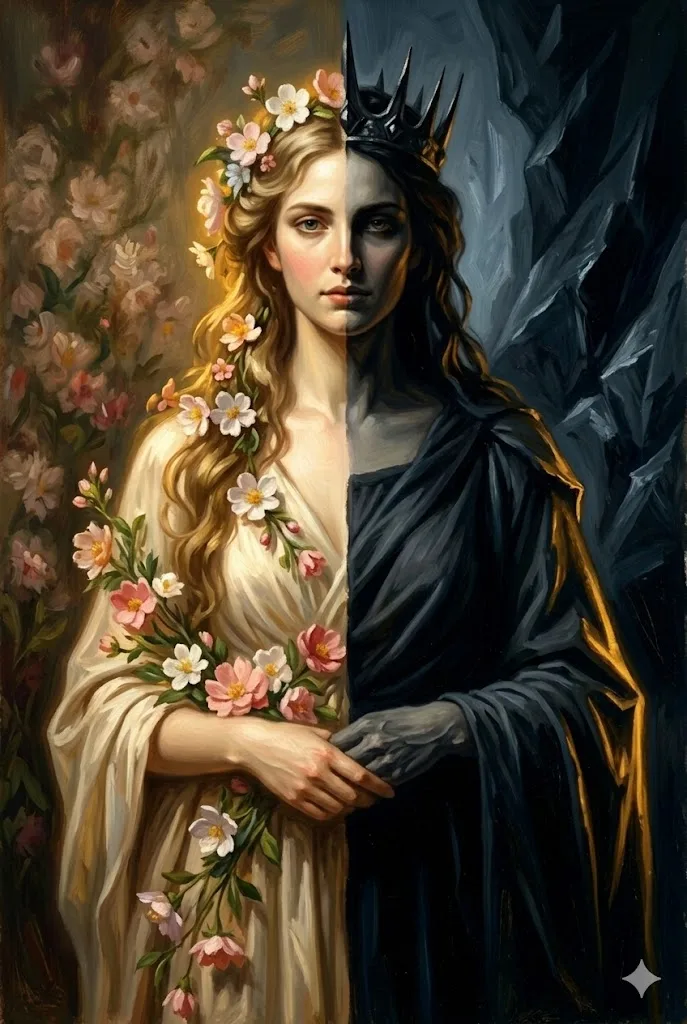
I. Who Was Persephone?
Persephone occupied one of the most unique positions in Greek mythology: she was simultaneously the goddess of spring and vegetation and the dread queen of the underworld. This duality — life and death, growth and decay, light and darkness — made her one of the most important and deeply venerated deities in the ancient Greek world, central to the Eleusinian Mysteries, the most sacred rites in all of Greek religion.
She was the daughter of Zeus and Demeter, the harvest goddess. As a young maiden, she was known as Kore ("the Girl"), and she spent her days picking flowers in the meadows of Sicily. Her life changed forever when Hades, god of the underworld, burst from the earth in his golden chariot and carried her down to his dark kingdom to be his bride.
II. The Abduction
While gathering flowers — specifically, a narcissus that Zeus had planted as a lure — Persephone was seized by Hades and dragged into the underworld. Demeter, hearing her daughter's cries, searched the earth desperately for nine days and nights. When she learned the truth from Helios, the all-seeing sun god, she was consumed by grief and rage. She withdrew her blessings from the earth, causing all crops to fail and threatening humanity with famine.
Zeus, pressured by the cries of starving mortals, ordered Hades to return Persephone. But Hades had one final trick: he offered Persephone pomegranate seeds before she left. Because she ate the food of the dead — either willingly or unwittingly — she was bound to the underworld. The compromise: Persephone would spend part of each year (spring and summer) with her mother, and part (autumn and winter) with Hades. This cycle of departure and return gave the ancient Greeks their explanation for the seasons.
III. Queen of the Dead
In the underworld, Persephone was no passive captive. She became a formidable queen — feared and respected by the dead and by heroes who ventured into her realm. When Orpheus came to plead for his wife Eurydice, it was Persephone who was moved to tears by his music and convinced Hades to allow Eurydice to leave. When Heracles descended to capture Cerberus, he sought and received Persephone's permission first.
The Eleusinian Mysteries, held annually near Athens, celebrated Persephone's story as an allegory of death and rebirth. Initiates who participated in the secret rites were promised a blessed afterlife — making Persephone's myth not just an explanation of nature, but a source of spiritual hope that sustained millions across the ancient world for nearly two thousand years.
Primary Classical Sources
The mythology of Persephone is preserved in numerous ancient texts, including:
- 📜 Homer, Iliad & Odyssey (c. 750 BC) — The foundational texts of Greek literature, containing extensive references to the gods and their interventions in mortal affairs.
- 📜 Hesiod, Theogony (c. 700 BC) — The primary source for the genealogy and origins of the Greek gods, including the succession myths and the rise of the Olympians.
- 📜 Homeric Hymns (c. 7th–6th century BC) — A collection of hymns to individual deities providing detailed mythological narratives not found elsewhere.
- 📜 Apollodorus, Bibliotheca (c. 1st–2nd century AD) — The most comprehensive ancient handbook of Greek mythology, systematically cataloguing myths and genealogies.
- 📜 Ovid, Metamorphoses (8 AD) — The Roman poet's masterwork retelling Greek myths with a focus on transformation, preserving many stories that would otherwise be lost.
- 📜 Pausanias, Description of Greece (c. 150 AD) — A detailed travelogue recording temples, cult sites, and local mythological traditions across the Greek world.
All content on this page has been cross-referenced with multiple classical sources and modern scholarly works to ensure accuracy.
Explore More Mythology
Get weekly deep dives into the gods, heroes, and myths of ancient Greece.