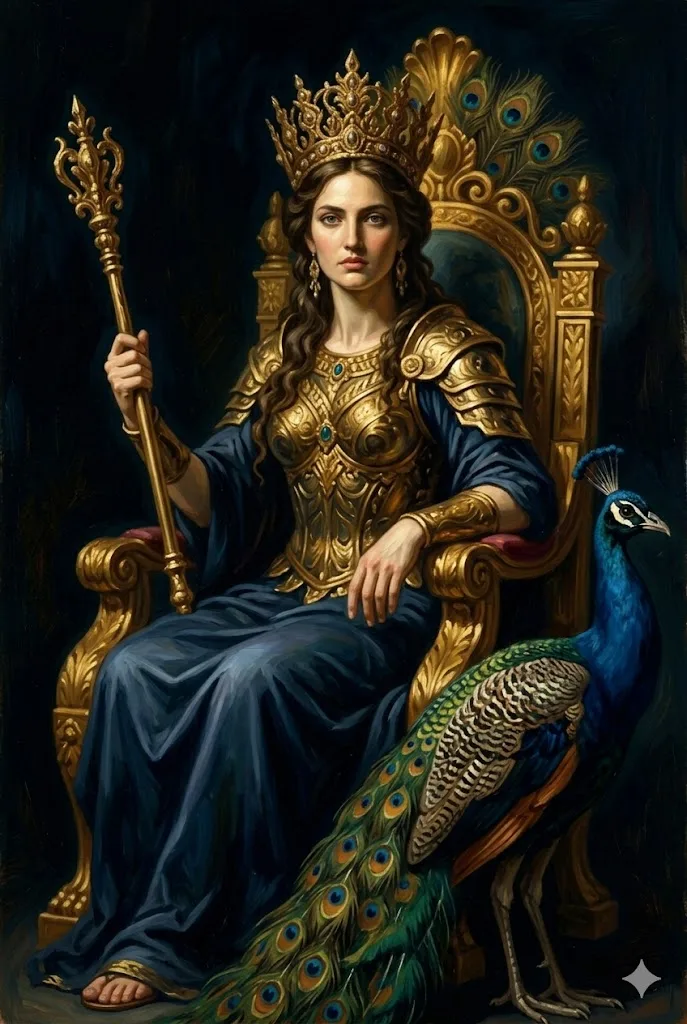
I. Who Was Hera?
Hera was the queen of the Olympian gods and the goddess of marriage, women, childbirth, and family. As the wife and sister of Zeus, she held the highest position among the goddesses — a title she defended with fierce jealousy and unrelenting vengeance against Zeus's many lovers and illegitimate children. She was both the protector of married women and the most famously wronged wife in all of mythology.
Despite her association with domestic harmony, Hera was far from passive. She was a formidable goddess in her own right — powerful enough to plot against Zeus, command storms and natural disasters, and drive heroes like Heracles to madness. The ancient Greeks portrayed her as proud, regal, and terrifyingly determined: a queen who would stop at nothing to defend her honor and punish those who threatened her position.
Her sacred animals were the peacock (whose tail was said to bear the hundred eyes of her slain servant Argus), the cow (symbolizing her role as a nurturing mother figure), and the cuckoo (the form Zeus took when he first seduced her). The pomegranate, symbol of fertility, was her sacred fruit, and the city of Argos was her most devoted center of worship.
II. The Wrath of Hera
Hera's most famous conflicts were with Zeus's lovers and children. She persecuted Heracles from the moment of his birth — sending serpents to his cradle, driving him to temporary madness (causing him to kill his own family), and engineering the Twelve Labours that defined his life. Ironically, his name means "Glory of Hera," a reminder that even her persecution ultimately served to make him the greatest hero in mythology.
She tormented Leto during her pregnancy with Apollo and Artemis, forbidding any land from sheltering her. She transformed Io, one of Zeus's lovers, into a cow and set the hundred-eyed giant Argus to guard her. She caused the death of Semele, mother of Dionysus, by tricking her into demanding to see Zeus in his true divine form — a sight no mortal could survive.
III. Worship & Legacy
Despite her fearsome reputation, Hera was deeply revered as the protector of marriage and women. Her main temple, the Heraion, was located near Argos and was one of the oldest and most important sanctuaries in Greece. The Heraia, women's athletic games held in her honor at Olympia, predated the Olympic Games themselves. As Juno in Roman religion, she became the patron goddess of the Roman state and gave her name to the month of June — still the most popular month for weddings.
Hera's own children and quarrels on Olympus
Hesiod gives Hera and Zeus three children: Ares, Hebe (youth) and Eileithyia, the goddess of childbirth. Hera could delay or speed up a birth through Eileithyia, and that is exactly how she worked against Heracles. In the Iliad, Agamemnon tells how she held back the birth of Heracles and hurried the premature birth of Eurystheus, so that Zeus' oath about a descendant ruling Argos would fall to the wrong child. Hesiod also says that Hera, angry at the birth of Athena, bore Hephaestus on her own without a father. The Homeric Hymn to Apollo goes further: there, in the same anger, she produces the monster Typhon by herself.
Her relationship with Hephaestus was strained. In the Iliad he recalls that his mother threw him out of heaven because he was lame, and he was caught and cared for in the sea by Thetis and Eurynome. Another story, told by the poet Alcaeus and depicted on many Athenian vases, says Hephaestus took revenge by sending her a golden throne that held fast whoever sat on it. Only Dionysus could get him back to Olympus to free her, by making him drunk and leading him home on a donkey.
Homer also shows Hera as an active conspirator. Achilles recalls that Hera, Poseidon and Athena once tried to bind Zeus, and Thetis foiled them by fetching the hundred-handed Briareus. In Book 15, Zeus reminds Hera of the time he hung her from the sky with golden chains and two anvils tied to her feet as punishment for persecuting Heracles.
The Deception of Zeus and other episodes
The most elaborate scene of Hera in Homer is Iliad Book 14, which ancient readers called the Dios Apate, "the Deception of Zeus". She wants to stop him helping the Trojans. She bathes in ambrosia, dresses with care, and borrows Aphrodite's embroidered band, which holds love, desire and seductive talk. She then bribes Hypnos with the promise of one of the Graces as a wife and seduces Zeus on Mount Ida, where the earth sends up flowers beneath them. While Zeus sleeps, Poseidon rallies the Greeks.
Other episodes show her as more than a jealous wife. In Apollonius' Argonautica, Hera is Jason's chief protector. She had tested him by appearing as an old woman at the flooded river Anauros, and he carried her across. She also wants revenge on King Pelias, who had neglected her sacrifices. The mortal Ixion tried to seduce her, and Zeus shaped a cloud in her likeness. Ixion's union with it produced the ancestor of the Centaurs, and he was bound to a fiery wheel (Pindar, Pythian 2). Ovid tells how Hera blinded Tiresias after he sided with Zeus in their argument over whether men or women get more pleasure from love.
Cult titles and sanctuaries
Hera's epithets followed a woman's life. At Stymphalos in Arcadia, Pausanias reports three sanctuaries to Hera as Pais (girl), Teleia (fulfilled, or wedded) and Chera (widowed or separated). Near Nauplia was the spring Kanathos, where, the Argives said, Hera bathed every year and became a maiden again. Homer's standard epithets for her are boopis, "cow-eyed", and leukolenos, "white-armed".
Her largest sanctuaries were the Argive Heraion and the Heraion of Samos, where Samians said she was born under a willow (lygos) tree beside the river Imbrasos. The temples built there in the sixth century BC were among the largest in the Greek world. In southern Italy she was worshipped as Hera Lacinia on the cape near Croton, where one column still stands. At the Argive Heraion, Pausanias saw Polykleitos' gold-and-ivory statue of the goddess seated on a throne. She held a pomegranate in one hand and a sceptre topped by a cuckoo in the other. Pausanias says the pomegranate story was too sacred to repeat. The cuckoo recalled the form Zeus took to court her.
Modern retellings tend to reduce Hera to jealousy alone. In cult, she was a powerful civic goddess, the patron of Argos and Samos, and the guarantor of lawful marriage. For a closer look at how she is judged, see Hera: villain or victim? and the wives of Zeus.
Ancient sources
- Homer, Iliad 14.153–353: the Deception of Zeus on Mount Ida, with Aphrodite's band and the help of Hypnos.
- Homer, Iliad 1.396–406, 15.18–24 and 19.95–133: the plot to bind Zeus, Hera's punishment with the anvils, and the delayed birth of Heracles.
- Hesiod, Theogony 921–929: Hera's children by Zeus and her fatherless birth of Hephaestus.
- Homeric Hymn to Apollo: Hera bears Typhon without Zeus in anger at the birth of Athena.
- Apollonius of Rhodes, Argonautica: Hera as patron of Jason and enemy of Pelias.
- Pausanias, Description of Greece, Books 2 and 8: the Argive Heraion and Polykleitos' statue, the spring Kanathos, and the three sanctuaries at Stymphalos.
Frequently asked questions
Who are Hera's children?
By Zeus: Ares, Hebe and Eileithyia. Hesiod says she bore Hephaestus without a father, and the Homeric Hymn to Apollo says she bore Typhon alone.
Why does Hera hate Heracles?
He was the son of Zeus by the mortal Alcmene, and Zeus intended him to rule. Hera delayed his birth so that Eurystheus would get that power, then pursued Heracles throughout his life. After his death and deification they were reconciled, and she gave him her daughter Hebe as a wife.
Where was Hera born?
The Samians said she was born on Samos beneath a willow tree beside the river Imbrasos. Argos also claimed her as its own.
What is the Heraion?
A sanctuary of Hera. The two most famous were near Argos and on Samos. Olympia also had an early temple of Hera, one of the oldest in Greece.
Explore More Mythology
Get weekly deep dives into the gods, heroes, and myths of ancient Greece.