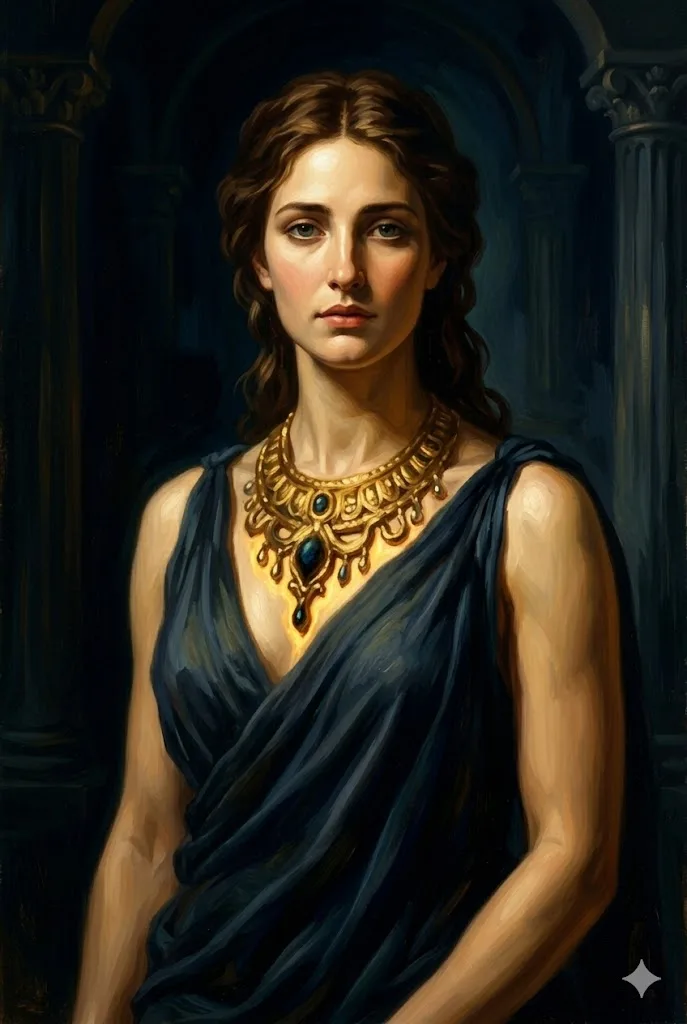
Daughter of Opposites
Harmonia was the goddess of harmony and concord, and her parentage was the most symbolically perfect in Greek mythology. She was the daughter of Ares (War) and Aphrodite (Love), making her the literal offspring of the two most opposing forces in the cosmos. The Greeks understood that true harmony is not the absence of conflict but the balance between opposing forces. Peace without passion is stagnation. Passion without peace is destruction. Harmonia is what exists when the two are held in perfect tension.
The Wedding
Harmonia married Cadmus, the legendary founder of Thebes, in a wedding almost as famous as that of Peleus and Thetis. All the gods attended and brought gifts. But Hephaestus, who had been cuckolded by Ares and Aphrodite, gave Harmonia a cursed wedding gift: a magnificent golden necklace that brought misfortune and death to every woman who possessed it. Some say the necklace was crafted with bitterness woven into its gold, Hephaestus's revenge for his wife's affair.
The Curse
The Necklace of Harmonia became one of the most dangerous objects in Greek mythology. It passed through generations, bringing ruin to every owner. Jocasta, mother and wife of Oedipus, owned it. Eriphyle, who betrayed her husband for it, owned it. The necklace was eventually dedicated at the Temple of Apollo at Delphi, where it presumably could cause no more harm. The curse of the necklace drove much of the mythological cycle of Thebes, one of the most tragic storylines in all of Greek myth.
Transformation
In old age, after witnessing the destruction of the family they founded in Thebes, Cadmus and Harmonia were transformed by the gods into serpents. This transformation, unlike most in Greek mythology, was not a punishment but a mercy. They slithered away from human suffering together, still a couple, still in harmony, escaping the cycle of curse and violence that had consumed their descendants.
Classical Sources
- 📜 Homer, Iliad & Odyssey (c. 750 BC)
- 📜 Hesiod, Theogony (c. 700 BC)
- 📜 Apollodorus, Bibliotheca (c. 1st-2nd century AD)
- 📜 Ovid, Metamorphoses (8 AD)
Cross-referenced with multiple classical sources for accuracy.
Explore More
Ares · Aphrodite · Hephaestus · Oedipus · Home