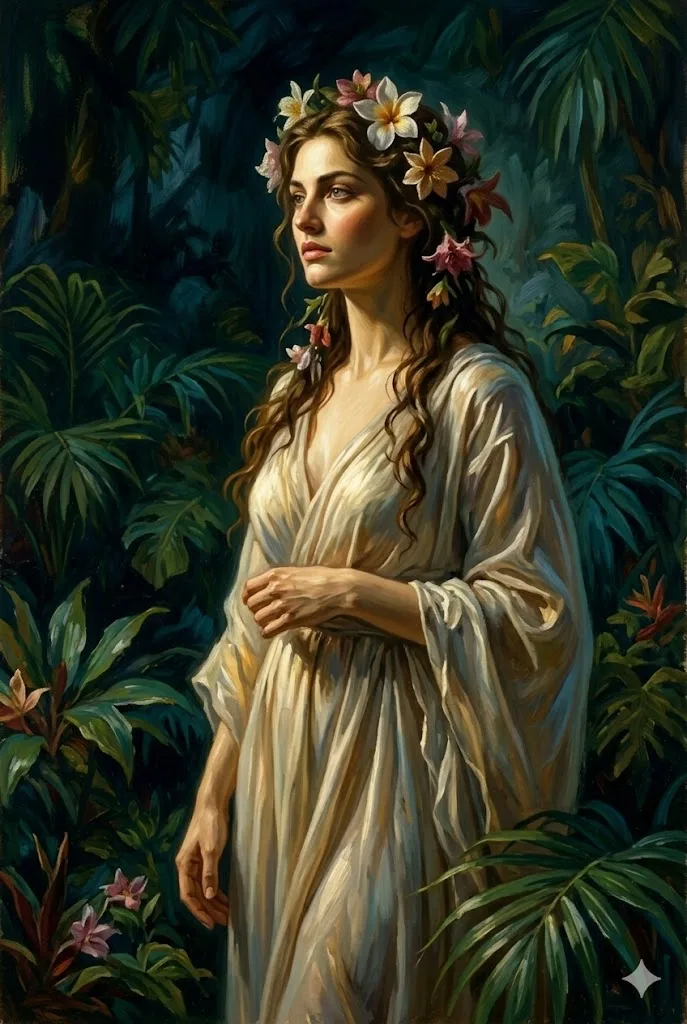
The Hidden Goddess
Calypso was a goddess (or nymph, depending on the source) who lived alone on the island of Ogygia, described by Homer as the navel of the sea, a paradise of lush meadows, singing birds, and cascading vines. Her name comes from the Greek kalyptein, meaning 'to conceal' or 'to hide,' and her island was so remote that no ship could find it unless the gods willed it. She was a daughter of the Titan Atlas in most accounts.
Seven Years
When Odysseus washed ashore on Ogygia after losing his entire crew, Calypso took him in, healed him, and fell in love with him. She kept him on her island for seven years, offering him everything a mortal could dream of: comfort, luxury, her own bed, and the ultimate gift, immortality and eternal youth. If Odysseus stayed, he would never grow old and never die. He would live forever in paradise with a goddess.
He Said No
Odysseus refused. Every day he sat on the shore staring at the sea, weeping for his home, his wife Penelope, and his son Telemachus. He chose mortality and a rocky island kingdom over godhood and eternal paradise. This is one of the most defining moments in all of mythology. It tells us what Homer valued most: home, family, and the authenticity of a mortal life, even with all its suffering, over an immortal existence that feels like a cage.
The Release
After seven years, Athena convinced Zeus to order Calypso to release Odysseus. Hermes delivered the message. Calypso obeyed but not without bitterness. She pointed out the hypocrisy of the male gods: they took mortal lovers freely, but when a goddess loved a mortal man, they intervened. Her protest is one of the earliest critiques of divine double standards in Western literature. She helped Odysseus build a raft, gave him provisions, and sent him on his way with fair winds, knowing she would be alone again.
Classical Sources
- 📜 Homer, Iliad & Odyssey (c. 750 BC)
- 📜 Hesiod, Theogony (c. 700 BC)
- 📜 Apollodorus, Bibliotheca (c. 1st-2nd century AD)
- 📜 Ovid, Metamorphoses (8 AD)
Cross-referenced with multiple classical sources for accuracy.
Explore More
Odysseus · The Odyssey · Athena · Ithaca · Home