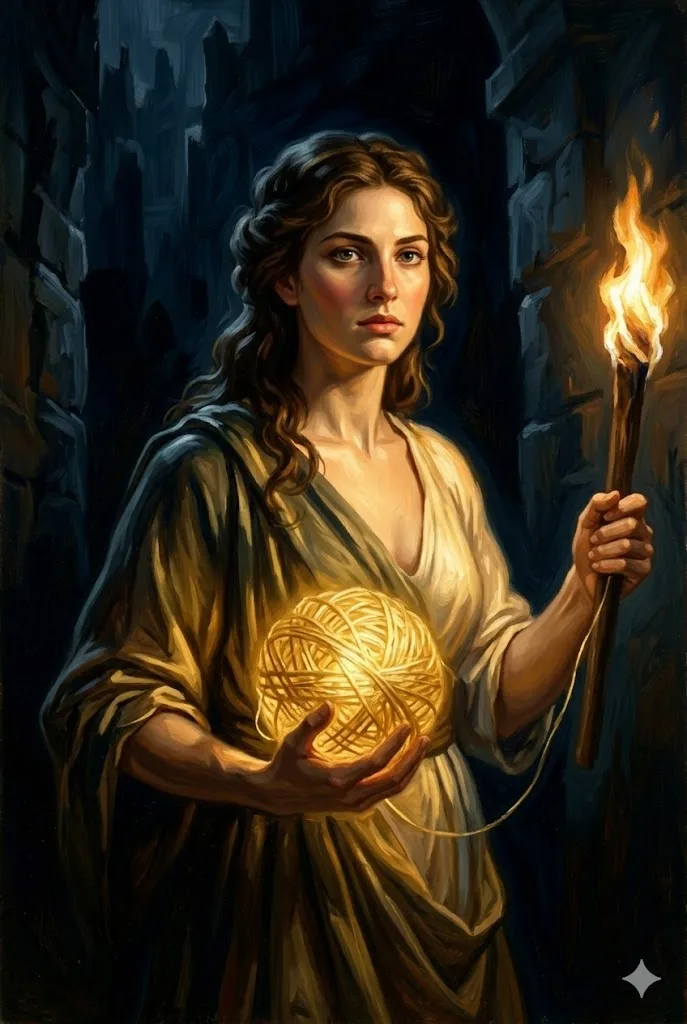
The Thread
Ariadne was a princess of Crete, daughter of King Minos and Pasiphaë. When the Athenian hero Theseus arrived as one of fourteen youths to be fed to the Minotaur, Ariadne fell in love with him. She approached the craftsman Daedalus and learned the secret to surviving the Labyrinth: a ball of thread. She gave Theseus the thread and a sword, instructing him to tie one end at the entrance and follow it back after killing the beast. Without Ariadne's help, Theseus would have died in the maze like everyone before him.
The Abandonment
After Theseus killed the Minotaur and escaped the Labyrinth, he fled Crete with Ariadne. But on the island of Naxos, while Ariadne slept, Theseus sailed away without her. The reasons vary by source: some say he forgot her, some say Athena commanded him to leave her, some say he was simply cruel. Ariadne woke alone on a strange island, watching the sail of the man she had betrayed her family for disappearing over the horizon. It is one of the most devastating moments of abandonment in mythology.
The Divine Marriage
But Ariadne's story does not end in tragedy. The god Dionysus found her weeping on Naxos and fell in love with her. He married her and elevated her to divine status, making her an immortal goddess. As a wedding gift, he gave her a crown of stars, which he later placed in the sky as the constellation Corona Borealis (the Northern Crown). Ariadne went from abandoned mortal to queen of a god, from the lowest moment of her life to eternal glory.
The Transformation
Ariadne's story is one of the few in Greek mythology where a woman who is wronged by a hero ends up in a better position than the hero himself. Theseus went on to cause the death of his own father Aegeus, was eventually overthrown and exiled from Athens, and died by being pushed off a cliff. Ariadne became immortal, beloved by a god, and honoured with a constellation. The myth suggests that the gods sometimes correct the injustices that heroes create.
Classical Sources
- 📜 Homer, Iliad & Odyssey (c. 750 BC)
- 📜 Hesiod, Theogony (c. 700 BC)
- 📜 Apollodorus, Bibliotheca (c. 1st-2nd century AD)
- 📜 Ovid, Metamorphoses (8 AD)
Cross-referenced with multiple classical sources for accuracy.