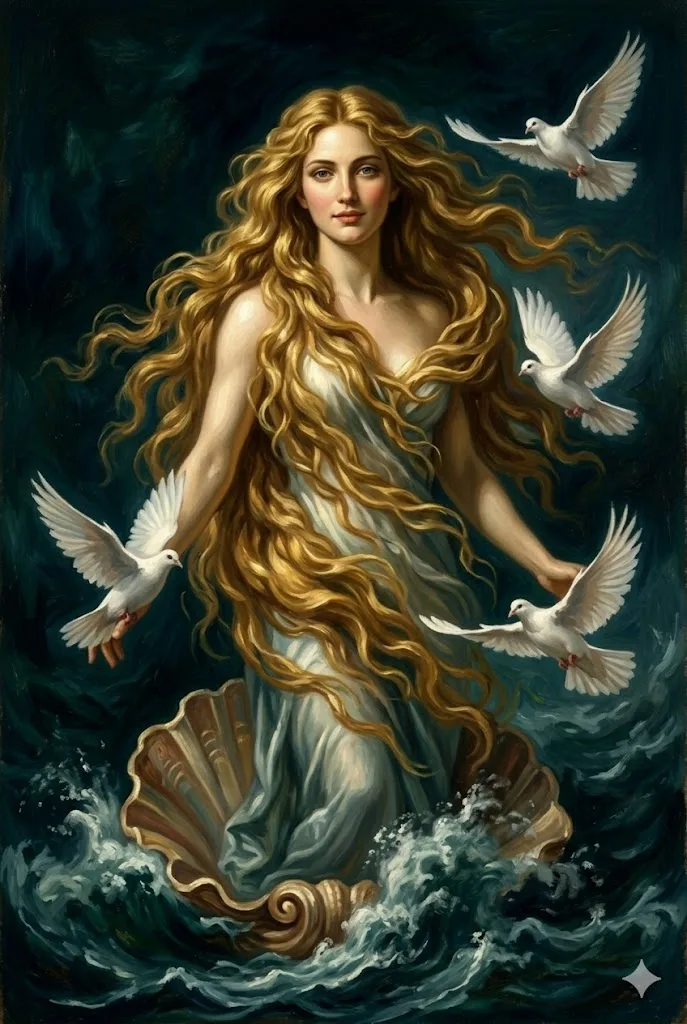
I. Who Was Aphrodite?
Aphrodite was the Greek goddess of love, beauty, pleasure, passion, and procreation. Her power was unique among the Olympians — she could make any god or mortal fall hopelessly in love, and her influence extended into every aspect of human life where desire played a role: romance, marriage, fertility, and even the beauty of art and nature. Even Zeus, king of the gods, was not immune to her charms.
She was both adored and feared. Aphrodite could bless lovers with passion and devotion, but she could also punish those who scorned love or boasted of being immune to desire. Entire kingdoms rose and fell because of her influence — most notably in the Trojan War, which began because of a beauty contest involving Aphrodite and ended with the destruction of one of the greatest cities in the ancient world.
The Greeks understood Aphrodite as embodying the irresistible force of attraction that binds the universe together. She was not merely the goddess of romantic love, but of the primal creative force that drives all living things toward union and reproduction. Flowers bloomed in her footsteps, birds sang at her approach, and the sea calmed when she appeared above the waves — for she was, according to the oldest myths, born from the ocean itself.
II. Birth from the Sea
Aphrodite's birth is among the most striking images in all of mythology. According to Hesiod's Theogony — the oldest surviving account — when the Titan Cronus castrated his father Uranus and threw the severed parts into the sea, a white foam gathered around them. From this foam (aphros in Greek, giving the goddess her name), Aphrodite emerged fully formed: a grown woman of supernatural beauty rising from the waves near the island of Cyprus.
She drifted across the sea on a scallop shell (an image immortalized in Botticelli's famous painting "The Birth of Venus") and first stepped ashore at Paphos, on the western coast of Cyprus. The Horae (goddesses of the seasons) greeted her, clothed her in fine garments, and adorned her with golden jewelry before presenting her to the gods of Olympus. Every deity who beheld her was struck by her beauty, and many immediately desired her as a wife.
A later tradition, found in Homer, gives Aphrodite a simpler origin: she was the daughter of Zeus and the Oceanid Dione. This version made her more firmly a member of the Olympian family, but the sea-born version remained the more popular and powerful image throughout antiquity.
III. Powers & Influence
Aphrodite's primary power was irresistible attraction. She possessed a magical girdle (called the cestus) woven with desire, longing, and seduction — and anyone who wore it became irresistible to all who beheld them. Even Hera, queen of the gods, once borrowed the cestus to rekindle Zeus's desire for her during a critical moment in the Trojan War.
Working alongside her son Eros (Cupid in Roman mythology), Aphrodite could kindle or extinguish love at will. She rewarded those who honored love with happiness and fulfillment, but punished those who rejected or mocked desire with obsessive, destructive passions. The myth of Hippolytus — who devoted himself entirely to the virgin goddess Artemis and scorned Aphrodite — ended in tragedy when the love goddess caused his stepmother Phaedra to fall desperately in love with him, destroying both their lives.
IV. Love, Marriage & Affairs
In one of mythology's greatest ironies, the goddess of beauty was married to Hephaestus, the god of the forge — the only physically imperfect Olympian. Zeus arranged the marriage either to prevent the other gods from fighting over her or as a reward to Hephaestus for his craftsmanship. The marriage was unhappy; Aphrodite carried on a long and passionate affair with Ares, the handsome god of war.
When Hephaestus discovered the affair, he crafted an unbreakable golden net and trapped the lovers in bed together, then invited all the gods to witness their humiliation. Rather than shaming Aphrodite, however, the spectacle merely reinforced her power — Poseidon and Hermes both openly declared they would trade places with Ares in an instant.
Aphrodite's children include Eros (by Ares or by unknown parentage), Phobos and Deimos (Fear and Terror, by Ares), Harmonia (by Ares), and Aeneas (by the mortal Trojan prince Anchises). Through Aeneas, she was considered the divine ancestor of the Roman people — the poet Virgil's Aeneid traces the founding of Rome back to Aphrodite's mortal son.
V. Famous Myths
The Judgment of Paris
The event that triggered the Trojan War began with a golden apple inscribed "To the Fairest," thrown among the gods by the goddess of strife, Eris. Three goddesses — Hera, Athena, and Aphrodite — each claimed the apple. Zeus appointed the Trojan prince Paris as judge. Each goddess offered a bribe: Hera promised power, Athena promised wisdom and victory in war, and Aphrodite promised the most beautiful woman in the world — Helen of Sparta. Paris chose Aphrodite, and when he sailed to Sparta and spirited Helen away to Troy, the greatest war in Greek mythology began.
Aphrodite and Adonis
Aphrodite fell deeply in love with the breathtakingly handsome mortal Adonis. She spent her days on earth with him rather than on Olympus, warning him to avoid dangerous animals during his hunts. Adonis ignored her warnings and was fatally gored by a wild boar (sent, in some versions, by the jealous Ares). Aphrodite rushed to his side, but it was too late. From his blood grew the anemone flower, and from her tears falling upon it, the rose turned red. Zeus eventually decreed that Adonis would spend part of each year with Aphrodite in the upper world and part with Persephone in the underworld — a myth paralleling the seasonal cycle.
Pygmalion and Galatea
The sculptor Pygmalion, disgusted by the faults of mortal women, carved an ivory statue of his ideal woman and fell deeply in love with it. He prayed to Aphrodite during her festival, and the goddess, moved by the sincerity of his devotion, brought the statue to life. The woman, named Galatea, married Pygmalion, and they lived together happily — a testament to the power of love to transform the impossible into reality.
"She is more beautiful than all other immortal goddesses, and even the wisest of gods cannot resist her power." — Ancient hymn to Aphrodite (paraphrased)
VI. Worship & Legacy
Aphrodite's cult was widespread, with major sanctuaries at Paphos and Amathus on Cyprus, Cythera, Corinth, and Athens. The temple at Corinth was famously associated with sacred prostitution, though modern scholars debate the accuracy of this claim. Her festivals included the Aphrodisia, celebrated across Greece with offerings of flowers, incense, and doves.
As Venus, her Roman equivalent, she became even more important — revered as the ancestress of the Julian family (through Aeneas and his descendant Julius Caesar) and the personification of Roman imperial destiny. The planet Venus, the second from the sun and the brightest object in the night sky after the moon, bears her Roman name. The word "aphrodisiac" derives directly from her Greek name, and her image — from Botticelli's masterpiece to modern pop culture — remains the definitive symbol of beauty and desire in Western civilization.
VII. Quick Facts
Aphrodite and Anchises: the Homeric Hymn
The longest early story about Aphrodite is the fifth Homeric Hymn. Zeus, tired of her boasting that she had made every god fall for mortals, turns her own power against her and fills her with desire for the Trojan herdsman Anchises on Mount Ida. She bathes and is dressed by the Graces in her temple at Paphos, then comes to Anchises disguised as a young Phrygian princess. She tells him a story about being carried off by Hermes to become his bride, and they sleep together. Afterwards she shows him who she is. Anchises is terrified, because sleeping with a goddess was believed to cost a man his strength. She promises him a son, Aeneas, who will rule the Trojans, but warns him never to say who the mother is. Later tradition says Anchises boasted anyway and was lamed or blinded by Zeus's thunderbolt. Along the way the hymn tells the stories of Ganymede and of Tithonus, whom Eos made immortal but forgot to make ageless, as Aphrodite explains why she cannot give Anchises immortality.
The Iliad shows her less flatteringly. When she rescues Aeneas on the battlefield, Diomedes, inspired by Athena, stabs her through the wrist. Divine ichor flows, and she runs back to Olympus to cry in the lap of her mother Dione. Zeus tells her gently that war is not her business and she should leave it to Ares and Athena. In Book 3, when Helen refuses to go back to Paris's bedroom, Aphrodite threatens her until she obeys. The goddess of love in Homer can be frightening.
Lesser-known myths of her anger and favour
- The women of Lemnos: according to Apollodorus, the women of Lemnos neglected her worship, and she cursed them with a foul smell. Their husbands took Thracian concubines, and the women murdered every man on the island, which is why the Argonauts found it ruled by women.
- Hippomenes and Atalanta: in Ovid she gives Hippomenes three golden apples from her sanctuary at Tamasus on Cyprus so he can beat Atalanta in the footrace. When he forgets to thank her, she makes the couple desecrate a shrine of Cybele, and they are turned into lions.
- Myrrha: some versions say Aphrodite caused Myrrha's incestuous desire for her father as punishment for her mother's boasting. The child born of that union was Adonis.
- Psyche: in Apuleius's Latin novel, Venus is jealous of a mortal girl worshipped for her beauty and sends Cupid to make her fall for a monster. See Cupid and Psyche.
Epithets, cult and Near Eastern roots
Many Greeks thought Aphrodite came from the east, and the evidence largely supports them. Herodotus says her oldest temple was the shrine of Aphrodite Ourania at Ascalon in Philistia, and that the Cypriots and the people of Cythera founded their own sanctuaries from it. Her links with the Phoenician Astarte and the Mesopotamian Ishtar are widely accepted, and Cyprus, with its mixed Greek and Phoenician population, was the natural meeting point. Hesiod already calls her Cypris (Cyprus-born) and Cythereia, after her two sea-born landfalls.
Her titles show how wide her range was. As Ourania, "heavenly", she was honoured at Athens and elsewhere. In Plato's Symposium the speaker Pausanias contrasts her with Pandemos, "of all the people", and turns the pair into the high and low forms of love, a philosophical reading the cult titles did not originally carry. Pandemos at Athens was a civic goddess linked with the unity of the city. At Sparta and Corinth Aphrodite was shown armed. Hesiod calls her philommeides, "laughter-loving", and adds a pun on medea, "genitals", recalling her birth. Strabo's famous claim that her temple on Acrocorinth kept over a thousand temple prostitutes is the main source for the "sacred prostitution" story, and many historians now doubt it was true.
Aphrodite in sculpture
The turning point in her image was the Aphrodite of Knidos by Praxiteles, carved around 350 BC. Pliny tells how the people of Kos chose a clothed statue and the people of Knidos bought the nude one, which became one of the most famous artworks of antiquity and the first major life-size female nude in Greek sculpture. It survives only in Roman copies. Later variations include the crouching Aphrodite, the Capitoline and Medici types, and the Hellenistic Aphrodite of Melos (the Venus de Milo) in the Louvre. The scallop shell is not only a Renaissance invention. Roman wall paintings, including one at Pompeii, already show her reclining in a shell, long before Botticelli.
Ancient sources
- Hesiod, Theogony 188–206: her birth from the foam around Uranus's severed genitals, her landfall at Cythera and Cyprus, her names, and Eros and Himeros attending her.
- Homeric Hymn 5, To Aphrodite: the seduction of Anchises on Mount Ida and the promise of Aeneas.
- Homer, Iliad 3 and 5; Odyssey 8.266–366: forcing Helen back to Paris, her wounding by Diomedes, and Demodocus's song of her affair with Ares.
- Sappho, fragment 1: a prayer calling "deathless Aphrodite" down from heaven in a chariot drawn by sparrows to help the poet in love.
- Herodotus, Histories 1.105: the temple of Aphrodite Ourania at Ascalon as the oldest of her shrines.
- Ovid, Metamorphoses 10: Pygmalion, Myrrha, Adonis, and the golden apples of Hippomenes.
Frequently asked questions
Was Eros the son of Aphrodite?
Not in the earliest source. Hesiod makes Eros one of the first cosmic powers, older than Aphrodite, who simply accompanies her after her birth. Making him her son, usually by Ares, is a later tradition. More of her children are covered in children of Aphrodite.
Where was Aphrodite's main sanctuary?
Old Paphos on Cyprus, where she was worshipped as a cone-shaped sacred stone, not a human-shaped statue. Tacitus and Roman coins describe that stone.
Why did Aphrodite support Troy in the Trojan War?
Paris had judged her the fairest and she had promised him Helen. Her son Aeneas also fought for Troy. See the Judgement of Paris.
Is Aphrodite the same as Venus?
The Romans identified their Venus, originally a goddess of gardens and charm, with Aphrodite and took over her myths. Venus's role as ancestor of Rome through Aeneas is a Roman development.
Explore More Mythology
Get weekly deep dives into the gods, heroes, and myths of ancient Greece.