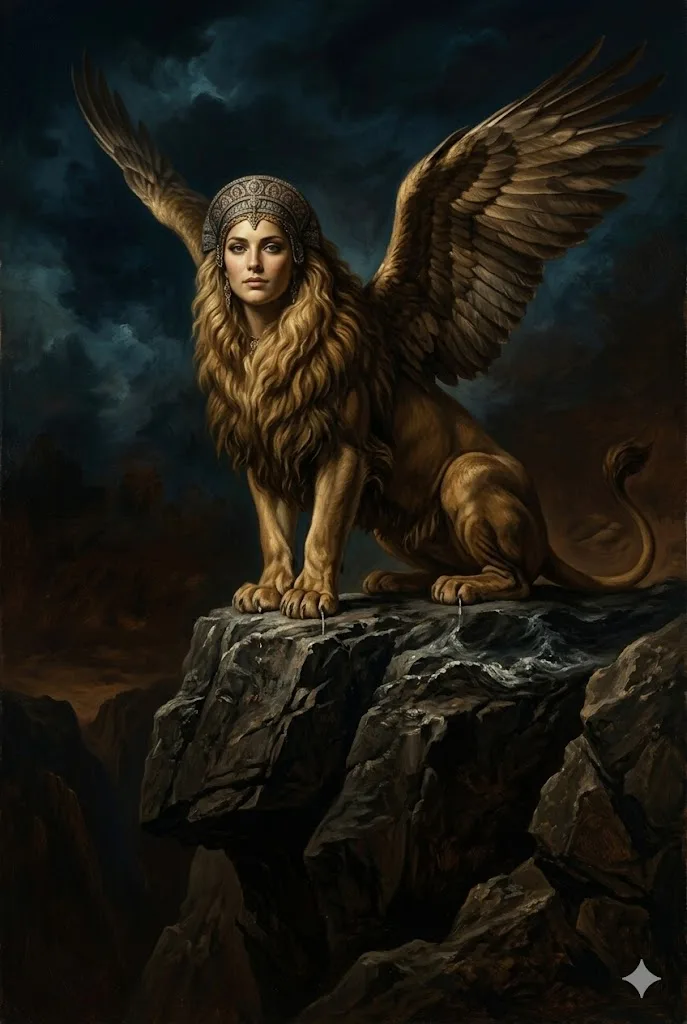
I. What Was the Sphinx?
The Sphinx was a fearsome monster sent by the gods to plague the city of Thebes — a creature with the head and breasts of a woman, the body of a lion, and the wings of an eagle. She perched on a high rock outside the city gates and posed a riddle to every traveler who passed. Those who could not answer were strangled and devoured. None could solve her puzzle, and the roads to Thebes became littered with bones.
Her famous riddle was: "What creature walks on four legs in the morning, two at noon, and three in the evening?" The answer, which the hero Oedipus finally gave, was "Man" — who crawls as a baby, walks upright in adulthood, and uses a cane in old age. When Oedipus solved the riddle, the Sphinx hurled herself from her rock and perished. Oedipus was hailed as Thebes's savior and made king — though his triumph set in motion one of the most tragic stories in all of mythology.
The Greek Sphinx was distinct from the Egyptian Sphinx (which was male and benevolent). The Greek version represented the dangers of hidden knowledge and the devastating consequences of confronting the truth — themes that permeate the entire Oedipus cycle.
Classical Sources
Ancient accounts of The Sphinx appear in:
- 📜 Hesiod, Theogony (c. 700 BC) — Origin and genealogy of mythological creatures.
- 📜 Apollodorus, Bibliotheca (c. 1st–2nd century AD) — Detailed descriptions of monsters and their encounters with heroes.
- 📜 Ovid, Metamorphoses (8 AD) — Vivid retellings of creature myths with emphasis on transformation.
- 📜 Homer, Iliad & Odyssey (c. 750 BC) — Encounters with mythological beasts during the Trojan War cycle.
Cross-referenced with multiple classical sources for accuracy.
Who sent the Sphinx, and why Thebes?
The ancient sources do not agree on why the monster came to Thebes. Apollodorus says Hera sent her, and the usual explanation is Hera's anger at Laius, who had abducted and abused Chrysippus, the young son of Pelops. Ancient commentators on the tragedians give other answers: some blame Ares, still angry that Cadmus had killed his sacred dragon when he founded the city, and others blame Dionysus. In each version the Sphinx punishes the royal house of Thebes for an old crime, so her arrival already belongs to the family curse that runs through the Oedipus story.
Her family tree also differs from author to author. In Hesiod's Theogony she is called Phix, "the ruin of the Cadmeans". Her mother is Echidna (or perhaps the Chimaera, since the Greek is ambiguous) and her father is the two-headed dog Orthus, not Typhon. Apollodorus gives the better-known parentage, Typhon and Echidna. The name Phix survived in the name of Mount Phikion, a hill near Thebes that local tradition pointed to as her lair.
Apollodorus also says she learned her riddle from the Muses. In his version the Thebans had been told by an oracle that they would be freed once the riddle was solved. They met in assembly again and again to work on it, and every time they failed she carried one of them off. When Creon's son Haemon was killed, Creon announced that whoever solved the riddle would get the kingdom and the widowed queen Jocasta. That reward is why Oedipus's victory led straight to his marriage with his own mother.
The riddle in its ancient form
The neat version about four legs in the morning, two at noon and three in the evening is a later paraphrase. The oldest surviving wording is a short hexameter poem quoted by Athenaeus from the mythographer Asclepiades. It speaks of a creature on earth that is two-footed, four-footed and three-footed and has a single voice, and that moves most slowly when it walks on the most feet. The image of a day standing for a lifetime is the interpreters' addition, not part of the riddle. Later writers also record a second riddle, about two sisters who each give birth to the other. The answer is day and night.
Not every version has Oedipus win with words alone. Pausanias records rationalising stories in which the Sphinx was a woman bandit who raided the countryside with a fleet and an army, or an illegitimate daughter of Laius who tested her half-brothers' claims to the throne. Some vase painters show Oedipus facing her with a spear.
The Sphinx in Greek art
The sphinx was a favourite motif in Greek art long before tragedy made her the riddler of Thebes. In Archaic Attica, carved sphinxes sat on top of grave stelai as guardians of the dead. Around 560 BC the people of Naxos set up a colossal marble sphinx on a tall Ionic column at Delphi, and it is still one of the highlights of the Delphi museum. Pausanias saw a sphinx on the helmet of Pheidias's gold-and-ivory Athena Parthenos. The best-known scene of the encounter is on an Attic red-figure cup of about 470 BC in the Vatican. It shows Oedipus seated in traveller's clothes, chin in hand, while the Sphinx looks down at him from an Ionic column.
These images show what the Greek sphinx was really about. She was a creature of thresholds and death: she guarded tombs, carried off young men, and sat between the wild and the city. She was not a symbol of wisdom. A common modern mistake is to confuse her with the Egyptian sphinx, a usually male, wingless royal or solar guardian. The Greek creature is female, winged and predatory, and the word "sphinx" itself is probably Greek, connected by ancient writers with sphingein, "to squeeze" or "to strangle".
Ancient sources
- Hesiod, Theogony 326–327: names Phix, offspring of Echidna and Orthus, as the destroyer of the Cadmeans.
- Sophocles, Oedipus Tyrannus: calls her the "harsh singer" whose riddle Oedipus solved through his own wit, not with help from birds or gods, and makes that cleverness the root of his downfall.
- Euripides, Phoenician Women: the chorus describes the winged maiden who swooped on Thebes and carried off its young men.
- Apollodorus, Library 3.5.8: gives her parentage as Typhon and Echidna, says Hera sent her and the Muses taught her the riddle, and tells of Haemon's death and Creon's proclamation.
- Pausanias, Description of Greece 9.26.2–4: places her at Mount Phikion and records the rationalised versions in which she was a bandit or a daughter of Laius.
- Athenaeus, Deipnosophistae 10: preserves the hexameter text of the riddle, quoting Asclepiades.
Frequently asked questions
What happened to the Sphinx after Oedipus answered the riddle?
In most versions she threw herself from her rock or from the citadel and died. Apollodorus says she leapt from the acropolis. A few vase paintings suggest Oedipus killed her in a fight.
Is the Greek Sphinx the same as the Great Sphinx of Giza?
No. The Giza sphinx is a wingless lion with a pharaoh's head, carved some two thousand years before the Oedipus myth took shape. The Greeks borrowed the general idea of a human-headed lion from the Near East and Egypt but turned it into a winged, female, man-killing monster.
Who were the Sphinx's siblings?
As a child of Echidna she was related to the Chimera, Cerberus, the Hydra and the Nemean Lion. In Hesiod the Nemean Lion is her full brother, since both are children of Orthus.
Why does the riddle matter so much in the Oedipus story?
Oedipus solves the riddle about "man" but does not know who he is himself. In Sophocles, the cleverness that saved Thebes is the same confidence that drives him to uncover the truth about his parents.
Explore More Mythology
Get weekly deep dives into the gods, heroes, and myths of ancient Greece.