I. What Were the Sirens?
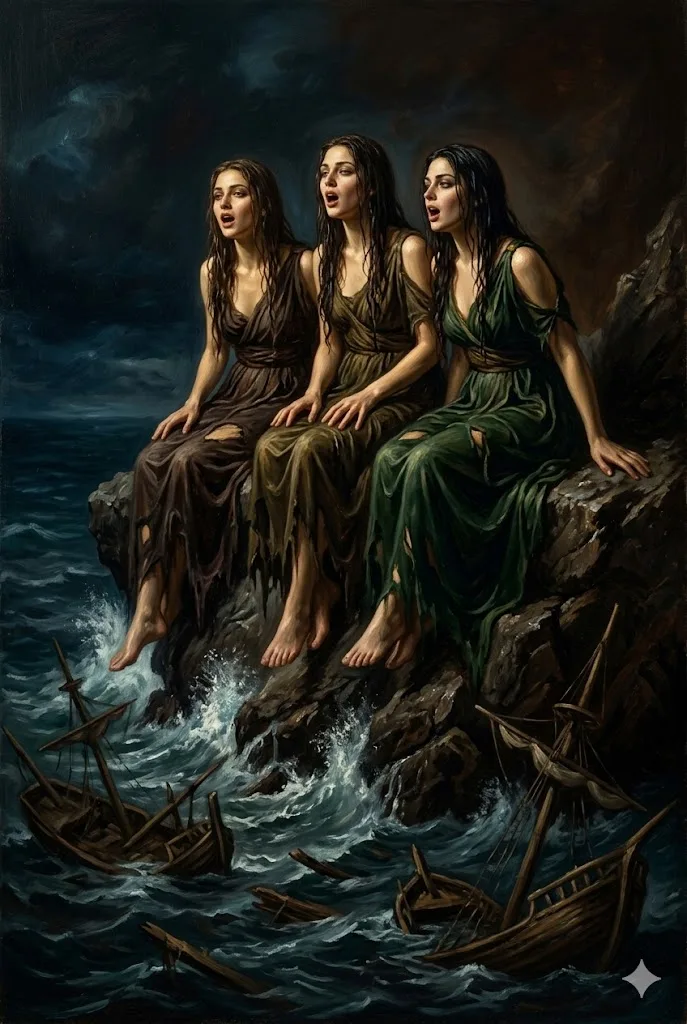
The Sirens were dangerous creatures who lured nearby sailors with their enchanting music and singing voices to their island, where, as later writers put it, ships were wrecked on the rocks. In the earliest Greek art, they were depicted as birds with the heads of women — later traditions transformed them into beautiful women from the waist up with the tails of fish, an image that eventually merged with the concept of mermaids. Their number varied from two to five, with most accounts settling on three.
The Sirens' song was not merely beautiful — it was supernaturally irresistible, promising each listener the one thing they desired most. For Odysseus, they sang of glory and all-encompassing knowledge. In Homer, those who heard them simply never returned home; later tradition pictured ships steering toward the sound and breaking on the rocks. Homer simply places them in a meadow surrounded by heaps of the bones of men, without describing what they looked like.
II. Odysseus and the Sirens
The most famous encounter with the Sirens comes from Homer's Odyssey. Warned by the enchantress Circe, Odysseus ordered his crew to plug their ears with beeswax so they could not hear the song. But Odysseus himself, unable to resist the chance to hear the most beautiful music in existence, had his men tie him to the ship's mast. As they sailed past, the Sirens sang to him, and Odysseus thrashed and screamed to be untied — but his crew, deaf to the song, kept rowing, and they passed safely.
III. Orpheus and the Argonauts
Earlier in mythological chronology, the Argonauts also survived the Sirens — but through a different method. When the Argo sailed past the Sirens' island, Orpheus took up his lyre and played music so overwhelmingly beautiful that it drowned out the Sirens' song entirely. His divine melodies proved more powerful than their enchantment, and the Argonauts passed unharmed. Only one crew member, Butes, heard the Sirens and leaped overboard — he was rescued by Aphrodite before he could drown.
In modern English, a "siren song" refers to any dangerously seductive appeal. Emergency sirens take their name from these creatures — an irresistible sound that demands immediate attention.
Classical Sources
Ancient accounts of The Sirens appear in:
- 📜 Hesiod, Theogony (c. 700 BC) — Origin and genealogy of mythological creatures.
- 📜 Apollodorus, Bibliotheca (c. 1st–2nd century AD) — Detailed descriptions of monsters and their encounters with heroes.
- 📜 Ovid, Metamorphoses (8 AD) — Vivid retellings of creature myths with emphasis on transformation.
- 📜 Homer, Iliad & Odyssey (c. 750 BC) — Encounters with mythological beasts during the Trojan War cycle.
Cross-referenced with multiple classical sources for accuracy.
What Homer actually says
The Odyssey is the oldest source, and it is surprisingly sparing. Circe warns that the Sirens bewitch anyone who comes near them; whoever hears their voice will never return home to his wife and children. They sit in a meadow, and around them lies a great heap of bones of rotting men, with the skin shrivelling on them. Homer uses the Greek dual form for them, which means he imagined exactly two, and he never describes their bodies at all. There is no mention of wings, feathers or fish tails, and no rocks that wreck ships, only a flowery meadow and the bones.
Their song, as Odysseus reports it, is also more specific than "promising each man his heart's desire". They address him by name as the great glory of the Achaeans and offer him knowledge: everything the Greeks and Trojans suffered at Troy, and everything that happens on the fertile earth. The temptation for this particular hero is to hear his own story told and to know all things. After he passes, a calm falls on the sea, which some readers take to be the Sirens' doing.
Parents, names and the origin of their wings
Later writers filled in what Homer left out, and they disagreed:
- Parentage. Apollodorus makes them daughters of the river-god Achelous and the Muse Melpomene; other writers name Terpsichore or Calliope as the mother. Sophocles reportedly called them daughters of Phorcys, and in Euripides' Helen they are "maidens, children of Earth".
- Names. Apollodorus names three: Peisinoe, Aglaope and Thelxiepeia, one playing the lyre, one singing and one the pipes. Another tradition, preserved by Lycophron and Strabo, gives Parthenope, Leucosia and Ligeia, each linked with a place on the southern Italian coast.
- Wings. Ovid says they were companions of Persephone and were gathering flowers with her when Hades took her. They prayed for wings so they could search for her over land and sea, and the gods granted it while letting them keep their faces and voices. Hyginus gives a harsher version: Demeter turned them into birds for failing to help her daughter.
Pausanias adds that Hera persuaded the Sirens to challenge the Muses to a singing contest. They lost, and the Muses plucked out their feathers and wore them as crowns.
Where they lived and how they died
Hesiod reportedly called their island Anthemoessa, "flowery", matching Homer's meadow. Ancient geographers placed the Sirens off the Sorrento peninsula near Capri, where a small cluster of islets was called the Sirenusae; today they are known as Li Galli. A widely told sequel says the Sirens were fated to die if a ship ever passed them safely. In some accounts this happened when the Argonauts escaped thanks to Orpheus, in others when Odysseus got through, and the Sirens threw themselves into the sea.
The bodies were said to have washed up along the Italian coast. Parthenope's tomb was shown at Naples, which was once called Parthenope after her, and Strabo reports that the Neapolitans held torch races and games in her honour. Leucosia gave her name to an island near Paestum.
Sirens of death, and of the cosmos
In the Greek world the Siren was as much a funerary figure as a seductress. Bird-bodied Sirens were carved on Athenian gravestones of the fourth century BC, often tearing their hair or playing music in mourning, singing the dead on their way. In Helen, Euripides has Helen call on the winged maidens to accompany her laments. Plato gave them a cosmic role: in the Myth of Er at the end of the Republic, a Siren sits on each of the eight whorls of the Spindle of Necessity, each singing a single note, and together they produce one harmony, an image behind the later idea of the music of the spheres.
The best-known depiction is the Siren Vase in the British Museum, an Athenian red-figure stamnos of about 480–470 BC. It shows Odysseus lashed to the mast while three bird-bodied Sirens perch on the rocks; one of them plunges toward the sea with her eyes closed, which many interpret as the Siren falling to her death.
The fish-tailed Siren appears only in the Middle Ages. An early medieval Latin catalogue of wonders, the Liber Monstrorum, describes Sirens as maidens with fish tails, and from then on the Siren and the mermaid gradually merged. In French, Italian and Spanish today, the same word (sirène, sirena) is used for a mermaid. For other bird-woman monsters of Greek myth, compare the Harpies, and for the Argonauts' route past the Sirens, see the Golden Fleece.
Ancient sources
- Homer, Odyssey 12.39–54 and 12.158–200 — Circe's warning, the meadow heaped with bones, and the Sirens' song offering Odysseus knowledge of Troy and the whole earth.
- Apollonius of Rhodes, Argonautica 4.891–921 — Orpheus drowns out the Sirens' song; Butes leaps overboard and is saved by Aphrodite.
- Apollodorus, Library Epitome 7.18–19 and 1.3.4 — their names, their parentage from Achelous and a Muse, and the prophecy that they would die if a ship passed safely.
- Ovid, Metamorphoses 5.551–563 — the Sirens as Persephone's companions who asked for wings to search for her.
- Plato, Republic 10.617b — the eight Sirens on the Spindle of Necessity, each singing one note of a single harmony.
- Pausanias, Description of Greece 9.34.3 — the singing contest with the Muses, who took the Sirens' feathers as crowns.
Frequently asked questions
Are Sirens and mermaids the same thing?
Not originally. Greek Sirens were bird-women; the fish-tailed form appears in the Middle Ages, after which the two figures merged in European folklore.
How many Sirens were there?
Homer implies two. Most later writers say three, though their names differ between traditions, and Plato's cosmic Sirens number eight.
What did the Sirens sing to Odysseus?
They praised him by name and promised to tell him everything that happened at Troy and everything that happens on earth.
What happened to the Sirens after Odysseus passed?
Homer does not say. Later writers claim they were fated to die if anyone survived them, and threw themselves into the sea.
Explore More Mythology
Get weekly deep dives into the gods, heroes, and myths of ancient Greece.