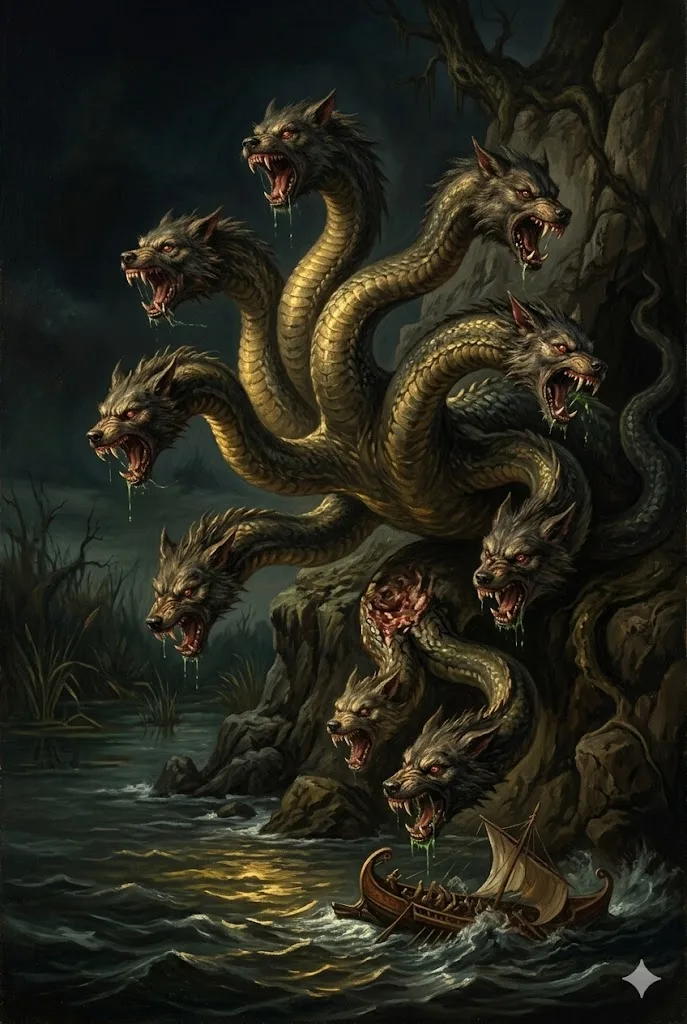
Between a Rock and a Hard Place
Scylla and Charybdis were two sea monsters who guarded opposite sides of a narrow strait, traditionally identified with the Strait of Messina between Italy and Sicily. Any ship that sailed too close to one would be destroyed by the other. Together, they created one of the most famous impossible choices in mythology and gave us the English expression 'between a rock and a hard place' (or the older 'between Scylla and Charybdis').
Scylla
Scylla was originally a beautiful sea nymph who was transformed into a monster. In Ovid's account, the sea god Glaucus fell in love with Scylla, but she rejected him. Glaucus asked the sorceress Circe for a love potion, but Circe, who wanted Glaucus for herself, poisoned the waters where Scylla bathed. The nymph was transformed into a nightmarish creature: from the waist up she appeared human, but from the waist down she sprouted six long serpentine necks, each ending in a head with triple rows of teeth. Twelve tentacle-like legs supported her body, and a ring of barking dog heads encircled her waist.
Scylla lived in a cave high on the cliff face, reaching down with her six heads to pluck sailors from passing ships. Each head could snatch and devour one man, meaning every ship that passed within her reach lost six crew members. There was no way to fight her because her heads struck simultaneously from multiple angles, and her cave was too high to reach with weapons.
Charybdis
On the opposite side of the strait lurked Charybdis, a monster that took the form of a massive whirlpool. Three times each day, Charybdis swallowed the entire sea around her and vomited it back up, creating a maelstrom that could consume entire ships. She was said to be a daughter of Poseidon and Gaia who was so voracious that she stole the cattle of Heracles. Zeus struck her with a thunderbolt and transformed her into the whirlpool as punishment. Unlike Scylla, who killed selectively, Charybdis destroyed ships completely. No one survived her.
Odysseus's Choice
In the Odyssey, the sorceress Circe warned Odysseus that he must pass between Scylla and Charybdis and that there was no way to avoid both. She advised him to sail closer to Scylla, because losing six men was better than losing the entire ship to Charybdis. Odysseus followed her advice, and Scylla snatched six of his men from the deck as the ship passed. He later described it as the most pitiful sight he witnessed in all his years of wandering, hearing his men screaming his name as the monster devoured them.
Classical Sources
- 📜 Homer, Iliad & Odyssey (c. 750 BC)
- 📜 Hesiod, Theogony (c. 700 BC)
- 📜 Apollodorus, Bibliotheca (c. 1st-2nd century AD)
- 📜 Ovid, Metamorphoses (8 AD)
Cross-referenced with multiple classical sources for accuracy.
Explore More
Odysseus · The Odyssey · Sirens · Cyclopes · Home
Homer's Scylla, line by line
Most popular descriptions of Scylla mix Homer with Ovid and later artists. Homer's own picture, given by Circe in Odyssey Book 12, is specific and in places surprising. Scylla lives in a cave halfway up a cliff so smooth and sheer that no mortal could climb it, its peak always wrapped in cloud. Her voice is no louder than that of a newborn puppy, a pun on her name, which sounds like skylax, "puppy". She has twelve feet, all dangling, and six very long necks, each with a terrible head and three rows of teeth crowded thick with black death. She stays sunk to the waist in her cave, leaning out to fish for dolphins, seals and anything larger that Amphitrite's sea provides. Homer says nothing about dogs growing from her waist; that image comes later.
Circe insists that Scylla is not mortal and cannot be fought: the only defence is to row past fast and call on her mother Crataeis, who will stop her from striking a second time. Odysseus nevertheless put on his armour and took two spears to the prow, but he could not even see her before six of his men were lifted from the ship. Scylla and Charybdis appear again at the end of the book. After his crew ate the cattle of the Sun and the ship was destroyed, Odysseus drifted back toward the strait on a makeshift raft. Charybdis swallowed it, and he survived only by leaping up and clinging to a fig tree that grew above the whirlpool, hanging there until she spat the timbers out again. Zeus, he says, did not let Scylla see him.
Who was Scylla's mother?
The ancient genealogies differ widely:
- Homer names her mother as Crataeis, "the mighty one".
- Apollonius of Rhodes makes her the daughter of Phorcys and of Hecate, "whom they call Crataeis", fusing the two traditions and linking her with Hecate.
- Hyginus in one passage lists her among the children of Typhon and Echidna, which places her in the same family as the Chimera, Cerberus and the Hydra; elsewhere he calls her daughter of the river Crataeis.
- Other writers mention the sea god Phorcys with different mothers, or Lamia.
Her transformation is equally variable. Ovid's story of Glaucus and Circe is the best known, but late commentators record a version in which Poseidon loved Scylla and his jealous wife Amphitrite poisoned her bathing place. Some late sources also say Heracles killed Scylla for stealing cattle from the herd of Geryon, and her father Phorcys brought her back to life.
Jason and Aeneas at the strait
Odysseus was not the only traveller to face her. In Apollonius's Argonautica, Hera arranges for Thetis and the Nereids to guide the Argo safely past Scylla, Charybdis and the Wandering Rocks, tossing the ship from one to another like girls playing with a ball. This is the voyage described on the page about Jason.
In Virgil's Aeneid Book 3, the seer Helenus advises Aeneas to take the long route around Sicily rather than risk the strait. Virgil's Scylla has a human face and maiden's breast above, but below she is a huge sea creature with a wolf's belly and dolphins' tails. Aeneas's fleet later comes within earshot of Charybdis and pulls away. Virgil also mentions Scyllas, in the plural, among the monsters at the gates of the underworld.
The other Scylla, and Scylla in art
A second, unrelated Scylla is easy to confuse with the monster. She was the daughter of King Nisus of Megara, who cut the purple lock of hair on which her father's life and kingdom depended, out of love for the besieging Minos. Minos rejected her in disgust, and she was turned into a seabird called the ciris. Even ancient poets blurred the two: Virgil's sixth Eclogue gives the daughter of Nisus the monstrous dogs of the sea-Scylla.
In art, Greek coins from southern Italy and Sicily, including those of Acragas and Cumae, show Scylla as a woman whose lower body ends in a fish tail ringed with the foreparts of dogs. The most dramatic surviving image is the huge marble group from the grotto of the emperor Tiberius at Sperlonga, south of Rome, showing Scylla seizing Odysseus's men from their ship. The town of Scilla on the Calabrian side of the Strait of Messina still carries her name. For the whirlpool opposite her, see Charybdis, and for the whole voyage, the Odyssey.
Ancient sources
- Homer, Odyssey 12.73–126, 12.222–259 and 12.426–446 — Circe's description of Scylla and Charybdis, the loss of six men, and Odysseus clinging to the fig tree above Charybdis.
- Apollonius of Rhodes, Argonautica 4.789–981 — Scylla as daughter of Phorcys and Hecate-Crataeis; Thetis and the Nereids guide the Argo past the strait.
- Ovid, Metamorphoses 13.730–14.74 — Glaucus's love for Scylla, Circe's jealousy and the poisoned pool.
- Virgil, Aeneid 3.410–432 and 3.554–569 — Helenus's warning and Virgil's description of Scylla with wolf belly and dolphin tails.
- Hyginus, Fabulae (Preface and 199) — Scylla as offspring of Typhon and Echidna, and the Glaucus and Circe story.
Frequently asked questions
How many heads did Scylla have?
Six, according to Homer, each on a long neck with three rows of teeth. Later art often adds dog heads or foreparts around her waist.
Was Scylla always a monster?
In Homer she simply is a monster, with no backstory. The tale of a beautiful nymph transformed by Circe's or Amphitrite's jealousy comes from later writers, especially Ovid.
Where were Scylla and Charybdis?
From antiquity they were placed in the Strait of Messina, with Scylla on the Italian side and Charybdis near Sicily.
Why did Odysseus choose Scylla over Charybdis?
Circe told him Scylla would take only six men, while Charybdis could swallow the whole ship.
Books to read next
- Homer, The Odyssey (trans. Emily Wilson)
- Homer, The Odyssey (trans. Robert Fagles)
- Madeline Miller, Circe
Links go to Bookshop.org, which supports independent bookstores. We earn a small commission if you buy, at no extra cost to you.