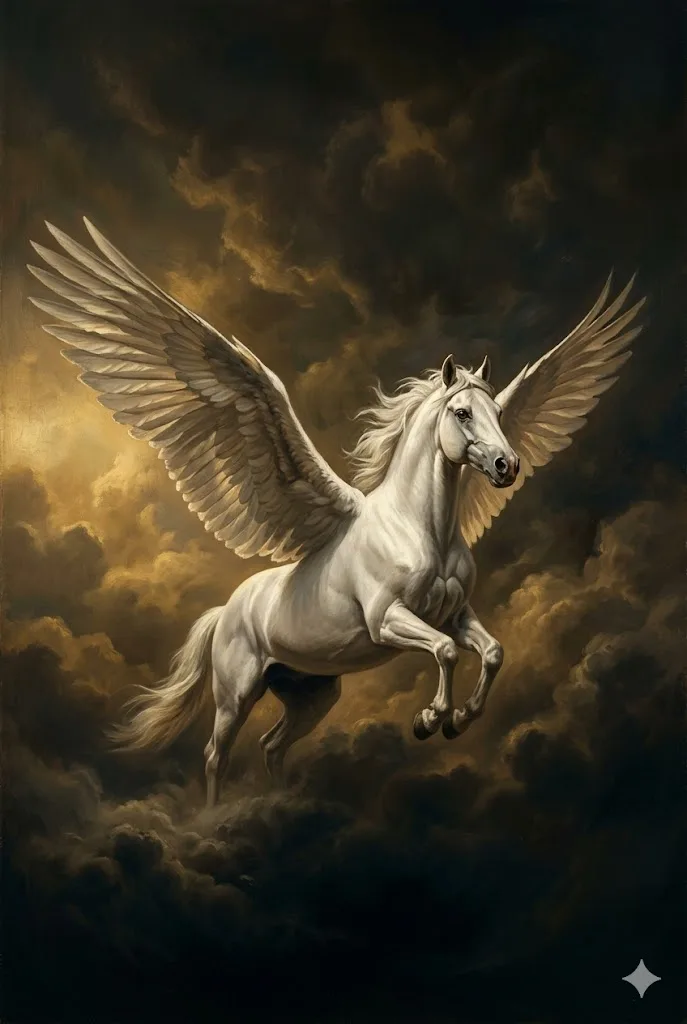
I. What Was Pegasus?
Pegasus was the magnificent winged horse of Greek mythology — a creature of breathtaking beauty who could soar through the heavens with the speed of the wind. He was born in one of mythology's most dramatic moments: when the hero Perseus severed the head of the Gorgon Medusa, Pegasus sprang fully formed from her neck, along with the warrior Chrysaor. Pegasus was the offspring of Medusa and Poseidon, conceived before Medusa's transformation into a monster.
Pure white with enormous, powerful wings, Pegasus was wild and untameable by ordinary means. He roamed freely between earth and Olympus, and wherever his hooves struck the ground, sacred springs burst forth. The most famous of these was the Hippocrene ("Horse's Spring") on Mount Helicon, sacred to the Muses — the spring that inspired poetry and art.
II. Bellerophon and the Chimaera
The hero Bellerophon tamed Pegasus with the help of a golden bridle given to him by Athena in a dream. Together, they accomplished the impossible: Bellerophon rode Pegasus into the sky to slay the Chimaera, a fire-breathing monster with the head of a lion, the body of a goat, and the tail of a serpent. From the air, mounted on the winged horse, Bellerophon could attack the beast without being consumed by its flames.
But Bellerophon's pride proved his undoing. Emboldened by his victories, he attempted to ride Pegasus to Mount Olympus itself — to take a seat among the gods. Zeus, angered by this presumption, sent a gadfly to sting Pegasus, who bucked Bellerophon off his back. The hero fell to earth and lived out his days as a crippled wanderer. Pegasus continued to Olympus, where Zeus welcomed him and gave him a place in the divine stables, using him to carry his thunderbolts.
III. Among the Stars
Zeus eventually placed Pegasus among the stars as a constellation — one of the largest and most recognizable in the northern sky. The constellation Pegasus is visible in autumn and is identified by the distinctive Great Square of Pegasus asterism. The winged horse became a universal symbol of poetic inspiration, freedom, and the human aspiration to transcend earthly limitations. Today, Pegasus remains one of mythology's most beloved figures, appearing in art, literature, and popular culture for over 2,500 years.
Classical Sources
Ancient accounts of Pegasus appear in:
- 📜 Hesiod, Theogony (c. 700 BC) — Origin and genealogy of mythological creatures.
- 📜 Apollodorus, Bibliotheca (c. 1st–2nd century AD) — Detailed descriptions of monsters and their encounters with heroes.
- 📜 Ovid, Metamorphoses (8 AD) — Vivid retellings of creature myths with emphasis on transformation.
- 📜 Homer, Iliad & Odyssey (c. 750 BC) — Encounters with mythological beasts during the Trojan War cycle.
Cross-referenced with multiple classical sources for accuracy.
Hesiod, Pindar and Homer's silence
The oldest account of Pegasus is a few lines in Hesiod's Theogony. When Perseus cut off Medusa's head, Hesiod says, out sprang great Chrysaor and the horse Pegasus, who was so called because he was born beside the springs (pēgai) of Ocean. He flew off to the immortals and now lives in the house of Zeus, carrying his thunder and lightning. Chrysaor, "Golden Sword", became the father of the three-bodied giant Geryon, so Pegasus is the uncle of the monster whose cattle Heracles later stole.
Homer's Iliad, oddly, tells the story of Bellerophon at length without mentioning Pegasus at all. The Lycian hero Glaucus recounts how his grandfather killed the Chimaera, fought the Solymi and the Amazons, and finally wandered alone "hated by all the gods", but the winged horse is absent. Pegasus enters Bellerophon's story clearly in Hesiod, who says the two of them killed the Chimaera, and in Pindar.
Pindar's Olympian 13, written for a Corinthian victor, gives the classic taming scene. Bellerophon struggled for a long time to catch the horse at the spring of Peirene in Corinth, until Athena appeared to him in a dream with a golden bridle. On waking he found it beside him, sacrificed a bull to Poseidon as tamer of horses, set up an altar to Athena Hippia (Athena of horses), and slipped the bit into Pegasus's mouth. Pindar's Isthmian 7 gives the end of the story: when Bellerophon tried to reach the dwelling of the gods, Pegasus threw him. The gadfly sent by Zeus appears in later retellings.
Springs, Corinth and the stars
Hippocrene, the "horse spring" on Helicon, is the best-known spring struck by Pegasus's hoof, and Ovid has the Muses show it to Athena, who has come specially to see the new wonder. In some later versions the strike was needed because Helicon was swelling with delight at the Muses' singing until Poseidon asked Pegasus to stop it. Pausanias reports a second Hippocrene at Troezen with the same origin story, and Peirene in Corinth was also linked to the horse.
Pegasus was the emblem of Corinth, Bellerophon's home city. Corinthian silver staters carried the winged horse for centuries, and the coins were so recognisable that they were nicknamed pōloi, "colts". Corinth's colonies, including Syracuse at times and towns in western Greece, struck their own Pegasus coins.
The constellation appears in Aratus's Phaenomena as simply "the Horse", only half of which is visible in the sky; Aratus links it to the spring on Helicon. The name Pegasus for the constellation became standard later. See constellation myths for other figures placed among the stars.
Pegasus on the stage and in art
Euripides wrote two tragedies about Bellerophon, Stheneboea and Bellerophon, both now fragmentary. In the second, the hero apparently rode Pegasus on stage using the theatrical crane. Aristophanes parodied the scene in Peace (421 BC), in which the farmer Trygaeus flies up to heaven on a giant dung beetle instead of a winged horse, begging the crane operator to be careful.
Greek art usually shows Pegasus not as a gleaming white show horse but as a compact, sturdy animal with curling, birdlike wings. On Archaic vases and the pediment of the Temple of Artemis at Corfu, the infant Pegasus and Chrysaor are shown beside their mother Medusa.
Common mix-ups
- Perseus did not ride Pegasus. In ancient sources Perseus flew using winged sandals lent by Hermes. The image of Perseus on Pegasus rescuing Andromeda is a Renaissance and later invention, possibly influenced by the hippogriff ridden by Ruggiero in Ariosto's Orlando Furioso.
- Pegasus is not a species. "Pegasi" as a breed of winged horses comes from modern fantasy. The Greeks knew one Pegasus, though they also imagined other winged horses, such as those that drew some gods' chariots.
- Pegasus is not a unicorn. Modern hybrids with horns, sometimes called alicorns, have no ancient basis.
For the rider's side of the story, see Bellerophon and the Chimera; for his mother's family, see the Gorgons.
Ancient sources
- Hesiod, Theogony 280–286 and 325 — the birth of Pegasus and Chrysaor from Medusa, the meaning of the name, his service carrying Zeus's thunder, and the killing of the Chimaera with Bellerophon.
- Pindar, Olympian 13.63–92 — Bellerophon tames Pegasus at Peirene with Athena's golden bridle and fights the Chimaera, the Amazons and the Solymi.
- Pindar, Isthmian 7.44–47 — Pegasus throws Bellerophon when he tries to reach the halls of Zeus.
- Homer, Iliad 6.155–205 — the story of Bellerophon told by Glaucus, notably without Pegasus.
- Ovid, Metamorphoses 5.250–268 — Athena visits Helicon to see the spring Hippocrene created by Pegasus's hoof.
- Aratus, Phaenomena — the constellation of the Horse and its link to the spring on Helicon.
Frequently asked questions
Who were Pegasus's parents?
Poseidon and Medusa. He was born from Medusa's severed neck, together with his brother Chrysaor, when Perseus beheaded her.
Did Perseus ride Pegasus?
Not in Greek myth. Perseus used Hermes' winged sandals; the rider of Pegasus was Bellerophon. The Perseus version comes from much later art.
What happened to Pegasus after Bellerophon fell?
He flew on to Olympus, where, as Hesiod already says, he served Zeus by carrying his thunder and lightning. He was later identified with a constellation.
Was Pegasus white?
Ancient texts do not specify his colour. The pure white Pegasus is mainly a modern image.
Explore More Mythology
Get weekly deep dives into the gods, heroes, and myths of ancient Greece.