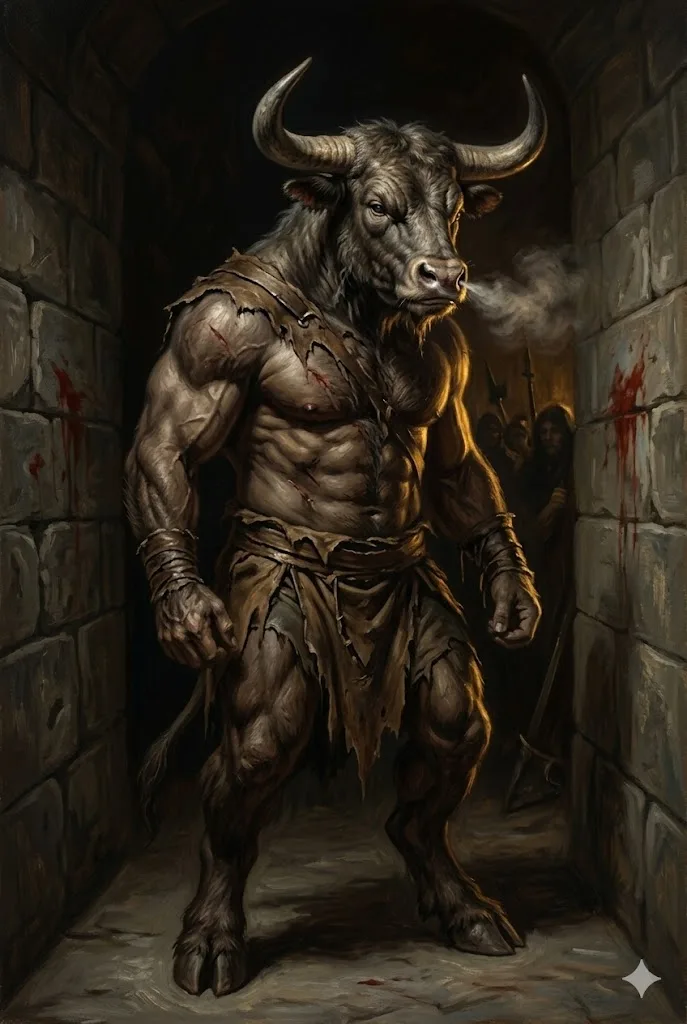
I. What Was the Minotaur?
The Minotaur was a monstrous creature with the body of a man and the head and tail of a bull, imprisoned in the Labyrinth — an immense, winding maze beneath the palace of King Minos on the island of Crete. It was born from one of mythology's most disturbing unions: Queen Pasiphaë, wife of Minos, was cursed by Poseidon to fall in love with a beautiful white bull, and the Minotaur was their unnatural offspring.
Unable to kill the creature but horrified by its existence, Minos commissioned the legendary inventor Daedalus to construct the Labyrinth — a structure so complex that no one who entered could ever find their way out. There the Minotaur was confined, fed a diet of human flesh: every nine years, Athens was forced to send seven young men and seven young women as tribute, to be devoured by the beast in the darkness of the maze.
II. Theseus and the Labyrinth
The hero Theseus, son of King Aegeus of Athens, volunteered to be one of the fourteen sacrifices, determined to end the tribute forever. When he arrived on Crete, Minos's daughter Ariadne fell in love with him and gave him a ball of thread (the "clue" — origin of the English word) so he could retrace his steps out of the Labyrinth after confronting the beast.
Theseus ventured into the maze, found the Minotaur in its dark center, and slew it with his bare hands (or, in some versions, with a sword Ariadne had hidden for him). Following the thread back through the winding corridors, he escaped with the other Athenian youths and sailed home — though his journey was marked by tragedy when he forgot to change his ship's sails from black to white, causing his father Aegeus to believe him dead and throw himself into the sea (thereafter called the Aegean).
III. Symbolism & Legacy
The Minotaur and its Labyrinth have become among the most powerful symbols in Western culture. The maze represents confusion, the subconscious, and the hidden darkness within civilization. The Minotaur itself symbolizes the monstrous consequences of unnatural desire and divine punishment. Archaeological discoveries at the Palace of Knossos on Crete — with its labyrinthine corridors and bull-jumping frescoes — suggest that the myth may have roots in actual Minoan religious practices.
Classical Sources
Ancient accounts of Minotaur appear in:
- 📜 Hesiod, Theogony (c. 700 BC) — Origin and genealogy of mythological creatures.
- 📜 Apollodorus, Bibliotheca (c. 1st–2nd century AD) — Detailed descriptions of monsters and their encounters with heroes.
- 📜 Ovid, Metamorphoses (8 AD) — Vivid retellings of creature myths with emphasis on transformation.
- 📜 Homer, Iliad & Odyssey (c. 750 BC) — Encounters with mythological beasts during the Trojan War cycle.
Cross-referenced with multiple classical sources for accuracy.
The bull from the sea and the name Asterion
The Minotaur's story begins with a broken promise rather than a random curse. According to Apollodorus, Minos claimed the Cretan throne by announcing that the gods would grant whatever he prayed for. He asked Poseidon to send a bull up out of the sea, vowing to sacrifice it. The bull came, but it was so fine that Minos sent it to his herds and sacrificed another. Poseidon's anger fell on Pasiphaë, daughter of Helios, who was made to desire the animal. Daedalus built her a hollow wooden cow on wheels, covered with a real cowhide, and she hid inside it to receive the bull.
The child had a proper name. Apollodorus calls him Asterius, and Pausanias calls him Asterion, which is also the name of an earlier king of Crete who married Europa and raised Minos. "Minotaur" (Minotauros, "bull of Minos") is really a nickname, and a pointed one, since the creature was not Minos's son at all. Jorge Luis Borges built his short story "The House of Asterion" (1947) around this forgotten name, telling the myth from inside the Labyrinth.
The white bull itself had a second career. After Pasiphaë's affair it ran wild, and capturing it became the seventh of Heracles' labours. Released on the mainland, it roamed to Marathon, where Theseus later killed it. The Athenians thus faced the father and then the son.
Why Athens paid the tribute, and how often
The human tribute was a war indemnity. Minos's son Androgeus died in Attica; in one version he was murdered out of jealousy after winning every contest at the Panathenaic games, in another Aegeus sent him against the Marathonian bull and it killed him. Minos made war on Athens, and when the city was struck by famine and plague, an oracle told the Athenians to give Minos whatever satisfaction he chose. He demanded seven youths and seven maidens.
Ancient writers disagree on the schedule. Plutarch and Ovid speak of a tribute every nine years, with Theseus sailing on the third occasion; other accounts make it yearly. Plutarch also preserves a rationalising version from the Athenian historian Philochorus, in which the Labyrinth was simply a prison and the "Minotaur" was a harsh Cretan general named Taurus, to whom the young Athenians were given as prizes in funeral games. Ancient readers were already uneasy with a man-bull and looked for history underneath.
The voyage to Crete had its own famous episode. In Bacchylides' Ode 17, Minos insults one of the Athenian girls on board, Theseus objects, and Minos challenges him to prove he is Poseidon's son by fetching a ring thrown into the sea. Theseus dives, is welcomed by Amphitrite in the palace below, and surfaces dry, crowned with a wreath, before the astonished Cretans.
Knossos, the Labyrinth and the Minotaur in art
The link between myth and Bronze Age Crete is more concrete than bull-leaping frescoes. A Linear B tablet from Knossos records an offering of honey to da-pu-ri-to-jo po-ti-ni-ja, usually read as "the Mistress of the Labyrinth", showing that some place or cult called daburinthos existed in Mycenaean-era Crete. Whether that word meant a maze, the palace, or a ritual space remains debated. Centuries later, Knossos struck coins showing a labyrinth pattern, sometimes square and sometimes round, as a civic emblem.
Homer never names the Minotaur, but the Iliad mentions the dancing-floor that Daedalus made at Knossos for Ariadne, and the Odyssey lists Ariadne among the dead women Odysseus sees. The fight with Theseus, by contrast, was a favourite of Archaic Athenian vase painters from the sixth century BC onward: the Minotaur is shown as a naked, muscular man with a bull's head, often already sinking to one knee while Theseus grips him and drives in a sword. Apollodorus says Theseus killed him with his fists, so the vases and the mythographer do not quite agree.
Later artists reimagined the creature. Dante places a raging Minotaur at the entrance to the circle of the violent in Inferno 12. Picasso turned him into a personal emblem in the 1930s, most famously in the etching Minotauromachy (1935), where the beast is at once brutal and pitiable.
What people often get wrong
- The Labyrinth was not under a palace in the ancient texts. It was a building made by Daedalus near Knossos; the "beneath the palace" image comes largely from modern links with Arthur Evans's excavations.
- Daedalus was not only the builder. He also gave Ariadne the idea of the thread, which is why Minos imprisoned him and his son, leading to the flight of Icarus.
- There is one Minotaur. Modern games and fantasy fiction treat minotaurs as a species, but Greek myth knows only this single creature.
For the full voyage, the abandonment of Ariadne on Naxos and its aftermath, see Theseus and the Minotaur and the profile of Theseus.
Ancient sources
- Apollodorus, Library 3.1.3–4 and 3.15.7–8; Epitome 1.7–11 — the bull from the sea, Pasiphaë and the wooden cow, the name Asterius, the death of Androgeus, the tribute, and Theseus killing the Minotaur with his fists.
- Plutarch, Life of Theseus 15–19 — the nine-year tribute, the voyage and Ariadne, and Philochorus's rationalised version with the general Taurus.
- Bacchylides, Ode 17 — Theseus and Minos quarrel on the voyage to Crete, and Theseus dives to the palace of Amphitrite.
- Ovid, Metamorphoses 8.152–182 — the hidden shame of Minos's house, the Labyrinth of Daedalus, the tribute drawn every ninth year, and Ariadne's thread.
- Catullus, Poem 64 — an elaborate account of Ariadne abandoned on the shore after helping Theseus kill the half-bull.
- Pausanias, Description of Greece 2.31.1 — mentions Theseus's victory over Asterion, son of Minos.
Frequently asked questions
What was the Minotaur's real name?
Asterion or Asterius. "Minotaur" means "bull of Minos" and was a name given to him because he was born in Minos's household.
Was the Minotaur evil?
The ancient sources treat him as a man-eating monster, but he was also the victim of Minos's broken vow and Poseidon's revenge. Modern writers such as Borges often portray him as lonely and sympathetic.
Did the Labyrinth really exist?
No maze has been found. The sprawling palace at Knossos, the Linear B reference to a "Mistress of the Labyrinth", and Cretan bull imagery suggest the myth grew from real Bronze Age places and rituals, but the details are uncertain.
How did Theseus kill the Minotaur?
Apollodorus says he beat it to death with his fists; Athenian vase painters usually show him using a sword. Both versions were known in antiquity.
Explore More Mythology
Get weekly deep dives into the gods, heroes, and myths of ancient Greece.