The Curse
The Minotaur's story begins with a broken promise. King Minos of Crete prayed to Poseidon to send him a bull from the sea as a sign of divine favour, promising to sacrifice it in the god's honour. Poseidon sent a magnificent white bull of supernatural beauty. But Minos, captivated by the animal's perfection, kept it for his own herds and sacrificed an ordinary bull instead. Poseidon's revenge was terrible: he caused Minos's wife Pasiphaë to fall into an uncontrollable, maddening lust for the bull.
The Birth
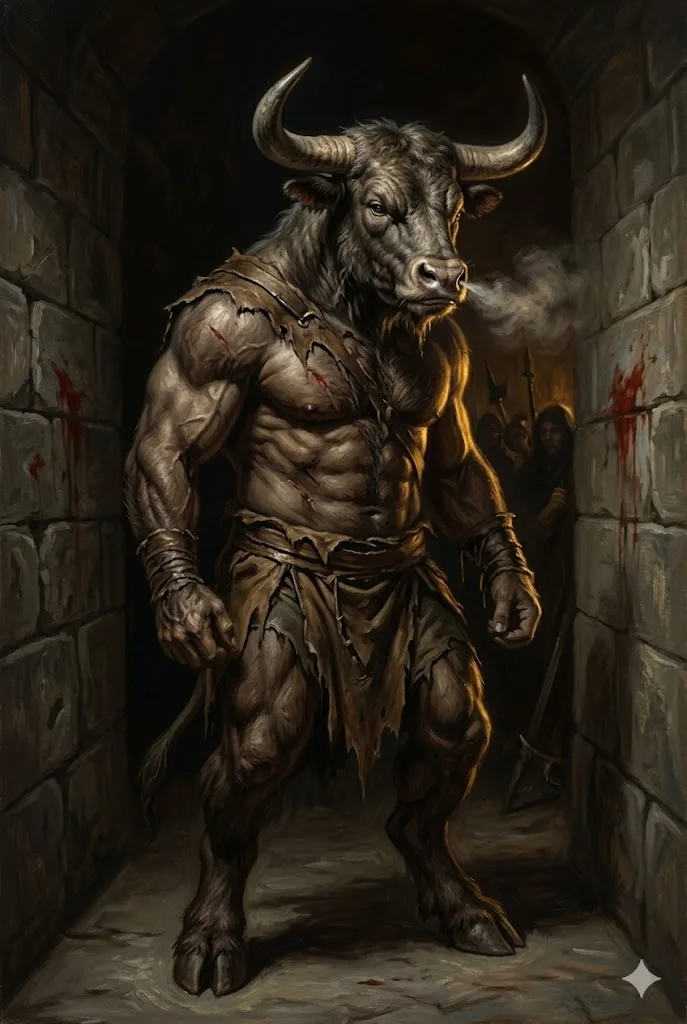
Pasiphaë, driven mad by Poseidon's curse, enlisted the master craftsman Daedalus to build a hollow wooden cow covered in real cowhide. She climbed inside, and the bull mated with it. The result of this union was the Minotaur, a creature with the body of a man and the head of a bull. Its real name was Asterion, meaning 'star,' a hauntingly beautiful name for a monstrous being. The creature was savage and uncontrollable, eating only human flesh.
The Labyrinth
Minos, horrified by the monster but unwilling to kill it (it was, after all, his wife's child), commissioned Daedalus to build the Labyrinth, an impossibly complex maze beneath the palace of Knossos. The Labyrinth was so intricate that no one who entered could ever find their way out. The Minotaur was imprisoned at its centre, and every nine years, Athens was forced to send seven young men and seven young women as tribute to be fed to the beast. This was Minos's punishment for Athens after the Athenians killed his son Androgeos.
The Kill
The Athenian prince Theseus volunteered as one of the fourteen victims, intending to kill the Minotaur and end the tribute forever. Minos's daughter Ariadne fell in love with Theseus and gave him a ball of thread and a sword. Theseus tied the thread at the entrance and unraveled it as he ventured deeper into the Labyrinth. He found the Minotaur in the darkness and killed it, either with the sword or with his bare fists depending on the source. He then followed the thread back to the entrance, rescued the other Athenians, and fled Crete with Ariadne.
The Tragedy Behind the Monster
Modern readers often note the deep tragedy of the Minotaur's existence. Asterion did not choose to be born a monster. He was the product of a god's revenge and a mortal's broken promise. He was imprisoned from birth in a maze with no exit, fed on human flesh because no one offered him anything else, and ultimately killed by a hero for crimes that were never truly his. The Minotaur can be read as a symbol of what happens when the powerful make mistakes and the innocent suffer the consequences.
Classical Sources
- 📜 Homer, Iliad & Odyssey (c. 750 BC)
- 📜 Hesiod, Theogony (c. 700 BC)
- 📜 Apollodorus, Bibliotheca (c. 1st-2nd century AD)
- 📜 Ovid, Metamorphoses (8 AD)
Cross-referenced with multiple classical sources for accuracy.