I. What Was the Hydra?
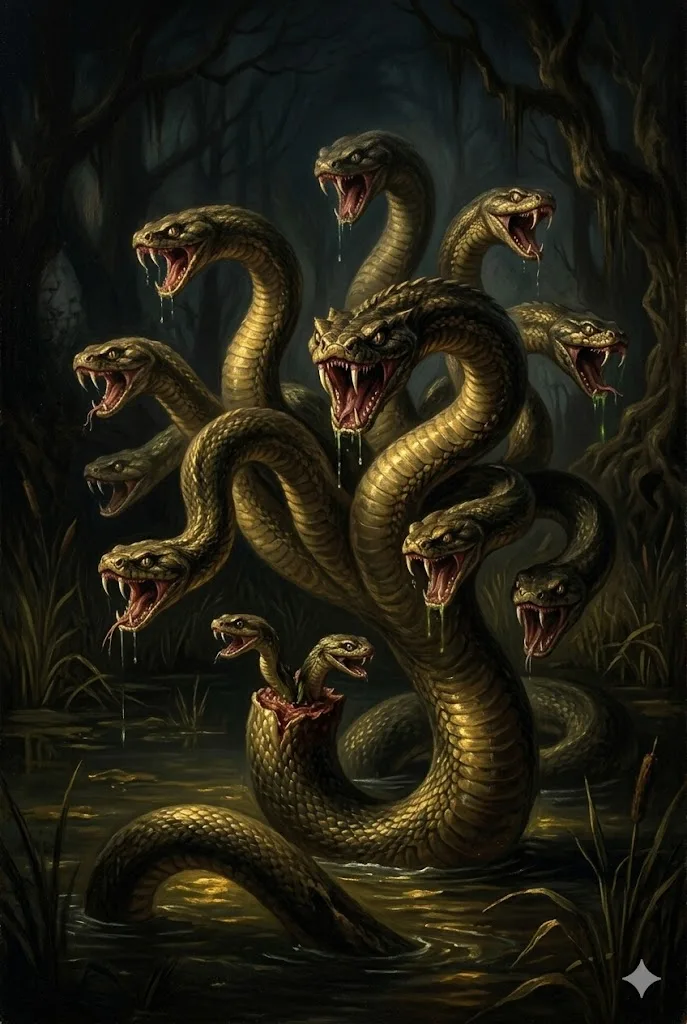
The Lernaean Hydra was a gigantic water serpent with multiple heads — most commonly said to be nine, though ancient sources vary from five to one hundred. It lurked in the swamps of Lerna, near Argos, guarding an entrance to the underworld. The Hydra's most terrifying feature was its regenerative ability: for every head that was severed, two new ones grew in its place, making it seemingly impossible to kill. One head — the central one — was immortal and could never be destroyed.
The Hydra was the offspring of Typhon (the most fearsome monster in Greek mythology) and Echidna (the half-woman, half-serpent "Mother of All Monsters"), making it sibling to Cerberus, the Chimaera, the Nemean Lion, and many other legendary beasts. Its breath and blood were lethally poisonous — even the tracks it left behind were toxic enough to kill anyone who stepped in them.
II. The Second Labour
Slaying the Hydra was the second of Heracles' Twelve Labours. He drove the creature from its lair by shooting flaming arrows into its den, then attacked with his sword. But every time he cut off a head, two more sprouted from the wound. To make matters worse, Hera sent a giant crab to attack Heracles' feet as he fought.
Heracles called upon his nephew Iolaus for help. Together they devised a strategy: as Heracles severed each head, Iolaus immediately cauterized the stump with a burning torch, preventing new heads from growing. One by one, they eliminated the mortal heads until only the immortal head remained. Heracles cut it off and buried it under a massive boulder, trapping it forever. He then dipped his arrows in the Hydra's venomous blood, creating the most lethal weapons in the Greek world — weapons that would later cause the deaths of several figures, including eventually Heracles himself.
III. Legacy
The Hydra is the largest of the 88 modern constellations, stretching across a vast portion of the southern sky. The phrase "fighting a hydra" has entered common language as a metaphor for any problem that multiplies when you try to solve it. Eurystheus refused to count the labour because Heracles had received help from Iolaus — one of two labours he rejected, forcing Heracles to complete additional tasks.
Classical Sources
Ancient accounts of The Hydra appear in:
- 📜 Hesiod, Theogony (c. 700 BC) — Origin and genealogy of mythological creatures.
- 📜 Apollodorus, Bibliotheca (c. 1st–2nd century AD) — Detailed descriptions of monsters and their encounters with heroes.
- 📜 Ovid, Metamorphoses (8 AD) — Vivid retellings of creature myths with emphasis on transformation.
- 📜 Homer, Iliad & Odyssey (c. 750 BC) — Encounters with mythological beasts during the Trojan War cycle.
Cross-referenced with multiple classical sources for accuracy.
How many heads? The ancient disagreement
Hesiod's Theogony names the Hydra as a child of Echidna and adds a revealing detail: Hera raised the creature herself because of her anger against Heracles. In other words, she raised it to destroy him. Hesiod says Heracles killed it with the help of Iolaus and the plans of Athena. He does not count the heads.
Later writers disagreed widely on the number. Ancient commentators report that the poet Alcaeus gave the Hydra nine heads and Simonides fifty. Euripides calls it "myriad-headed," and Diodorus Siculus says a hundred. Apollodorus settles on nine, with the middle head immortal, which is the version most modern retellings follow. Pausanias, writing at Lerna itself, was skeptical. He suggested that the Hydra may have had only one head and that the poet Peisander of Camirus multiplied them to make the beast more frightening and his own verses more impressive.
Lerna: the setting of the labour
Lerna was more than a swamp. It lay on the coast south of Argos, an area of springs, marsh and a small lake that ancient visitors called the Alcyonian Lake. People said the lake had no bottom. Pausanias reports the local belief that Dionysus went down through it to Hades to bring back his mother Semele, and that the emperor Nero tried and failed to sound its depth. Mysteries of Demeter were celebrated at Lerna, and in another story it is where the Danaids buried the heads of the husbands they had murdered. A place so full of water and linked to the underworld was a natural home for a regenerating water-snake.
Apollodorus describes the fight: Heracles drove the Hydra out with burning arrows, and it coiled around one of his feet. The crab Hera sent to help it was crushed underfoot. Hera later placed it among the stars as the constellation Cancer (see constellation myths). Iolaus burned the neck stumps with brands lit from a nearby wood. Apollodorus also says that the immortal head was buried beside the road from Lerna to Elaeus.
The long reach of the poison
The Hydra's venom kept killing long after the Hydra was dead, and it links several of Heracles' stories:
- The centaurs and Chiron. In a fight with the centaurs that began at Pholoe, one of Heracles' poisoned arrows accidentally struck the wise Chiron. Chiron was immortal and could not die from the wound, but he could not heal it either, so he gave up his immortality. Pausanias reports that the river Anigrus in Elis smelled foul because wounded centaurs had washed their Hydra-poisoned wounds in it.
- Nessus and Deianira. Heracles shot the centaur Nessus for attacking his wife Deianira. The dying centaur told her to keep his blood, now mixed with the Hydra's poison, as a love charm. In Sophocles' Women of Trachis, she later smears it on a robe for her husband, and the poison eats into his flesh and drives him to the pyre on Mount Oeta.
- Philoctetes and Troy. Heracles left his bow and poisoned arrows to Philoctetes, who lit the pyre. Without those arrows Troy could not fall, and Philoctetes eventually used one to kill Paris.
In art, and what people get wrong
The fight was popular with vase painters from the archaic period on. A Caeretan hydria of about 525 BC, now in the J. Paul Getty Museum, shows Heracles and Iolaus attacking a coiling, many-headed snake. The theme returned in the Renaissance with Antonio del Pollaiuolo's small panel of Hercules and the Hydra in the Uffizi, and again in the nineteenth century with Gustave Moreau's Hercules and the Lernaean Hydra in the Art Institute of Chicago.
A few common mistakes are worth correcting. The Hydra was the second labour, not the first; the first was the Nemean Lion (see the Twelve Labours). It was a water-snake (hydra comes from the Greek for water), not a fire-breathing dragon. Ancient sources stress its poison, not its fire. The idea that two heads grew back for every one cut off is in Apollodorus, but not every ancient version includes the doubling.
Ancient sources
- Hesiod, Theogony 313–318: the Hydra as Echidna's offspring, raised by Hera to destroy Heracles and killed by him with Iolaus and Athena's help.
- Apollodorus, Library 2.5.2: the full account of the labour, including nine heads, the crab, the cauterizing, the buried immortal head and Eurystheus' refusal to count the labour.
- Euripides, Heracles: the chorus praises Heracles for burning the "myriad-headed" hound of Lerna.
- Pausanias, Description of Greece 2.37 and 5.5: Lerna and its bottomless lake, his doubts about the number of heads, and the river Anigrus.
- Sophocles, Women of Trachis: the Hydra's poison in Nessus' blood and the death of Heracles.
- Diodorus Siculus, Library of History 4.11: a hundred-headed Hydra and Heracles' victory with Iolaus.
Frequently asked questions
How many heads did the Hydra have?
Apollodorus says nine, with one immortal, and this is the usual answer. Other ancient sources give fifty, a hundred, or "countless," and Pausanias thought it may originally have had just one.
Why didn't Eurystheus count the Hydra labour?
According to Apollodorus, he refused because Iolaus had helped Heracles. That is one reason the labours grew from ten to twelve.
Where was Lerna?
Lerna was on the western shore of the Argolic Gulf, south of Argos in the northeastern Peloponnese. It was known for its springs, marshes and a lake said to have no bottom.
What happened to the Hydra's immortal head?
Heracles cut it off and buried it under a heavy rock beside the road from Lerna to Elaeus, so that it could do no further harm.
Explore More Mythology
Get weekly deep dives into the gods, heroes, and myths of ancient Greece.