Hecatoncheires — The Hundred-Handed Ones — Weapons of the
⚡ Quick Facts
Rejected by Their Father
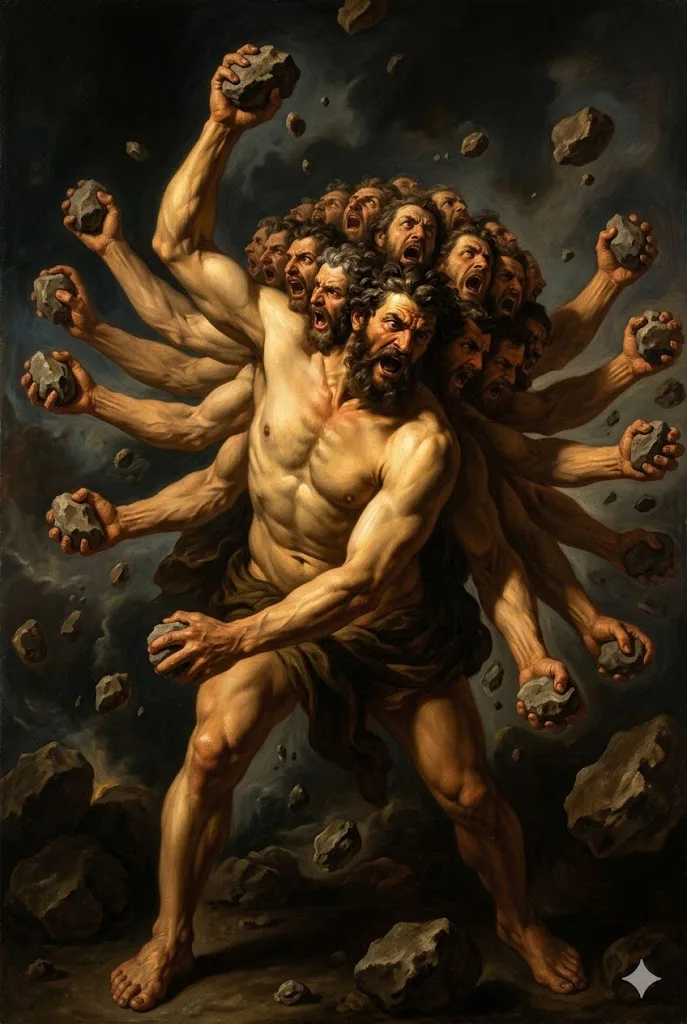
The Hecatoncheires were among the firstborn children of Uranus (Sky) and Gaia (Earth), alongside the Cyclopes. Each of the three brothers — Briareus, Cottus, and Gyges — had a hundred hands and fifty heads, making them the most physically imposing beings in all of creation.
Their father Uranus was so horrified by their appearance that he imprisoned them in Tartarus, the deepest pit of the Underworld. This act of cruelty was one of the reasons Gaia conspired with Cronus to overthrow Uranus — though Cronus, once in power, kept the Hecatoncheires imprisoned as well.
The Weapons That Won the War
When Zeus rose against the Titans, his grandmother Gaia advised him to free the Hecatoncheires from Tartarus. Zeus did so, and the three giants became the decisive weapon in the Titanomachy — the ten-year war between the Olympians and the Titans.
Each Hecatoncheire could hurl a hundred boulders simultaneously. In the final battle, the three brothers unleashed a barrage of three hundred rocks at once, overwhelming the Titan defenses. The mountains shook, the earth groaned, and even the sea boiled. The Titans were defeated and hurled into Tartarus.
Eternal Guardians
After the war, the Hecatoncheires were given the honor — or the duty — of guarding the gates of Tartarus, ensuring the Titans would never escape. Briareus in particular became a figure of importance: when Hera, Poseidon, and Athena once conspired to bind Zeus, the sea-nymph Thetis summoned Briareus to Olympus, and his mere presence intimidated the conspirators into backing down.
Hesiod's account in detail
The fullest early account of the Hundred-Handers is in Hesiod's Theogony, which spells the eldest's name Obriareus as well as Briareus. Hesiod says that a hundred unapproachable arms sprang from their shoulders and fifty heads grew above them. Their father Uranus hated all of his children, but Hesiod says he grew angry with these three in particular, envying their strength and size, and bound them deep in the earth. When the war between the Olympians and the Titans had dragged on for ten years without a winner, Gaia told Zeus that he could win only with their help. He brought them up into the light and fed them nectar and ambrosia, and Cottus answered for the brothers with a short speech of loyalty, promising to fight for Zeus out of gratitude.
In the final battle of the Titanomachy, Hesiod puts Cottus, Briareus and Gyges at the front. They throw three hundred rocks at a time and cover the Titans with missiles until the Titans are driven under the earth and chained. Afterwards they live at the bronze gates of Tartarus, built by Poseidon, as Zeus' "trusty guards." Hesiod also gives Briareus a marriage: as a reward for his strength, Poseidon gave him his daughter Cymopolea ("Wave-walker") as a wife.
Apollodorus adds a detail that Hesiod does not have. While the Cyclopes and Hundred-Handers were imprisoned in Tartarus, a she-monster named Campe guarded them. Zeus killed Campe to free them, and in gratitude the Cyclopes gave him the thunderbolt.
Briareus or Aegaeon: friend or enemy of Zeus?
The eldest brother carries two names. Homer explains that the gods call him Briareus but men call him Aegaeon, a name that links him with the Aegean Sea. In the Iliad, Thetis reminds Zeus of the time she brought Briareus to Olympus. Homer adds that Briareus was "stronger than his father" and sat beside Zeus delighting in his glory, so that the plotting gods were afraid and gave up the plan to bind Zeus.
Not everyone made him a loyal ally. A lost epic on the Titan war was said to make Aegaeon a son of Gaia and Pontus who fought on the Titans' side. Virgil follows this darker tradition in the Aeneid, comparing the raging Aeneas to Aegaeon, who had a hundred arms and fifty mouths and chests blazing with fire, and who clashed fifty shields against the thunderbolts of Jupiter. Virgil also places "hundred-fold Briareus" among the monstrous shapes at the entrance to the underworld. Later writers sometimes mixed the Hundred-Handers up with the Giants who fought the gods in the Gigantomachy, so Briareus occasionally appears as a rebel buried under a volcano.
Briareus in local legend
Briareus also played a role in at least one local foundation story. Pausanias records a Corinthian tradition in which Poseidon and Helios disputed ownership of the land of Corinth, and Briareus was chosen to judge between them. He gave the Isthmus to Poseidon and the heights of Acrocorinth to Helios. This explained why Poseidon's sanctuary and the Isthmian Games stood on the Isthmus. Some ancient writers also report that the strait at the western end of the Mediterranean was called the Pillars of Briareus before it came to be called the Pillars of Heracles.
What gets confused
The Hundred-Handers were not Titans, although they were children of the same parents. They fought against the Titans. They are also distinct from the Giants, who were born later from the blood of Uranus and fought a separate war against the Olympians. Hesiod does not make them warders of Tartarus as a punishment. He presents the role as a position of trust. The Latin name Centimani is simply a translation of the Greek hekatoncheires, "hundred-handed."
Ancient sources
- Hesiod, Theogony 147–153, 617–735, 815–819: the brothers' birth and appearance, their imprisonment, Gaia's advice, their part in the Titan war, their guard duty at Tartarus, and Briareus' marriage to Cymopolea.
- Homer, Iliad 1.396–406: Thetis summons Briareus/Aegaeon to Olympus to stop Hera, Poseidon and Athena from binding Zeus.
- Apollodorus, Library 1.1–1.2: their imprisonment by Uranus and again by Cronus, and their release by Zeus after he killed the jailer Campe.
- Virgil, Aeneid 6 and 10: Briareus at the gates of the underworld, and Aegaeon fighting Jupiter's thunderbolts.
- Pausanias, Description of Greece 2.1: Briareus as judge in the dispute between Poseidon and Helios over Corinth.
Frequently asked questions
What are the names of the Hecatoncheires?
Briareus (also called Obriareus, or Aegaeon among mortals), Cottus and Gyges, whose name is sometimes spelled Gyes.
Are the Hecatoncheires stronger than the Titans?
In Hesiod's telling, their arrival is what ends the ten-year war. Their combined barrage defeats the Titans, so in that sense they decided the conflict. Homer even says Briareus was stronger than his own father.
Did the Hecatoncheires fight for Zeus or against him?
In Hesiod, Homer and Apollodorus they fight for Zeus. A minority tradition, followed by Virgil, makes Aegaeon an enemy of Jupiter.
How many heads did the Hecatoncheires have?
Each had fifty heads and a hundred arms, according to Hesiod and later writers who followed him.