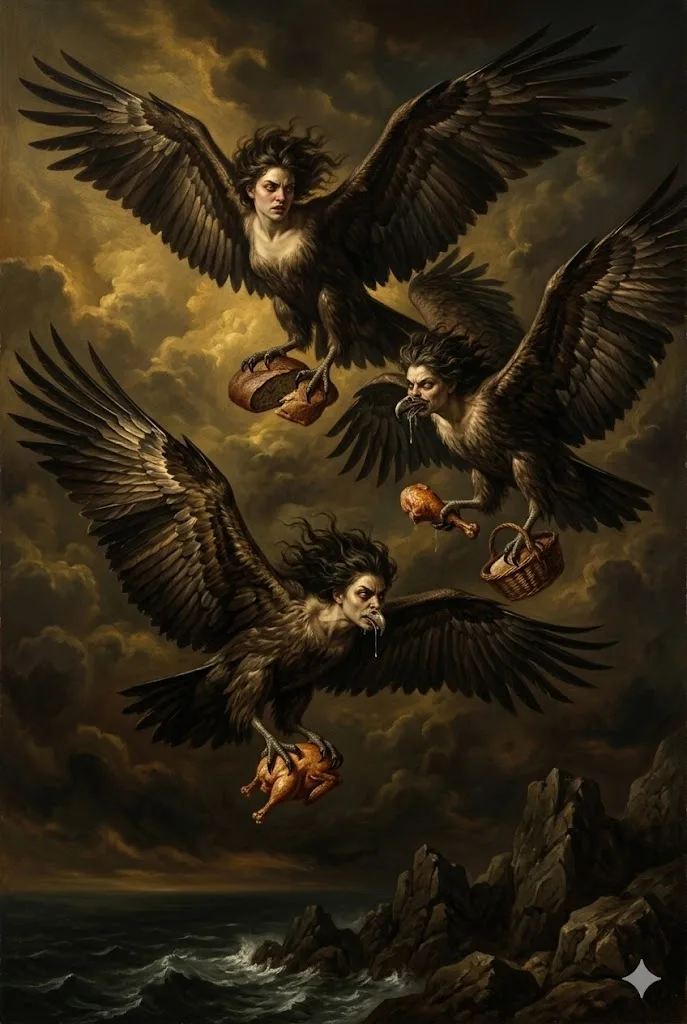
The Storm Spirits
The Harpies (from the Greek harpazein, meaning 'to snatch') were winged female spirits associated with sudden, violent gusts of wind. In the earliest sources, they were described as beautiful winged women who flew faster than birds and the wind itself. Over time, their portrayal became increasingly monstrous: by the Roman period, they were depicted as hideous bird-women with the faces of pale, starving women, razor-sharp talons, and a unbearable stench.
The Harpies were daughters of the sea god Thaumas and the Oceanid Electra, making them sisters of Iris, the rainbow goddess. Their names varied between sources, but the most commonly cited were Aello ('Storm Swift'), Ocypete ('Swift Wing'), and Celaeno ('The Dark'). They served as agents of divine punishment, snatching people or food on behalf of the gods, particularly Zeus.
The Torment of Phineus
The most famous myth involving the Harpies is the story of King Phineus. Phineus was a Thracian king and prophet who had been given the gift of prophecy by Apollo. But when he revealed too much of Zeus's plans to mortals, Zeus punished him with a terrible curse: he was blinded, set before a magnificent feast, and surrounded by the Harpies, who would swoop down and steal or befoul his food every time he tried to eat. Phineus was left perpetually starving, surrounded by abundance he could never consume.
When Jason and the Argonauts arrived at Phineus's kingdom during their quest for the Golden Fleece, the starving king begged for help. Two of the Argonauts, the winged sons of Boreas (the North Wind), chased the Harpies across the sky. In some versions they killed the Harpies; in others, Iris appeared and swore an oath that the Harpies would never torment Phineus again, and the sons of Boreas relented. In gratitude, Phineus told Jason how to navigate the Clashing Rocks, saving the Argo from destruction.
Symbolism
The Harpies embodied the ancient Greek experience of sudden, inexplicable loss. Food spoiled by contamination, people who vanished without explanation, possessions carried away by storms — all could be attributed to the Harpies' invisible predation. They represent the terrifying randomness of nature in a world without refrigeration, weather forecasting, or modern security. In Virgil's Aeneid, the Harpies torment Aeneas and his crew, connecting the Greek tradition to Roman mythology and ensuring the creatures' survival in Western literature.
Classical Sources
- 📜 Homer, Iliad & Odyssey (c. 750 BC)
- 📜 Hesiod, Theogony (c. 700 BC)
- 📜 Apollodorus, Bibliotheca (c. 1st-2nd century AD)
- 📜 Ovid, Metamorphoses (8 AD)
Cross-referenced with multiple classical sources for accuracy.
Explore More
Jason · Golden Fleece · Zeus · Iris · Home
From wind spirits to bird-women
The earliest Harpies are not grotesque. Hesiod calls them "lovely-haired." He names two, Aello and Ocypete, daughters of Thaumas and the Oceanid Electra, and says they keep up with the blasts of the winds and with birds on their swift wings. Homer never describes them. He uses harpuiai almost as a word for sudden storm winds. When Telemachus wonders what has happened to his father, he says the Harpies have carried Odysseus off without trace. Penelope tells how the orphaned daughters of Pandareus were raised by the goddesses and then snatched by the Harpies and handed over as servants to the hateful Erinyes.
The Iliad adds the strangest detail. Achilles' immortal horses Xanthus and Balius were born to the Harpy Podarge ("Swift-foot") and the west wind Zephyrus, who mated with her while she grazed in a meadow beside the stream of Ocean. In this picture, the Harpy is part wind and part mare, which says a great deal about how the earliest Greeks imagined these beings. The names multiplied over time. Podarge, Aello (sometimes Aellopus), Ocypete (or Ocythoe) and Celaeno all appear, and different authors give different numbers.
Phineus: why he was punished and how it ended
Ancient authors disagree about Phineus' crime. In Apollonius of Rhodes' Argonautica, he is punished for revealing the will of Zeus to mortals too precisely. Other versions in Apollodorus blame him for blinding his own sons, after their stepmother falsely accused them, or for showing Phrixus' sons the way to Greece. The ending varies as well. Apollonius tells the most detailed version. Zetes and Calais, the winged sons of Boreas, chase the Harpies as far as the islands then called the Plotae ("Floating Islands"). There Iris, the Harpies' own sister, stops them. She swears by the Styx that the Harpies will never return, and the brothers turn back. The islands were renamed the Strophades, the "Islands of Turning," and the Harpies withdrew to a cave on Crete.
Apollodorus mentions a version in which it was fated that the Harpies would die at the hands of the Boreads, and that the brothers themselves would die if they failed to catch them. One Harpy fell into a river in the Peloponnese, which was afterwards called the Harpys after her. Either way, the episode fits into a larger story: once he is freed, Phineus tells the Argonauts how to pass the Clashing Rocks, the next step of the voyage toward the Golden Fleece.
Virgil, Dante and the Harpies in art
Virgil sets his Harpy episode on the same Strophades. In Aeneid Book 3, the Trojans land, slaughter cattle and sit down to eat, only for the Harpies to swoop on the meal and foul it. When the Trojans fight back with swords, Celaeno perches on a high rock and calls herself the greatest of the Furies. She delivers a curse disguised as a prophecy: the Trojans will not found their city until hunger drives them to eat their own tables. In Book 7 the curse is fulfilled harmlessly when the men eat the flat loaves they have been using as plates. Virgil also places Harpies at the gates of the underworld in Book 6. See the Aeneid summary for where these episodes fall in the epic. Dante borrowed Virgil's Harpies for the seventh circle of the Inferno, where they nest in the wood of the suicides and tear at the leaves of the souls that have become trees.
Greek artists drew them as winged women in rapid flight. On the Chalcidian "Phineus Cup" (about 530 BC, now in Würzburg), the Boreads chase the Harpies away from the blind king's table. The well-known "Harpy Tomb" from Xanthos in Lycia, now in the British Museum, shows bird-bodied women carrying small human figures, perhaps souls. The name is modern, and scholars debate whether the figures are Harpies, Sirens or some local spirit of death.
Common confusions
Harpies are often confused with Sirens because both were later shown as women with bird bodies. The difference is in what they do: Sirens lure sailors with song, while Harpies snatch and spoil. The image of the hideous, filthy Harpy comes mainly from Virgil and later Roman writers, not from early Greek poetry. The modern word "harpy" for a nagging or grasping woman is an English usage and has nothing to do with Greek myth.
Ancient sources
- Hesiod, Theogony 265–269: the Harpies Aello and Ocypete, daughters of Thaumas and Electra and sisters of Iris, fast as winds and birds.
- Homer, Iliad 16: the Harpy Podarge as the mother, by Zephyrus, of Achilles' horses Xanthus and Balius.
- Homer, Odyssey 1, 14 and 20: the Harpies as winds that carry people away, including the daughters of Pandareus.
- Apollonius of Rhodes, Argonautica 2: Phineus' torment, the pursuit by Zetes and Calais, Iris' oath and the naming of the Strophades.
- Apollodorus, Library 1.9.21: alternative crimes of Phineus, the fate linking the Boreads and the Harpies, and the Harpies' names.
- Virgil, Aeneid 3: the Harpies on the Strophades and Celaeno's prophecy about eating tables.
Frequently asked questions
How many Harpies were there?
Hesiod names two, Aello and Ocypete. Later writers add Celaeno and sometimes Podarge, which makes three the most common modern count.
Were the Harpies evil?
Not exactly. They usually act as agents of Zeus' punishment, as with Phineus, or as forces of nature that carry people away. Virgil's Harpies are the most hostile and repulsive version.
Did the sons of Boreas kill the Harpies?
Accounts differ. Apollonius has Iris stop the chase and promise that the Harpies will leave Phineus alone. Other versions, noted by Apollodorus, have one or both Harpies die during the pursuit.
Where did the Harpies live?
Apollonius sends them to a cave on Crete after the chase. Virgil has them living on the Strophades islands in the Ionian Sea and also at the entrance to the underworld.
Books to read next
- Stephen Fry, Mythos
- Edith Hamilton, Mythology
- Apollodorus, The Library of Greek Mythology (Oxford World's Classics)
Links go to Bookshop.org, which supports independent bookstores. We earn a small commission if you buy, at no extra cost to you.