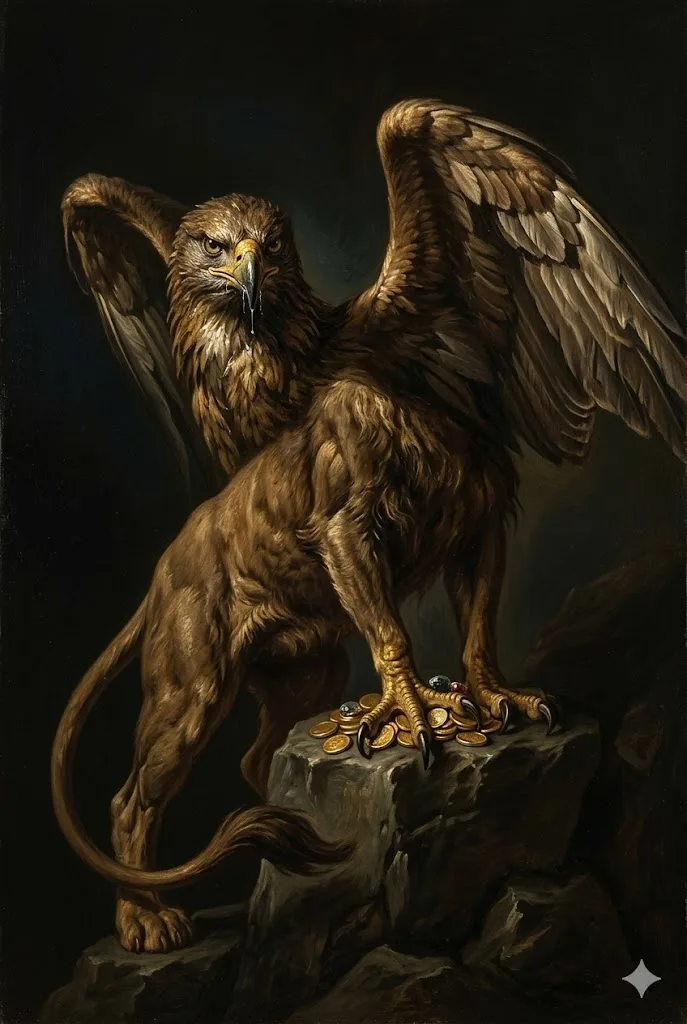
I. What Was the Griffin?
The Griffin (Gryps) was a legendary creature with the head, wings, and talons of an eagle combined with the body, hind legs, and tail of a lion — uniting the king of birds with the king of beasts into a single, supremely powerful guardian. Griffins were believed to inhabit the mountains of Scythia and the deserts of India, where they fiercely guarded vast deposits of gold from the one-eyed Arimaspian tribesmen who perpetually tried to steal it.
The Greeks adopted the Griffin from Near Eastern mythology, where eagle-lion hybrids appear in art dating back to the 4th millennium BC. In Greek culture, Griffins became associated with divine power, vigilance, and retribution. They were sacred to Apollo (as solar creatures of light and power) and were said to pull the chariots of various gods. Their nests were made of gold, and their eggs were agate stones.
Griffins symbolized the union of terrestrial and celestial power — the lion's earthly strength combined with the eagle's heavenly vision. They became popular decorative motifs in Greek, Roman, and medieval art, and survive today in heraldry, coats of arms, and fantasy literature as one of mythology's most enduring and beloved creatures.
Classical Sources
Ancient accounts of Griffin appear in:
- 📜 Hesiod, Theogony (c. 700 BC) — Origin and genealogy of mythological creatures.
- 📜 Apollodorus, Bibliotheca (c. 1st–2nd century AD) — Detailed descriptions of monsters and their encounters with heroes.
- 📜 Ovid, Metamorphoses (8 AD) — Vivid retellings of creature myths with emphasis on transformation.
- 📜 Homer, Iliad & Odyssey (c. 750 BC) — Encounters with mythological beasts during the Trojan War cycle.
Cross-referenced with multiple classical sources for accuracy.
Where the griffin story comes from
The Greek griffin (gryps, plural grypes) lived on the edges of geography, not in a myth cycle. No Olympian story makes a griffin its central character, and Hesiod and Homer never mention one. The tale of gold-guarding griffins goes back to a lost poem, the Arimaspea of Aristeas of Proconnesus, probably from the seventh century BC. In it, Aristeas claimed to have travelled north beyond the Scythians to the Issedones. They told him about the one-eyed Arimaspians and, further on, the griffins that guard gold, with the Hyperboreans living beyond them.
Herodotus repeats this account but keeps his distance. He says gold is plentiful in the far north and that the Arimaspians are said to steal it from griffins. He does not believe that one-eyed men exist and says he is passing on what the Scythians report. In Aeschylus' Prometheus Bound, Prometheus warns Io about the route ahead: she must beware "the sharp-beaked hounds of Zeus that never bark, the griffins," and the one-eyed Arimaspian horsemen who live by a river that flows with gold.
The griffins of India are a separate tradition. Ctesias of Cnidus, a Greek physician at the Persian court, described Indian griffins as four-footed birds the size of wolves, with legs and claws like a lion's and red feathers on their breasts. In this version they guard gold in the mountains, and the people who collect it travel at night to avoid them. Aelian preserves this account, along with the detail that the griffins fight to protect their young rather than the gold. Pliny the Elder, on the other hand, flatly lists griffins among fabulous creatures.
Griffins and the gods
Because the Hyperboreans lived beyond the griffins, the creature became tied to Apollo, who was said to spend the winter months among that people. Fourth-century vase paintings and later reliefs show Apollo riding a griffin or seated on one. Griffins also appear in the art of Dionysus, and in the Roman period they became the standard companion of Nemesis, often shown with one paw resting on her wheel. On the Athenian Acropolis, Pausanias says the helmet of Pheidias' great statue of Athena Parthenos carried a sphinx in the middle and griffins on either side. He took the occasion to quote Aristeas on griffins fighting the Arimaspians for gold, and added that griffins are wild beasts like lions, with the wings and beak of an eagle.
The griffin in ancient and later art
The motif is much older than Greek literature. Griffins appear in Egyptian and Mesopotamian art, and in the Aegean they appear on Minoan seals and in the frescoes of the Throne Room at Knossos on Crete, although the Knossos creatures are wingless and were heavily restored. The richly furnished Mycenaean-era burial excavated at Pylos in 2015 became known as the "Griffin Warrior" tomb because of an ivory plaque with a griffin found in it. In the seventh century BC, Greek workshops produced bronze cauldrons ringed with cast griffin heads with open beaks, pricked ears and a knob on the forehead. Many were dedicated at Olympia and on Samos. Further north, Scythian gold work often shows griffins attacking deer and horses, the same steppe world that Aristeas described.
The griffin outlived antiquity easily. In Virgil's eighth Eclogue, a disappointed lover says that griffins will soon mate with mares, meaning an impossible thing. Centuries later, Ariosto made that impossibility real as the hippogriff of Orlando Furioso. In Dante's Purgatorio a griffin draws the chariot of the Church, and its double nature is generally read as a symbol of Christ. Medieval bestiaries and heraldry made it a symbol of vigilance and courage.
In 2000, the historian Adrienne Mayor suggested that ancient prospectors in Central Asia may have seen fossil skeletons of beaked dinosaurs such as Protoceratops and taken them for griffins. The idea is popular but disputed, and it remains a hypothesis, not an established explanation. Readers should also be cautious about details that appear only in medieval or modern retellings, such as agate eggs or griffin feathers that cure blindness. These are not standard features of the Greek sources. Compare the griffin with other composite beasts such as the Sphinx and the Chimera.
Ancient sources
- Herodotus, Histories 3.116 and 4.13–27: reports Aristeas' journey, the Arimaspians and the gold-guarding griffins, with open skepticism.
- Aeschylus, Prometheus Bound: Prometheus warns Io about the "unbarking hounds of Zeus," the griffins, and the one-eyed Arimaspians.
- Ctesias, Indica (preserved in later summaries): the four-footed, red-breasted griffins of India that guard gold.
- Aelian, On the Nature of Animals: retells the Indian griffin account, including how gold seekers avoid them.
- Pausanias, Description of Greece 1.24: the griffins on Athena Parthenos' helmet and Aristeas' story about the Arimaspians.
- Pliny the Elder, Natural History: mentions the griffin tradition and rejects it as fabulous.
Frequently asked questions
Is the griffin from Greek mythology?
The griffin is older than Greece and came from Near Eastern art, but the Greeks gave it a geography and a role: guarding gold from the Arimaspians in the far north or in India. It belongs more to travellers' tales than to stories of gods and heroes.
What is the difference between a griffin and a hippogriff?
A griffin is part eagle and part lion. The hippogriff is a later invention, half griffin and half horse, made famous by Ariosto in the sixteenth century. It grew out of the ancient saying that griffins and horses could never mate.
Which god is the griffin associated with?
Mainly Apollo, through his link with the Hyperboreans beyond the griffins' land. In Roman times the griffin also became the companion of Nemesis.
Did the griffin appear in any Greek hero's story?
Not in any major one. No hero of classical myth fights a griffin. The creature appears in ethnography, poetry and art, not in heroic adventure.
Explore More Mythology
Get weekly deep dives into the gods, heroes, and myths of ancient Greece.