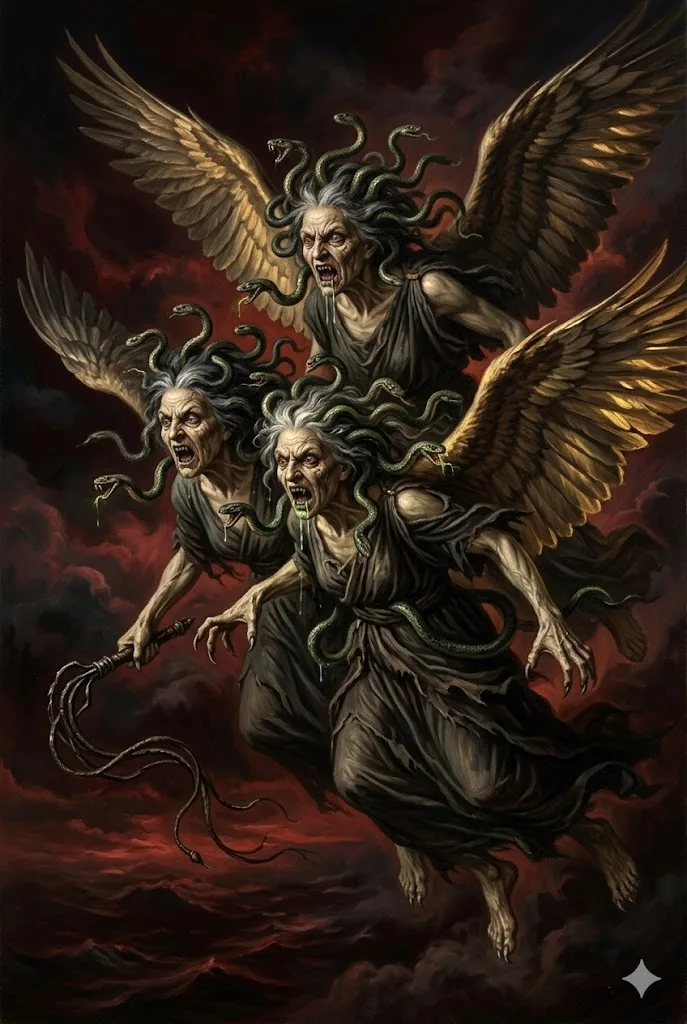
The Erinyes
The Furies, known in Greek as the Erinyes (Ἐρινύες), were among the most terrifying figures in all of Greek mythology. They were ancient goddesses of vengeance and retribution who pursued and punished the guilty, particularly those who had committed crimes against family. Murder of a parent, violation of an oath, and offences against the natural order were their special concerns. The Greeks feared them so deeply that they often referred to them by the euphemistic title 'Eumenides' (the Kindly Ones) to avoid attracting their attention.
Origins
According to Hesiod's Theogony, the Furies were born from the blood of Uranus when his son Cronus castrated him with a sickle. Drops of the sky god's blood fell upon the earth (Gaia), and from that blood sprang the Erinyes. This origin from an act of primal violence against a father made them the natural avengers of crimes against family. Other traditions made them daughters of Nyx (Night), placing them among the oldest and most primordial forces in the cosmos, older than Zeus and the Olympian gods.
There were traditionally three Furies: Alecto ('the Unceasing'), whose rage never stopped; Megaera ('the Grudging'), who personified jealousy and envy; and Tisiphone ('the Avenger of Murder'), who punished killers. They were depicted as fearsome women with snakes writhing in their hair, blood dripping from their eyes, and black robes. They carried whips and torches, and their presence brought madness, disease, and unending guilt.
The Trial of Orestes
The most famous myth involving the Furies is the trial of Orestes, dramatized in Aeschylus's Oresteia trilogy (458 BC). After Orestes killed his mother Clytemnestra to avenge her murder of his father Agamemnon, the Furies pursued him relentlessly across Greece, driving him to the edge of madness. He fled to Athens and begged Athena for help. Athena established a trial, the first jury court in mythology, with Athenian citizens as jurors. Apollo defended Orestes, arguing that the father's claim outweighed the mother's. The Furies served as prosecutors, demanding blood for blood.
The jury split evenly, and Athena cast the deciding vote to acquit Orestes. But rather than simply dismissing the Furies, Athena offered them a new role: instead of agents of blind vengeance, they would become honoured guardians of justice in Athens, worshipped in a cave beneath the Acropolis. They accepted, and their transformation from the Erinyes (Furies) to the Eumenides (Kindly Ones) represents one of the most profound moments in Greek literature — the evolution from a culture of blood vengeance to one of institutional justice.
Classical Sources
- 📜 Homer, Iliad & Odyssey (c. 750 BC)
- 📜 Hesiod, Theogony (c. 700 BC)
- 📜 Apollodorus, Bibliotheca (c. 1st-2nd century AD)
- 📜 Ovid, Metamorphoses (8 AD)
Cross-referenced with multiple classical sources for accuracy.
Explore More
Nyx · Athena · Achilles · Athens · Home
The Erinyes in Homer and Hesiod
Long before tragedy gave them a voice, the Erinyes were already at work in epic. Homer usually speaks of a single Erinys or of unnamed Erinyes, and he treats them less as monsters than as the enforcers of a curse. In the Iliad, Phoenix tells Achilles how his father Amyntor called on "the hateful Erinyes" to curse him with childlessness, and Meleager's mother Althaea beats the earth, calling on Hades and Persephone to kill her son, while an Erinys "that walks in darkness" hears her from Erebus. When Agamemnon swears that he never touched Briseis, he names the Erinyes among the powers who punish perjurers beneath the earth. They also check things that go against nature: when Achilles' horse Xanthus is given a human voice to prophesy his master's death, the Erinyes silence it.
The Odyssey shows the same pattern within families. Epicaste (the Jocasta of later drama) hangs herself and leaves Oedipus "all the sorrows that a mother's Erinyes bring to pass." Penelope, in a dark mood, tells how storm winds snatched the orphaned daughters of Pandareus and handed them over to the Erinyes as servants. The philosopher Heraclitus later pushed the idea onto a cosmic scale: if the sun ever overstepped its measures, the Erinyes, "ministers of Justice," would find it out.
Hesiod gives two pieces of the picture. The Theogony has them grow from the blood of Uranus soaking into Gaia, and the Works and Days says they attended the birth of Horkos (Oath) on the fifth day of the month, which is why that day was considered dangerous. Aeschylus, by contrast, has them call Nyx their mother. Their number was also not fixed. Aeschylus gives them no individual names. The familiar trio of Alecto, Tisiphone and Megaera is set out in Apollodorus and in Virgil's Aeneid, where Tisiphone guards Tartarus, Alecto stirs up war in Latium, and one of the Dirae is sent against Turnus.
After the verdict: other versions of Orestes' story
The trial in Aeschylus' Eumenides is the best-known ending, but it was never the only one. In Euripides' Iphigenia in Tauris, some of the Erinyes refuse to accept the Athenian verdict and keep hounding Orestes. Apollo sends him to the land of the Taurians to steal Artemis' statue, and there he finds his sister Iphigenia. In Euripides' Orestes, set only days after the murder of Clytemnestra, we see the goddesses only through Orestes' fits of madness as Electra nurses him.
Local legends in the Peloponnese kept their own versions. Pausanias describes a place in Arcadia called Maniai ("Madnesses") near Megalopolis, where Orestes was said to have gone mad. According to local tradition, the goddesses appeared to him black at first, and after he bit off one of his own fingers they appeared white, and he regained his sanity. A sanctuary of the Eumenides at Ceryneia in Achaea was said to have been founded by Orestes himself.
Worship, offerings and appearance in art
At Athens, the goddesses were worshipped as the Semnai Theai, "the Venerable Goddesses," at a cleft on the slope of the Areopagus, the hill where homicide trials were held. Pausanias says their statues there had nothing frightening about them. Two of them were by the sculptor Scopas, and the middle one was by Calamis. Their rites were set apart from those of other gods: Aeschylus and Sophocles both mention wineless libations, and in Oedipus at Colonus the chorus tells Oedipus to pour water and honey for the goddesses of the grove at Colonus, the place where he finally dies. In Arcadia, Demeter herself was worshipped at Thelpusa under the epithet Erinys, "the Angry One," which shows how closely the name was tied to divine rage over a wrong.
Pausanias says that Aeschylus was the first to give the Erinyes snakes in their hair. Vase painting soon picked up the image. South Italian vases from the fourth century BC show them surrounding Orestes as he clings to the omphalos at Delphi, often dressed like huntresses in short tunics and high boots, with snakes wound around their arms and sometimes wings. The hunting image fits Aeschylus' chorus, which tracks Orestes by the scent of blood like a pack of hounds.
A common modern mistake is to treat the Furies as evil spirits or demons of hell. To the Greeks, they were dreadful but just. They stood for claims that no one else would press, such as a murdered mother's, a cheated guest's or a broken oath's, and even Zeus did not overrule them. They are also distinct from the Fates, although Aeschylus calls the Moirai their sisters by their mother Night.
Ancient sources
- Homer, Iliad (Books 9 and 19): Phoenix's and Althaea's curses, Agamemnon's oath invoking the Erinyes, and the Erinyes silencing the horse Xanthus.
- Homer, Odyssey (Books 11 and 20): a mother's Erinyes pursuing Oedipus, and the daughters of Pandareus given to the Erinyes as servants.
- Hesiod, Theogony and Works and Days: their birth from Uranus' blood, and their presence at the birth of Oath.
- Aeschylus, Eumenides: the Erinyes as the chorus, hunting Orestes, prosecuting him at the Areopagus and accepting Athena's offer of a home in Athens.
- Sophocles, Oedipus at Colonus: the grove of the Eumenides at Colonus and the ritual offerings made to them.
- Pausanias, Description of Greece (Books 1 and 8): the Semnai at Athens and their statues, Aeschylus as the first to give them snake-hair, and the Arcadian story of Orestes at Maniai.
Frequently asked questions
What is the difference between the Furies and the Eumenides?
They are the same goddesses under different names. "Erinyes" was their usual Greek name, "Furies" comes from the Roman Furiae, and "Eumenides" ("the Kindly Ones") was a respectful euphemism. Athens also worshipped them as the Semnai Theai. Aeschylus' Eumenides links these names through the story of their reconciliation with Athena.
Who were the Furies' parents?
Hesiod says they sprang from the blood of Uranus falling on Gaia. Aeschylus makes them daughters of Night (Nyx). Other later genealogies exist, but these two are the main ancient versions.
Did the Furies punish only murder?
No. Murder of kin was their central concern, but in Homer they also punish perjury, a son's offence against his father, and breaches of the natural order. Later writers put them in Tartarus, where they torment the dead.
Why did the Greeks avoid saying their name?
Speaking a dangerous power's name could be thought to draw its attention, so people used flattering titles such as "Kindly Ones" or "Venerable Goddesses" instead. Sophocles' Colonus chorus says they pray to them in silence, without raising their voices.
Books to read next
- Stephen Fry, Mythos
- Edith Hamilton, Mythology
- Apollodorus, The Library of Greek Mythology (Oxford World's Classics)
Links go to Bookshop.org, which supports independent bookstores. We earn a small commission if you buy, at no extra cost to you.