I. Who Were the Cyclopes?
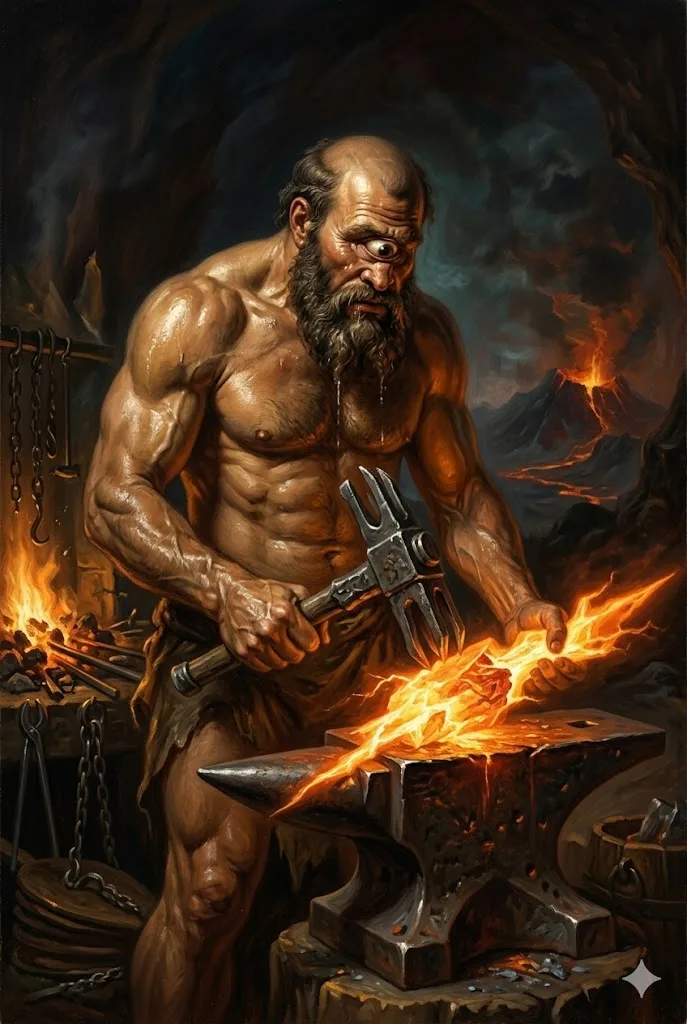
The Cyclopes (singular: Cyclops, meaning "circle-eyed") were a race of one-eyed giants in Greek mythology. There were two distinct groups: the elder Cyclopes — Brontes (Thunder), Steropes (Lightning), and Arges (Bright) — who were sons of Uranus and Gaea and master craftsmen who forged Zeus's thunderbolts; and the younger, savage Cyclopes of Sicily, shepherds and cannibals who lived in caves and recognized no law or authority.
The elder Cyclopes were imprisoned in Tartarus by their father Uranus, freed by Cronus during the first cosmic revolution, then imprisoned again by Cronus himself. When Zeus finally freed them during the Titanomachy, they repaid him by creating the three most powerful weapons in mythology: Zeus's thunderbolts, Poseidon's trident, and Hades' Helm of Darkness.
II. Polyphemus and Odysseus
The most famous individual Cyclops was Polyphemus, a son of Poseidon who lived in a cave on Sicily. When Odysseus and his crew landed on the island during their voyage home from Troy, Polyphemus trapped them in his cave and began eating them two at a time. Odysseus devised a cunning escape: he got the giant drunk on wine, told him his name was "Nobody," then blinded him by driving a sharpened stake into his single eye while he slept.
When Polyphemus cried for help, shouting "Nobody is hurting me!", the other Cyclopes assumed he was ill and left him alone. Odysseus and his surviving men escaped by clinging to the undersides of Polyphemus's sheep as they left the cave to graze. But Odysseus's pride got the better of him: as he sailed away, he shouted his real name back to the blinded giant, allowing Polyphemus to pray to his father Poseidon for revenge — curse that kept Odysseus wandering the seas for another decade.
Classical Sources
Ancient accounts of Cyclopes appear in:
- 📜 Hesiod, Theogony (c. 700 BC) — Origin and genealogy of mythological creatures.
- 📜 Apollodorus, Bibliotheca (c. 1st–2nd century AD) — Detailed descriptions of monsters and their encounters with heroes.
- 📜 Ovid, Metamorphoses (8 AD) — Vivid retellings of creature myths with emphasis on transformation.
- 📜 Homer, Iliad & Odyssey (c. 750 BC) — Encounters with mythological beasts during the Trojan War cycle.
Cross-referenced with multiple classical sources for accuracy.
A Third Kind of Cyclops: The Wall-Builders
Ancient Greeks spoke of a third group besides the thunderbolt-smiths and the shepherds of the Odyssey. These were the master masons who built the huge walls of the Bronze Age citadels in the Argolid. Pausanias says the walls of Tiryns and the Lion Gate at Mycenae were the work of Cyclopes. Strabo records a tradition that seven of them came from Lycia at the request of King Proetus to fortify Tiryns, and he calls them "belly-hands," workers who lived by their labour. The stones at Tiryns are so large that later Greeks could not believe humans had moved them. Archaeologists still call this unmortared style of boulder walling "Cyclopean masonry."
The Smiths: Weapons, Death and Afterlife
Hesiod introduces Brontes, Steropes and Arges as sons of Uranus and Gaia, identical to the gods in every way except for a single round eye in the middle of their foreheads, which is where their name comes from. They gave Zeus thunder, lightning and the thunderbolt in gratitude for their release. Apollodorus adds the helmet for Hades and the trident for Poseidon, which came out of the same workshop during the Titanomachy.
The smiths also have a death story, unusual for children of Uranus. When Zeus struck down Asclepius for raising the dead, Apollo took revenge by killing the Cyclopes who had made the thunderbolt. Zeus nearly threw Apollo into Tartarus for it, and instead sentenced him to a year's service as a herdsman for King Admetus of Pherae. Euripides opens his Alcestis with Apollo explaining this. Some sources, troubled that Apollo could kill beings older than Zeus, say he killed the sons of the Cyclopes instead.
Later poets moved the Cyclopes into Hephaestus' forge. In Callimachus' Hymn to Artemis, the young goddess visits them on the island of Lipari and they make her bow and arrows. The poet adds that the Cyclopes are so frightening that goddesses threaten their disobedient daughters with them. Virgil sets Vulcan's workshop in the Aeolian islands, where Brontes, Steropes and Pyracmon hammer out a half-finished thunderbolt and then the shield of Aeneas.
Polyphemus Beyond the Odyssey
Homer's account contains details that retellings often lose. His Cyclopes have no assemblies or laws. Each one rules his own wives and children. They do not plough or plant, because grain and vines grow for them unaided. Polyphemus' mother is the sea-nymph Thoösa, daughter of Phorcys. A seer named Telemus had warned him long before that a man named Odysseus would blind him, so when he hears the name he realises the prophecy has come true. He had expected a giant, not a small, weak man. Homer never names the island as Sicily. The identification, with Mount Etna as the Cyclopes' home, is later, and Thucydides passes it on as the oldest tradition about the island's inhabitants.
Hellenistic poets gave Polyphemus a softer side. In Theocritus' eleventh Idyll, a lovesick young Cyclops sits on a rock above the sea singing to the Nereid Galatea, offering her his cheeses and his cave, and conscious of his shaggy eyebrow. Ovid turns this into tragedy in Metamorphoses 13: Galatea loves the young shepherd Acis, and Polyphemus, catching them together, crushes Acis with a piece of the mountain. Galatea turns her dead lover into a Sicilian river. Euripides' Cyclops, the only complete satyr play that survives, retells the blinding as a comedy, with Silenus and the satyrs enslaved in the giant's cave.
The Cyclopes in Art
The blinding of Polyphemus is one of the earliest myths that can be identified in Greek art. A large Proto-Attic funerary amphora from Eleusis, from the seventh century BC, shows Odysseus and his men driving the stake into the giant's eye. Another early version appears on an Argive fragment of about the same period. Nearly seven centuries later, the emperor Tiberius' seaside grotto at Sperlonga in Italy held a huge marble group of the same scene, now reconstructed in the museum there. The escape under the rams was another favourite, especially on Archaic vases.
Ancient sources
- Hesiod, Theogony 139–146 and 501–506: the three elder Cyclopes, their single eye, and the gift of thunder and lightning to Zeus.
- Homer, Odyssey 9.105–566: the lawless Cyclopes, Polyphemus' cave, the blinding, "Nobody," and Polyphemus' prayer to Poseidon.
- Euripides, Alcestis 1–7: Apollo explains his servitude to Admetus as punishment for killing the Cyclopes.
- Callimachus, Hymn to Artemis: the Cyclopes at Lipari forge Artemis' bow and arrows.
- Theocritus, Idyll 11; Ovid, Metamorphoses 13: Polyphemus' love for Galatea and the death of Acis.
- Pausanias, Description of Greece 2.16 and 2.25: the Cyclopes as builders of the walls of Mycenae and Tiryns.
Frequently asked questions
Are the Cyclopes Titans?
No. They are siblings of the Titans, children of Uranus and Gaia, but form their own group along with the hundred-handed Hecatoncheires. All of them were imprisoned by their father.
Was Polyphemus one of the original three Cyclopes?
No. Polyphemus is a son of Poseidon and belongs to Homer's race of shepherd Cyclopes, which is a different tradition from Hesiod's three smiths.
What does "Cyclops" mean?
"Round-eye" or "circle-eye," from Greek kyklos (circle) and ōps (eye). Hesiod himself explains the name by their single round eye.
Why are huge ancient walls called "Cyclopean"?
Because later Greeks believed only giants could have stacked the enormous stones of Mycenae and Tiryns, and attributed them to the Cyclopes.
Explore More Mythology
Get weekly deep dives into the gods, heroes, and myths of ancient Greece.