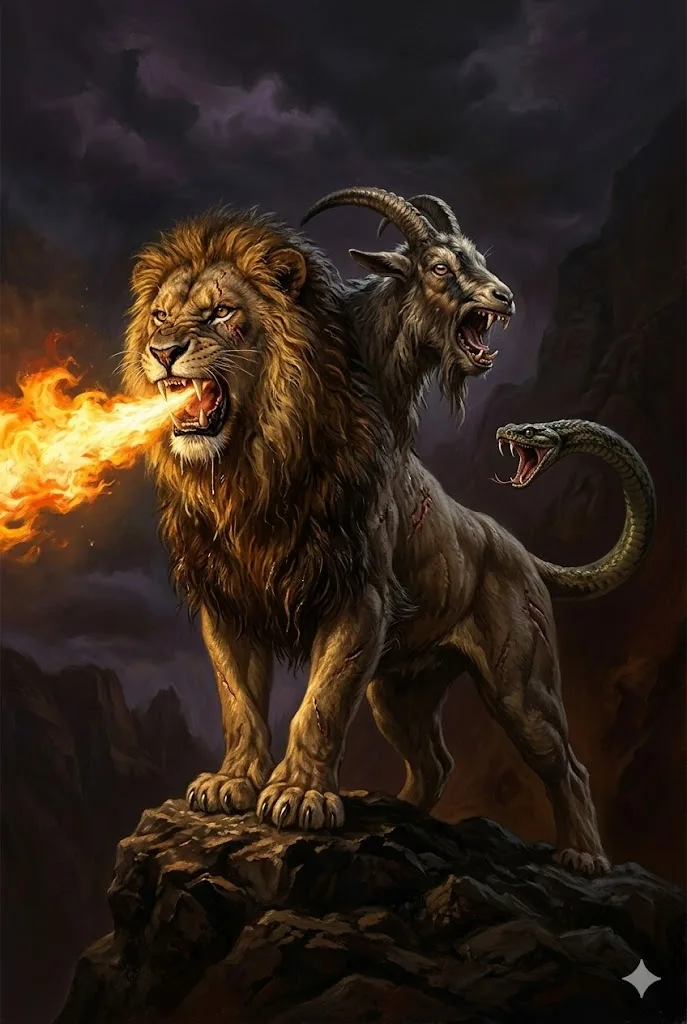
I. What Was the Chimaera?
The Chimaera was one of the most fearsome hybrid monsters of Greek mythology — a fire-breathing creature with the head of a lion, the body of a goat, and a tail that ended in a living serpent's head. Some ancient sources gave it three heads: the lion in front, the goat in the middle of its back, and the serpent at the rear. It ravaged the kingdom of Lycia in Asia Minor, destroying livestock, burning crops, and killing anyone who dared approach.
Like many of the greatest monsters, the Chimaera was a child of Typhon and Echidna, making it sibling to the Hydra, Cerberus, the Nemean Lion, and the Sphinx. Its fire breath made it virtually unapproachable on the ground — no warrior could get close enough to strike before being consumed by flames.
II. Bellerophon and Pegasus
The hero Bellerophon was tasked with slaying the Chimaera by King Iobates of Lycia, who expected the quest to be fatal. But Bellerophon had an advantage no other hero possessed: the winged horse Pegasus, which he had tamed with a golden bridle given to him by Athena in a dream. From the air, mounted on Pegasus, Bellerophon could attack the Chimaera without being reached by its flames.
Ancient sources such as Hesiod and Apollodorus simply say Bellerophon shot the Chimaera down from Pegasus. In a late (Byzantine) version, Bellerophon fitted a block of lead to the tip of his spear and thrust it into the Chimaera's mouth. The monster's own fire breath melted the lead, which poured down its throat and destroyed its internal organs. The word "chimera" has since entered the English language to mean any fantastical, impossible combination — and in genetics, a "chimera" refers to an organism containing cells from two different individuals.
Classical Sources
Ancient accounts of The Chimaera appear in:
- 📜 Hesiod, Theogony (c. 700 BC) — Origin and genealogy of mythological creatures.
- 📜 Apollodorus, Bibliotheca (c. 1st–2nd century AD) — Detailed descriptions of monsters and their encounters with heroes.
- 📜 Ovid, Metamorphoses (8 AD) — Vivid retellings of creature myths with emphasis on transformation.
- 📜 Homer, Iliad & Odyssey (c. 750 BC) — Encounters with mythological beasts during the Trojan War cycle.
Cross-referenced with multiple classical sources for accuracy.
What the Earliest Poets Said
The Chimaera is old. Homer describes her in the Iliad when Glaucus tells Diomedes the story of his grandfather Bellerophon. She was of divine stock, not human: a lion in front, a serpent behind and a she-goat in the middle, breathing out the terrible force of blazing fire. Homer also preserves a detail that later accounts drop. A Lycian named Amisodarus "reared the raging Chimaera," as if she were a dangerous animal raised by a local lord, and his sons fought at Troy. Homer gives Bellerophon no flying horse. He kills the monster "trusting in the signs of the gods."
Hesiod's Theogony adds Pegasus and the three heads, one each of lion, goat and snake. His genealogy is ambiguous, though. The pronoun introducing the Chimaera's mother can refer either to Echidna or to the Hydra, so some readers make the Chimaera a granddaughter of Echidna. A few lines later the same ambiguity hides who mated with the dog Orthus to produce the Sphinx and the Nemean Lion: either Echidna or the Chimaera herself. Later mythographers such as Apollodorus settled it simply, naming Typhon and Echidna as parents.
Bellerophon's Victory, Version by Version
Pindar's thirteenth Olympian ode, written for a Corinthian victor, tells the most complete early version of how Pegasus was tamed. Bellerophon struggled to catch the horse at the spring of Peirene in Corinth. He slept at Athena's altar on a seer's advice and woke holding a golden bridle she had left him. Mounted on Pegasus, he shot the Chimaera, the Amazons and the Solymi from the cold air above. Pindar also hints at what came later: in his seventh Isthmian he says Pegasus threw Bellerophon when he tried to ride up to Olympus.
Apollodorus repeats the core story: King Iobates set the task hoping it would kill the hero, the Chimaera had been raised by Amisodarus, and Bellerophon shot her from above. The lead-tipped spear that melts in her fiery throat is a late addition, best known from Byzantine commentators such as John Tzetzes. It does not appear in Homer, Hesiod or Pindar, where arrows or simple divine help do the job.
The Burning Mountain of Lycia
Ancient writers placed the Chimaera's lair in Lycia, and one site in particular kept the name. Pliny the Elder records that in the territory of Phaselis "Mount Chimaera" burned with fire that never went out, day or night. This is Yanartaş, above modern Çıralı on the southern Turkish coast. Methane seeps from the rock there and keeps small flames alight that visitors can still see after dark. Strabo and other ancient geographers also discuss the Chimaera in connection with Lycian geography, and some rationalising writers turned the monster into a volcanic mountain, a place infested with lions and snakes, or even a pirate ship with a lion figurehead. The everlasting flames gave the myth a landscape visitors could point to.
The Chimaera in Art
The Chimaera was a popular subject long before Classical sculpture. Corinthian vase painters of the seventh and sixth centuries BC, working in Bellerophon's home city, often painted her, usually with the goat's head rising from her back. The most famous single image is the Chimaera of Arezzo, a large Etruscan bronze of around 400 BC found in 1553 and now in the National Archaeological Museum in Florence. The wounded beast rears back, and the serpent tail, restored in the eighteenth century, bites at one of the goat's horns. An inscription on the right foreleg names the Etruscan sky-god Tinia, suggesting it was a votive offering. Bellerophon fighting the Chimaera also appears in a fourth-century BC pebble mosaic at Olynthus, and the scene stayed popular on Roman mosaics into late antiquity.
One point people often miss is that the Chimaera is female. The Greek word chimaira means a young she-goat, and ancient poets always use feminine pronouns for her. The goat is the creature's name and centre, not a minor addition to a lion.
Ancient sources
- Homer, Iliad 6.179–186 and 16.328–329: the lion–goat–serpent description, Bellerophon's victory, and Amisodarus who reared the Chimaera.
- Hesiod, Theogony 319–325: the three-headed, fire-breathing Chimaera, killed by Pegasus and Bellerophon, with an ambiguous mother.
- Pindar, Olympian 13 and Isthmian 7: Athena's golden bridle, the taming of Pegasus at Peirene, and Bellerophon's fall.
- Apollodorus, Library 2.3.1–2: Iobates' commission and the killing of the Chimaera from horseback.
- Pliny the Elder, Natural History 2.236: the ever-burning fires of Mount Chimaera near Phaselis.
Frequently asked questions
Was the Chimaera male or female?
Female. Her name means "she-goat," and Homer and Hesiod both treat her as feminine.
Is Mount Chimaera a real place?
Yes. The burning gas vents at Yanartaş, near Olympos in southwest Turkey, are usually identified with the Mount Chimaera that Pliny describes.
How did Bellerophon kill the Chimaera?
The early sources say he attacked from the air on Pegasus, using arrows or a spear. The story of melting lead in her throat comes much later. For the rest of the family, see the list of Greek monsters.
Where does the word "chimera" come from?
From this monster. Because she combined three animals, her name came to mean any impossible hybrid or fantasy, and biologists use it for an organism containing genetically distinct cells.
Explore More Mythology
Get weekly deep dives into the gods, heroes, and myths of ancient Greece.