Charybdis — The Maw of the Sea That Devoured Ships W
⚡ Quick Facts
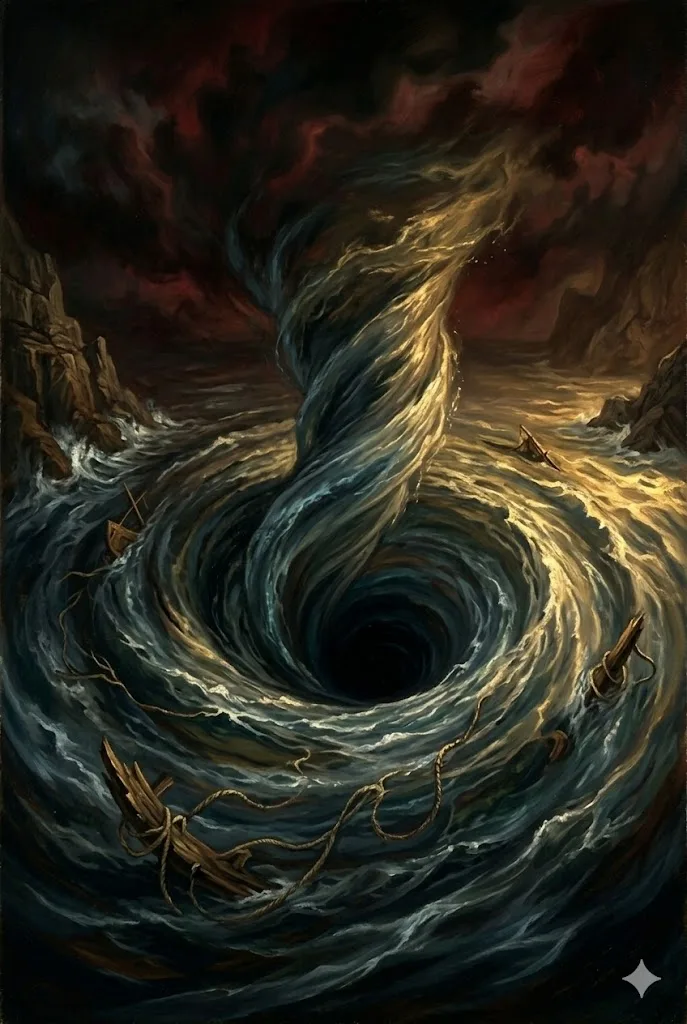
The Living Whirlpool
Homer gives Charybdis no parentage or backstory. In later, post-Homeric versions she was originally a naiad — a water nymph and daughter of Poseidon and Gaia. She was loyal to her father in his rivalry with Zeus, and she flooded lands to expand Poseidon's domain. Zeus punished her by transforming her into a monster chained to the ocean floor beneath a fig tree. Another tradition says she was struck down by Zeus for stealing the cattle of Heracles.
Three times each day, Charybdis swallowed the sea above her and spewed it back out, creating a massive whirlpool capable of dragging entire ships to the bottom. She was positioned directly across from Scylla, creating a narrow strait where sailors had to choose their danger.
Between Scylla and Charybdis
In the Odyssey, Odysseus was forced to navigate between the two monsters. The sorceress Circe advised him to sail closer to Scylla, who would only take six men, rather than risk Charybdis, who would destroy the entire ship. The expression "between Scylla and Charybdis" — caught between two equally terrible choices — remains in use today.
Later, after Zeus destroyed his final ship with a thunderbolt, Odysseus clung to a piece of wreckage that was sucked into Charybdis. He survived only by grabbing the fig tree above the whirlpool and hanging there until the waters receded and spat out his makeshift raft.
What Homer Actually Describes
Homer's Charybdis is stranger and vaguer than most retellings suggest. In Odyssey 12, Circe describes two cliffs. The higher one, peaked in cloud, holds Scylla's cave. The lower one, "a bowshot" away, has a large wild fig tree growing on it, and beneath it "divine Charybdis" sucks down the dark water three times a day and belches it up three times. Homer gives her no body, no face and no family. Nobody in the poem ever sees her, only what she does to the sea. When Odysseus' ship passes, the crew watch the water boil like a cauldron over a fire and see the seabed laid bare, dark with sand, while Scylla snatches six men from the other side.
The second encounter is more precise than the summary above might suggest. After Zeus wrecks the ship for the killing of the Sun's cattle, Odysseus lashes the mast and keel together and is carried back to the strait overnight. As Charybdis swallows his raft, he leaps up and clings to the fig tree "like a bat." He cannot climb it or find a foothold, so he hangs there until the timbers are thrown back up. Homer marks the moment with an everyday simile: about the hour a man rises from the assembly for supper after judging many disputes. Odysseus then drops into the water beside the beams and paddles away with his hands. Zeus keeps Scylla from seeing him.
Parents and Punishment: Later Additions
Charybdis' parentage as a daughter of Poseidon and Gaia comes from post-Homeric writers, and there are two different stories of how she became a whirlpool. One makes her a sea nymph who flooded land to enlarge her father's realm. The other, preserved in Latin commentary on Virgil, makes her a greedy woman who stole cattle from Heracles as he drove Geryon's herd through Italy and Sicily. Zeus struck her with a thunderbolt and she fell into the sea, where she kept her hunger. Both stories explain an existing hazard, and neither is in Homer.
The Argonauts' route passed the same strait. In Apollonius' Argonautica, Hera arranges for Thetis and the Nereids to steer the Argo away from Scylla and Charybdis and through the Wandering Rocks, tossing the ship from hand to hand like girls playing ball on a beach. Jason never really "encounters" Charybdis. He is helped past her.
Charybdis Placed on the Map
By the classical period Greeks had firmly identified Charybdis with the Strait of Messina between Sicily and Italy, with Scylla on the Calabrian side. Thucydides, describing operations there in the Peloponnesian War, says the strait is "the so-called Charybdis" through which Odysseus is said to have sailed. He explains it naturally: two seas, the Tyrrhenian and the Sicilian, meet there in a narrow channel and produce violent currents. Strabo discusses the same identification at length. The strait really does have strong tidal currents that switch direction several times a day, with eddies off the Sicilian shore near Capo Peloro. These are dangerous to small boats but nothing like a ship-swallowing vortex. Ancient readers also argued about whether Homer meant a real place at all, and that argument has never fully died.
Virgil follows the geography closely. In Aeneid 3 the seer Helenus warns Aeneas that Scylla holds the right side of the strait and Charybdis the left, and advises the long voyage around Sicily instead. Later the Trojans hear the roar of the water and row hard away. Ovid, at the start of his Scylla episode in Metamorphoses 13, uses the same layout. Writers of Greek and Latin proverbs adopted the pair long before English did. "Avoiding Charybdis, he fell into Scylla" was quoted in medieval Latin as incidit in Scyllam qui vult vitare Charybdim.
Charybdis in Art
Unlike Scylla, who appears on coins, vases and sculpture as a woman with dogs at her waist, Charybdis has almost no ancient image. That fits Homer's account of a force rather than a creature. The giant mouth ringed with teeth, familiar from modern fantasy films, games and novels, is a modern invention.
Ancient sources
- Homer, Odyssey 12.101–110, 12.234–259, 12.426–446: Circe's description of the fig-tree cliff, the first passage of the strait, and Odysseus hanging from the fig.
- Apollonius of Rhodes, Argonautica 4: Thetis and the Nereids guide the Argo past Scylla, Charybdis and the Wandering Rocks.
- Thucydides, History 4.24: identifies the Strait of Messina as "the so-called Charybdis" and explains the currents.
- Virgil, Aeneid 3.420–432 and 3.554–569: Helenus' warning and the Trojans' escape from the whirlpool's roar.
- Ovid, Metamorphoses 13: Charybdis on the left and Scylla on the right, introducing the story of Scylla's transformation.
Frequently asked questions
Is Charybdis a real whirlpool?
Ancient writers identified her with the Strait of Messina, which has strong, changing tidal currents and eddies. They are a real hazard to small craft, but nothing like Homer's ship-swallowing maelstrom.
What does "between Scylla and Charybdis" mean?
Being forced to choose between two dangers, where avoiding one brings you closer to the other. In the Odyssey Circe's advice is to accept the smaller certain loss (six men to Scylla) rather than risk losing the whole ship.
Did Charybdis have a body?
Homer never describes one. She is only seen through her effect on the water, and ancient art almost never shows her, unlike Scylla.
Why was Charybdis punished?
Homer gives no reason. Later sources say either that she flooded land for Poseidon or that she stole Heracles' cattle and Zeus struck her with a thunderbolt.