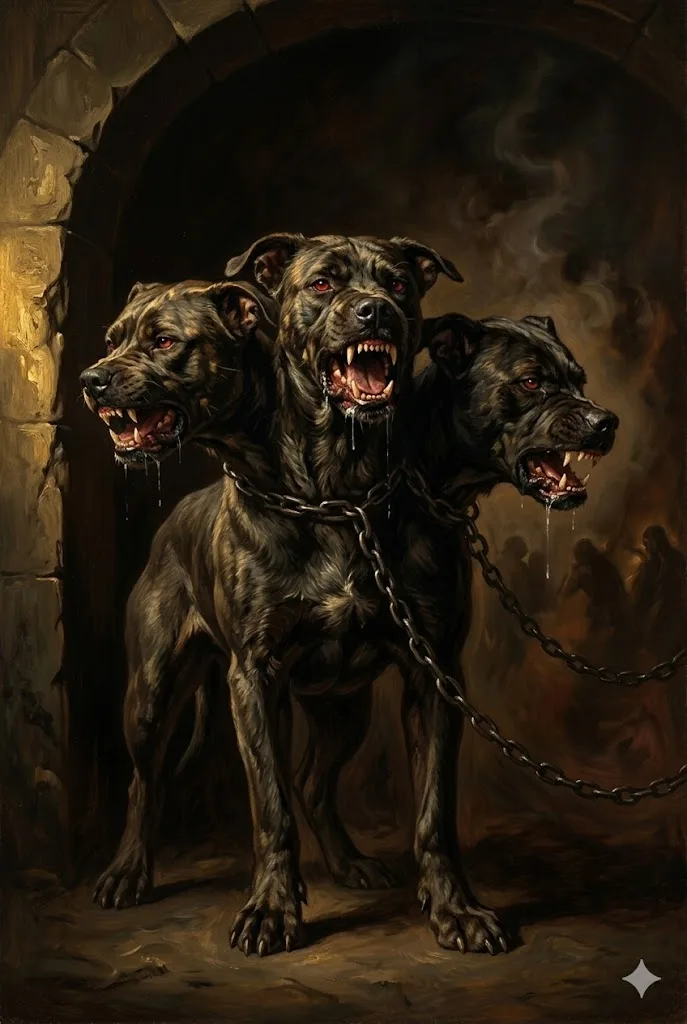
I. What Was Cerberus?
Cerberus was the monstrous multi-headed hound who guarded the entrance to the Greek underworld, preventing the dead from escaping and the living from entering without permission. Most commonly depicted with three heads (though Hesiod gave him fifty), Cerberus was the offspring of two of mythology's most fearsome monsters: Typhon, the hundred-headed giant who challenged Zeus for supremacy, and Echidna, the half-woman, half-serpent known as the "Mother of All Monsters."
His duty was absolute: every soul that entered the underworld was permitted to pass, but none could leave. Cerberus could be soothed — the Sibyl of Cumae drugged him with a honey cake to help Aeneas descend to the underworld, and Orpheus lulled him to sleep with his lyre — but only one hero ever subdued him by force: Heracles, who wrestled the beast into submission with his bare hands as the final and most dangerous of his Twelve Labours.
II. Guardian of the Dead
Cerberus sat at the banks of the River Styx (or the River Acheron), just beyond the point where the ferryman Charon deposited the newly dead. Later allegorical readings, not ancient myth, took his three heads to represent past, present, and future — or birth, youth, and old age. His serpentine tail and the snakes that wreathed his body made him a terrifying sight even by the standards of the underworld's inhabitants.
Despite his ferocity, Cerberus was a loyal servant of Hades. He performed his role faithfully for eternity, ensuring the natural order between life and death was maintained. In this sense, Cerberus was not a villain but a necessary force — a guardian who kept the boundary between worlds intact.
Classical Sources
Ancient accounts of Cerberus appear in:
- 📜 Hesiod, Theogony (c. 700 BC) — Origin and genealogy of mythological creatures.
- 📜 Apollodorus, Bibliotheca (c. 1st–2nd century AD) — Detailed descriptions of monsters and their encounters with heroes.
- 📜 Ovid, Metamorphoses (8 AD) — Vivid retellings of creature myths with emphasis on transformation.
- 📜 Homer, Iliad & Odyssey (c. 750 BC) — Encounters with mythological beasts during the Trojan War cycle.
Cross-referenced with multiple classical sources for accuracy.
Three Heads, Fifty or a Hundred
The three-headed hound is the standard modern image, but ancient sources did not agree on the number. Hesiod's Theogony calls him "fifty-headed," bronze-voiced and an eater of raw flesh. Pindar is reported to have given him a hundred heads, and Horace calls him the "hundred-headed beast." The tragedians and most vase painters settled on three. Attic painters, though, often show only two heads, probably because two dog heads in profile were easier to fit on a pot. Apollodorus gives the most detailed description: three dog heads, the tail of a serpent, and the heads of every kind of snake growing along his back.
Hesiod also explains how Cerberus does his job, and it is more sinister than a growling guard. He fawns on the newly dead, wagging his tail and ears to welcome them in, and devours anyone who tries to slip back out. The dead are welcome to enter. Only an attempt to leave counts as a crime.
How Heracles Brought Him Up
Homer already knew the episode. In the Iliad Athena recalls helping Heracles fetch "the dog of hateful Hades," and in the Odyssey Heracles' ghost tells Odysseus it was the hardest labour he was given. Apollodorus supplies the procedure. Before going down, Heracles was initiated into the Eleusinian Mysteries, to be ritually prepared for meeting the dead. He entered the underworld at Taenarum, the cave at the southern tip of the Peloponnese, and freed Theseus on the way. Hades agreed to let him take the dog only if he could master it without weapons. Protected by his lion skin, Heracles choked Cerberus into submission while the serpent tail bit him. He brought the dog up through Troezen, showed him to Eurystheus, and then returned him to the underworld. Cerberus was never killed or kept.
Local traditions disagreed about where he came up. Some put the exit at Troezen or Hermione in the Argolid. Others put it at the Acherusian headland near Heraclea Pontica on the Black Sea. Ovid uses that site for an origin story: as Cerberus was dragged into daylight, he slavered in rage, and the foam produced aconite (wolfsbane), the poison Medea later prepared for Theseus. One ancient writer even explained the monster away. Pausanias reports that Hecataeus of Miletus thought the "hound of Hades" was a deadly snake that lived at Taenarum, named that way because its bite killed at once.
Other Ways Past the Dog
Heracles used force, but most visitors used tricks. Orpheus charmed him with music. In Virgil's Aeneid the Sibyl throws him a sop of honey and drugged grain, and all three throats gulp it down. Apuleius' Psyche, sent below by Venus in the story of Cupid and Psyche, carries two barley cakes soaked in honeyed wine, one for the way in and one for the way out.
Cerberus also became a familiar figure in Roman and later art. The sculpture tradition of Hades and Persephone enthroned often sets a three-headed dog at the god's feet, and Serapis, the Graeco-Egyptian god, took over the motif. The Caeretan hydria in the Louvre shows a comic version of the labour: Eurystheus hides in a storage jar as Heracles leads the dog towards him.
What People Often Get Wrong
Ancient myth does not say the three heads stand for past, present and future, or for youth, middle age and old age. Those are allegorical readings by later commentators and moralists. Cerberus does not belong to Charon either. He belongs to Hades, guards the gate as a whole, and in Hesiod has nothing to do with the river crossing. And while the Greek name Kerberos has been linked to Sanskrit śarvara, an epithet of one of Yama's dogs, scholars have never settled the etymology.
Ancient sources
- Hesiod, Theogony 310–312 and 769–774: Cerberus as the fifty-headed child of Typhon and Echidna, welcoming the dead and devouring escapees.
- Homer, Iliad 8.366–369; Odyssey 11.623–626: the "dog of Hades" fetched by Heracles with the help of Athena and Hermes.
- Apollodorus, Library 2.5.12: the fullest account of the twelfth labour, including the Eleusinian initiation, Taenarum and the no-weapons condition.
- Virgil, Aeneid 6.417–425: the Sibyl drugs Cerberus with a honeyed sop so Aeneas can pass.
- Ovid, Metamorphoses 7.406–419: aconite springs from Cerberus' foam as Heracles drags him into daylight.
- Pausanias, Description of Greece 3.25.5–6: the cave at Taenarum and Hecataeus' theory that Cerberus was really a snake.
Frequently asked questions
Did Heracles kill Cerberus?
No. Hades' condition was that the dog be taken alive and unarmed, and after showing him to Eurystheus, Heracles returned him to the underworld. See the full Twelve Labours.
How many heads did Cerberus have?
Usually three, but Hesiod says fifty and Pindar reportedly a hundred. Many Greek vases show only two.
Who were Cerberus' siblings?
Through Typhon and Echidna: Orthus (Geryon's two-headed dog), the Lernaean Hydra and, in most accounts, the Chimaera. Later authors add others, such as the Sphinx and the Nemean Lion.
Why is Cerberus associated with honey cakes?
Because of Virgil's Sibyl and Apuleius' Psyche, who both get past him with sweetened cakes. "A sop to Cerberus" became an English phrase for a bribe that keeps a troublesome guardian quiet.
Explore More Mythology
Get weekly deep dives into the gods, heroes, and myths of ancient Greece.