I. What Were the Centaurs?
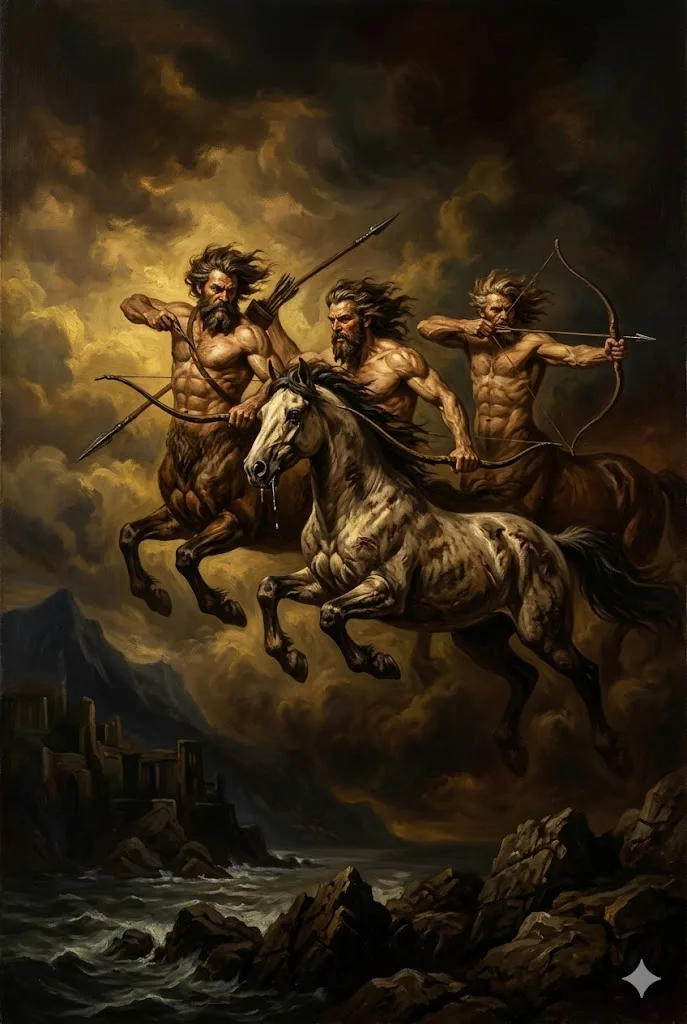
The Centaurs (Kentauroi) were a tribe of creatures with the upper bodies of men and the lower bodies of horses. They lived in the wild mountains and forests of Thessaly and were notorious for their savage, uncontrollable behavior — especially when drunk. They represented the untamed, animal side of human nature: lustful, violent, and impossible to civilize.
According to the most common origin myth, the Centaurs were born when King Ixion attempted to seduce Hera. Zeus shaped a cloud in Hera's likeness (called Nephele), and Ixion mated with it. From this unnatural union, the first centaur — Centaurus — was born, and from him sprang the entire race. This origin in deception and lust set the tone for the Centaurs' wild character.
The Battle of the Lapiths
The most famous Centaur story is the Centauromachy — the great battle between the Centaurs and the Lapith tribe at the wedding of King Pirithous. The Centaurs, invited as guests, became drunk on wine and attempted to abduct the Lapith women, including the bride. The ensuing battle, in which Theseus fought alongside the Lapiths, became one of the most depicted scenes in Greek art — symbolizing the triumph of civilization over barbarism.
Chiron the Wise
Not all Centaurs were savage. Chiron, son of the Titan Cronus and the Oceanid Philyra, was the wisest and most just of all Centaurs. He was a renowned teacher who tutored many of the greatest Greek heroes: Achilles, Jason, Asclepius (god of medicine), and Actaeon. Chiron was accidentally wounded by one of Heracles' Hydra-venom arrows. Being immortal, he could not die but suffered unbearable pain. He eventually traded his immortality for the freedom of Prometheus and was placed among the stars as the constellation Sagittarius (or Centaurus).
Classical Sources
Ancient accounts of Centaurs appear in:
- 📜 Hesiod, Theogony (c. 700 BC) — Origin and genealogy of mythological creatures.
- 📜 Apollodorus, Bibliotheca (c. 1st–2nd century AD) — Detailed descriptions of monsters and their encounters with heroes.
- 📜 Ovid, Metamorphoses (8 AD) — Vivid retellings of creature myths with emphasis on transformation.
- 📜 Homer, Iliad & Odyssey (c. 750 BC) — Encounters with mythological beasts during the Trojan War cycle.
Cross-referenced with multiple classical sources for accuracy.
Pholus, Nessus and the Centaurs Heracles Fought
Apart from the wedding brawl, the Centaurs turn up most often in the career of Heracles. On the way to hunt the Erymanthian Boar he was entertained by the centaur Pholus in his cave on Mount Pholoe in Arcadia. Pholus served his guest roast meat but ate his own raw; when Heracles asked for wine, Pholus hesitantly opened a jar that belonged to the Centaurs in common. The smell drew the rest of the herd, armed with rocks and pine trunks. Heracles drove them off with firebrands and arrows, and the survivors fled to Chiron at Cape Malea, where, in Apollodorus' telling, an arrow aimed at one of them struck Chiron by accident. Pholus died too: marvelling that so small a thing could kill such large creatures, he drew an arrow from a corpse and dropped it on his own foot.
The centaur who mattered most to Heracles came at the end of his life. Nessus worked as a ferryman at the river Evenus and tried to assault Deianira while carrying her across. Heracles shot him from the bank. As he was dying, Nessus told Deianira to keep his blood as a love charm. Years later, afraid of losing her husband to Iole, she smeared it on a robe and sent it to him, and the Hydra venom in the blood burned him alive. Sophocles makes this the plot of Women of Trachis. There is also a second Eurytion, a centaur who tried to force a marriage with the daughter of King Dexamenus and was killed by Heracles. He is not the Eurytion of the wedding story.
How the Origin Story Changed
In the battle memories of the Iliad, Homer calls them simply phēres. Nestor recalls fighting these "mountain-dwelling beasts" alongside the Lapiths, and the catalogue of ships remembers that Pirithous drove the "shaggy beasts" off Mount Pelion. The Odyssey retells the wedding episode briefly, as a warning about wine: the centaur Eurytion got drunk in Pirithous' hall, and the Lapiths cut off his ears and nose and threw him out, which started the feud.
The Ixion story is first told in full by Pindar (Pythian 2), and it differs from the popular version in one important way. In Pindar, the cloud bears a son called Kentauros who is not a horse-man at all, only an outcast. Kentauros then mates with the mares of Magnesia on the slopes of Pelion, and their offspring are the hybrid race. So the horse half comes from the mares, not from the cloud. Chiron and Pholus stand outside this family tree completely. Chiron is the son of Cronus and Philyra, which is why he is immortal. Apollodorus makes Pholus the son of Silenus and an ash-tree nymph, so he is related to the satyrs rather than to Ixion.
Ovid gives the longest account of the battle, in Metamorphoses 12, with Nestor as narrator. He adds the tragic pair Cyllarus and Hylonome, a rare female centaur who kills herself on the spear that killed her mate. He also tells of Caeneus, the Lapith who had been born a woman and was made invulnerable. Since weapons could not wound him, the Centaurs buried him under a pile of tree trunks. Apollonius of Rhodes and Pindar knew the Caeneus story too.
Centaurs in Greek Art
The earliest centaurs in Greek art look odd to modern eyes. On many Archaic vases they are a complete human man, human legs included, with a horse's barrel and hind legs joined on at the back. The familiar form, where a human torso rises from a full horse body, became standard during the sixth century BC. Monumental sculpture loved the Centauromachy. Apollo stands at the centre of the west pediment of the Temple of Zeus at Olympia while Lapiths and Centaurs struggle around him. The south metopes of the Parthenon show single combats between the two sides. The frieze from the Temple of Apollo at Bassae shows the battle at its most violent. In fifth-century Athens the Lapith victory was widely understood to echo the Greek victory over Persia, which is part of why Theseus became so prominent in these scenes.
Common Misunderstandings
Sagittarius is not reliably Chiron. The Hellenistic star-catalogue attributed to Eratosthenes puts Chiron in the southern constellation Centaurus. It identifies the Archer as Crotus, a satyr-like companion of the Muses, and argues that the figure has two legs and a satyr's tail, not four hooves. Later writers mixed the two up, and modern horoscopes simply use the centaur image (see constellation myths). It is also wrong to treat "centaur" as one uniform character. Chiron the teacher and Pholus the host have different parents, characters and myths from the wild Pelion herd. Ancient writers kept them apart on purpose, using the civilised exceptions to show up the rule.
Ancient sources
- Homer, Iliad 1.262–268 and 2.740–744: Nestor's memory of fighting the mountain "beasts" with Pirithous and Caeneus, and Pirithous driving them from Pelion.
- Homer, Odyssey 21.295–304: the drunken centaur Eurytion mutilated in Pirithous' hall, the origin of the feud with men.
- Pindar, Pythian 2: Ixion's crime against Hera, the cloud-image, and Kentauros fathering the race on the Magnesian mares.
- Sophocles, Women of Trachis: Nessus' deadly gift and the death of Heracles.
- Apollodorus, Library 2.5.4: Pholus, the opened wine jar, and the wounding of Chiron.
- Ovid, Metamorphoses 12: the extended Lapith–Centaur battle, including Caeneus, Cyllarus and Hylonome.
Frequently asked questions
Were there female centaurs in Greek mythology?
Yes, though they are rare in the texts. Ovid's Hylonome is the best-known literary example. Painters and mosaicists, especially in the Hellenistic and Roman periods, showed centauresses more often, sometimes nursing young.
Why did the Centaurs fight the Lapiths?
They were guests at Pirithous' wedding, could not handle undiluted wine, and tried to carry off the bride and the other women. The Odyssey traces the feud to the drunken Eurytion.
How did Chiron die if he was immortal?
The Hydra venom gave him an incurable wound. Ancient authors say he gave up his immortality so that he could die. In Apollodorus this is linked to the release of Prometheus.
Is the centaur Nessus the same as the one at the wedding?
No. Nessus is a separate centaur, known for the river crossing with Deianira. He belongs to the Heracles cycle, not to the Lapith wedding.
Explore More Mythology
Get weekly deep dives into the gods, heroes, and myths of ancient Greece.